
In most cases, yes, but such an outcome happens only if there is negligence on the part of the property owner. Under California law, owners can be held liable when they knew or should have known about dangerous situations and failed to repair them or give proper warnings. An accident on someone's property is not automatic liability, because the result depends on the hazard and on what the injured person was doing.
In 2009, Michael Saeedian founded Saeedian Law Group, and the firm has focused solely on personal injury law ever since. Our premises liability attorneys handle slip and fall, swimming pool, and negligent security claims, and each case starts with the inspection logs that show what the owner knew. If you were hurt on someone else's property, book a free consultation, and under our contingency fee, you pay nothing unless we recover compensation for you.
This article covers how California decides when a property owner is legally responsible for an injury and what an injured person has to prove to recover damages.
How California Law Decides Whether a Property Owner Is Liable

California premises liability law rests on one statute and one Supreme Court case, and nearly every premises liability case still runs through both of them. Below, we explain what the duty is and what factors courts use when deciding how far it reaches.
The Duty of Care Every Property Owner Owes
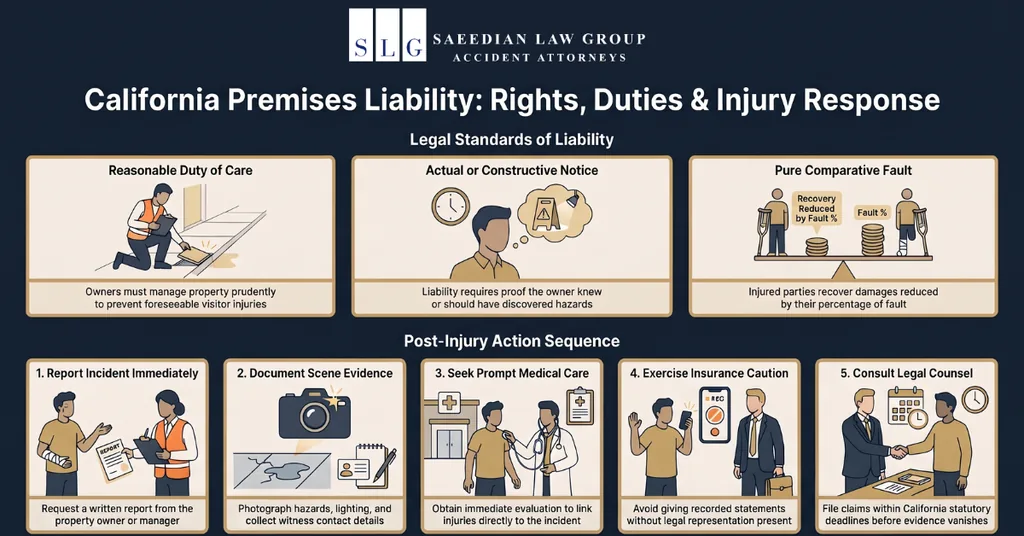
Civil Code section 1714 holds people responsible for injuries that result from their failure to exercise ordinary care when managing their own property. In reality, owners of property have an obligation to visitors to use reasonable care to keep the place safe, as would a prudent person considering the circumstances. The owner must exercise reasonable care to spot potential hazards and then repair them or warn others away from them.
The duty reaches beyond the name on the deed, because the state's civil jury instructions apply it to anyone who owns, leases, occupies, or controls the property. A tenant or a property manager can therefore be held responsible alongside the owner. Owners are not insurers of every visitor's safety, so a fall by itself does not prove the property owner failed in that duty.
The Rowland v. Christian Factors Courts Weigh
In Rowland v. Christian, the California Supreme Court held in 1968 that the test is whether the owner acted reasonably given the probability of injury to others. The court listed some factors that can justify reducing this duty. It starts with the foreseeability of harm and how closely the owner's actions relate to that harm. Courts also consider what an owner's duty would entail and whether there is insurance coverage for any risks involved. Both moral blame and efforts to prevent future harm matter too.
Those factors rarely help an owner who ignored a broken step, since the repair is cheap and the danger is easy to foresee. They are more important in unusual situations like assaults by strangers or dangers that lie far away from usual visitor paths.
Does a Visitor's Legal Status Still Matter in California?
Lots of states still classify visitors into specific groups with different duties for each group, which is why there's so much online advice about invitees and licensees. California takes a different approach, although a visitor's legal status has not disappeared from the analysis.
How the Traditional Visitor Categories Work
Under traditional common law, an invitee is someone who visits land with a business purpose, such as someone shopping at a store. The owner owes this visitor a high duty: to check out the property and fix anything that inspection discovers. A licensee is a social guest or visiting family member, and the owner usually owes that person only a warning about known hidden dangers. Trespassers receive minimal protection, usually just a duty to avoid intentional or reckless harm.
Rowland rejected those strict categories as criteria for determining liability in California. The jury instructions now count the reason for a visit as one factor among many, so a paying customer and a social guest are both owed reasonable care.
The table below compares how each type of visitor is treated under the traditional rule and under California law.
| Visitor Type | Common Example | Traditional Rule in Many States | California Approach |
| Invitee | Shopper in a store or client at an office | Highest duty to inspect and make the premises safe | General duty of reasonable care under Civil Code 1714 |
| Licensee | Social guest or visiting family member | Warn of known hidden dangers | Same general duty, with the reason for the visit considered as one factor |
| Trespasser | Person who enters without permission | Avoid willful or reckless harm only | Reasonable care still applies, but claims tied to listed felonies are barred by Civil Code 847 |
| Child trespasser | Young child attracted to a backyard pool | Attractive nuisance doctrine | The Restatement section 339 rule applied in King v. Lennen is now part of the Rowland analysis |
| Recreational user | Hiker permitted on private property without cost | Varies by state | Civil Code 846 limits the duty of care, with three statutory exceptions |
How California Handles Trespassers and Recreational Users
Two statutes give owners real protection against claims by people who should not have been on the land or who came for recreation. Under Civil Code section 847, an owner is not liable to someone hurt while committing a listed felony on the property once that person is convicted. Civil Code section 846 gives owners only a limited responsibility to people who go there for recreational activities such as hiking or fishing.
Protection ceases if the owner charged a fee for entry, willfully or maliciously failed to guard or warn against a dangerous condition, or expressly invited the injured person onto the land. A guest who is expressly invited is not covered by this statute, but someone merely permitted to hike on the land is.
Swimming Pools and the Attractive Nuisance Doctrine for Children
Kids receive special protection because they don't have the same ability to see dangers that adults do. King v. Lennen was a case that happened in 1959 where an 18-month-old child drowned in a swimming pool belonging to a neighbor. The California Supreme Court applied section 339 of the Restatement of Torts there, calling it state law for child trespassers. After Rowland, the same questions feed into the reasonable care analysis, including whether the owner knew children were likely to wander onto the land.
The Centers for Disease Control and Prevention reports that more young children ages 1 to 4 die of drowning than from any other cause. That's why fencing and gates that latch themselves are so important in a swimming pool accident claim.
What an Injured Person Must Prove in a Premises Liability Claim
A successful claim is more than proof that someone got hurt somewhere on the property. Under CACI No. 1000, the injured person must show the defendant owned or controlled the property and was negligent in using or maintaining it. They must also show they were harmed and that the negligence was a substantial factor in causing that harm.
Actual or Constructive Notice of the Hazard
Many disagreements hinge on notice, meaning what the owner knew and when. Actual notice exists when the owner knew about the danger; for example, if a tenant complained in writing. Constructive notice exists when the hazard existed long enough that a reasonable inspection would have found it. In Ortega v. Kmart Corp., the Supreme Court held that a shopper can prove constructive notice by showing the store skipped reasonable inspections before the fall.
Causation and Damages
The injured person also has to tie the unsafe conditions to the injury itself, usually through medical records and photos taken at the scene. If negligence on the part of the owner of the property is proven, the injured person may be able to get reimbursed for medical bills and lost wages. Emotional distress counts as well, and how long it takes to recover is important for valuing pain and suffering.
Common Situations That Lead to Premises Liability Claims
Falls are a frequent source of premises claims, and the CDC's falls data shows how often they happen. Over 14 million adults aged 65 and older report that they fall each year; this is roughly 1 out of every 4 people. A fall on a wet floor or a staircase with poor lighting often becomes a slip-and-fall case. Slipping on a public sidewalk may involve a city, and who is responsible for a sidewalk fall claim often depends on who controls that stretch of pavement.
Other recurring issues with properties include loose railings and potholes in a parking area. Owners can also face claims from negligent security if there is an assault that foreseeably happens because of an unlocked dark garage or broken gates. CACI No. 1005 describes when a business must take reasonable precautions to protect its customers from crimes committed by others. An owner or landlord who keeps a known dangerous dog on the premises can face a dog bite claim along with the dog's owner.
Landlords and Businesses That Control the Property
Usually, the person in charge of where an injury happened is legally responsible. Under CACI No. 1006, a landlord must inspect a rental before the tenant moves in and keep common areas like stairwells reasonably safe. Inside a unit, the landlord is only responsible for hazards it actually knew about and had the right and ability to fix. Those rules apply to every claim that comes from an apartment injury, where the landlord and the management company may be at fault.
Businesses carry the same property owner's responsibility with far more foot traffic, so regular inspections are part of keeping a safe environment for customers. Our lawyers deal with claims for hotel injury and retail injury where missing inspections were at fault. When a customer is injured in a store, the first question is often whether an employee checked that aisle before the fall.
Ready to Talk About Your Premises Liability Claim?
Under California law, if someone who owns property ignored something that hurts you, then you have the right to seek compensation for any resulting losses. The proof of notice, from inspection records to camera footage, often disappears within weeks, so speaking with a lawyer early protects your claim. Talking briefly with our team can show who may be legally responsible and what insurance policy would apply.
Our California injury lawyers recovered $5 million for a client who was involved in a truck accident (prior results do not constitute guarantees of success). Contact us today for a free review of your apartment or store injury claim.
Common Defenses Property Owners Raise

Owners and their insurers rarely accept a claim at face value, and the common defenses fall into two groups.
Open and Obvious Dangers and Trivial Defects
The jury instruction on obvious conditions says an owner does not have to warn about a danger so obvious that anyone could reasonably be expected to see it. The owner still has to use reasonable care when people must encounter the danger out of necessity, a rule courts trace to Osborn v. Mission Ready Mix. A worker may still have a claim if they must cross the only path to a loading dock, even though the hazard was plain to see. Owners also invoke the trivial defect doctrine, which holds that walkways need not be perfect and small cracks do not make them liable.
Comparative Fault
Insurance companies often deflect responsibility by blaming cellphone use or ignoring a warning sign. California follows pure comparative fault under Li v. Yellow Cab Co., so someone who is found to be 30% responsible for an accident still gets to recover 70% of their damages. Comparative fault is not a free pass for the owner, because it reduces the award but leaves the claim alive. While some other states have contributory negligence rules that prevent any recovery if the plaintiff is even slightly at fault, California doesn't follow that rule.
How Homeowners Insurance Handles an Injury on Your Property
For most homeowners, the insurance policy decides who actually pays an injury claim. The California Department of Insurance explains that personal liability insurance kicks in when you or any family members are legally responsible for hurting someone. That insurance also includes paying for an attorney to defend you if someone who got hurt sues you. Medical payments coverage is separate and pays reasonable medical expenses for people accidentally hurt on your property, generally without any finding of fault.
The limit of liability varies from policy to policy, so policy owners should look at the declarations page to find out how much the insurance company will pay at most. The insurer will investigate fault before it pays, and a liability claim that exceeds the limit can leave the owner personally responsible for the difference. In that situation, an injured person may be able to sue beyond policy limits if the owner has other assets. If a guest gets injured at your home, you should report that claim to your insurance company as quickly as possible and then fix any hazards to avoid similar accidents for future visitors.
Steps to Take After an Injury on Someone Else's Property
The things you do right after an accident matter because they can affect whether your claim stays strong later on. Here are the most important steps we focus on for the cases our firm handles.
Report the Incident to the Owner or Manager
First, tell the owner or store manager what has happened before you leave, and ask for a copy of the incident report. A written report made the same day is hard for an insurance company to dispute later.
Photograph the Hazard and Collect Witness Statements
Then take photos from different angles of that exact spot and note the lighting conditions as well as the presence or absence of any warning signs. Ask anyone who saw the fall for a name and phone number, because witness statements fade and surveillance video is often recorded over within weeks.
Get Medical Attention Even for Minor Injuries
See a doctor the same day or the next, even if the pain seems mild at first. Symptoms of head injuries can take quite some time to show up, and insurance adjusters use any lapses in treatment to suggest that the problem is something else altogether.
Be Careful With the Insurance Company
Expect a call from the owner's insurer within days, often asking for a recorded statement about the fall. You do not have to give one, and waiting until you have spoken with a lawyer is a smart move. Adjusters use those recordings to support either a low-price offer or an argument that you were partly at fault.
Talk to a Premises Liability Lawyer Before the Deadline
Have a lawyer look over the claim before the deadline and when evidence is still new. An attorney can write preservation letters to protect video evidence and also draft a demand letter to support reaching an equitable settlement. The final settlement should reflect future care as well as past bills, which is hard to judge without a full medical picture.
"Most premises cases are decided by what the owner knew and when they knew it. That proof usually sits in maintenance logs and camera footage that can disappear within a few weeks," says Michael Saeedian, founding attorney of Saeedian Law Group.
Deadlines for Filing a Premises Liability Claim in California
Most injury lawsuits must be filed within two years under Code of Civil Procedure 335.1. For an injured child, the two-year deadline is usually paused until the child turns 18 under Code of Civil Procedure 352, but family members should move quickly nonetheless. Government Code 911.2 requires a written claim within six months if the property is owned by a city or county, and that deadline is not paused for a minor; a late claim needs an application within one year. The rules of the Government Claims Act control when a lawsuit against that agency can be filed.
Frequently Asked Questions
Saeedian Law Group has handled premises liability claims since 2009, from grocery store falls to apartment stairwell injuries. Here are the questions that property owners and injured visitors frequently ask our lawyers.
Can Someone Sue You if They Get Hurt on Your Property?
Yes, an injured person can sue if they believe your negligence caused the injury. They still have to prove you knew or should have known about the hazard and failed to act.
Are You Liable if a Trespasser Gets Hurt on Your Property?
Sometimes, because California imposes a duty of reasonable care that applies to trespassers as well. The trespass is weighed against them, and someone hurt while committing a listed felony cannot recover once convicted.
Does Homeowners Insurance Cover a Guest Who Falls on Your Property?
Usually, yes, through personal liability insurance if you are legally responsible for someone falling. Medical payments coverage can also pay smaller medical bills without a fault finding.
What Happens if an Injury Claim Exceeds Your Policy Limits?
The owner can be personally responsible for the amount above the policy limit. Many homeowners buy an umbrella policy to cover that gap.
Is a Property Owner Liable if the Hazard Was Obvious?
Often, no warning is needed because an obvious danger is its own warning. The owner may still be liable when people have no real choice but to deal with it.
Can You Still Recover Damages if You Were Partly at Fault?
Yes, California's pure comparative fault rule lets you recover damages reduced by your share of fault. Being partly to blame does not bar the claim.
Who Is Responsible for an Injury at a Rental Property?
Usually, landlords take care of common spaces and hazards that they know about inside apartments. Tenants may be held responsible for conditions they created and controlled.
How Long Do You Have to File a Premises Liability Claim in California?
Most claims must be filed within two years of the injury. A claim against a government entity has to be presented within six months.
Attorney Advertising
This article was reviewed by Michael Saeedian, Esq., California State Bar #265470, Saeedian Law Group, 9100 Wilshire Blvd. Suite 500W, Beverly Hills, CA 90212.
Legal Disclaimer
This article provides general information about California premises liability law and is not legal advice. Reading this article or contacting Saeedian Law Group does not create an attorney-client relationship. Every case depends on its own facts, and past results do not guarantee future outcomes.

Michael Saeedian founded Saeedian Law Group in 2009 with the goal of providing injured individuals and their loved ones with caring, personalized, and attentive legal representation.