
California does not establish a specific compensation amount for falls on sidewalks or pavement, as the value depends on the extent of injuries, losses, and the degree of fault involved. One jury awarded a jogger nearly $90,000 for a wrist broken on a raised city sidewalk, while Los Angeles weighed a $425,000 settlement for a different sidewalk fall. Neither amount is typical, so each claim is valued based on its own injuries, evidence, and share of fault.
Michael Saeedian founded Saeedian Law Group in 2009 and was named to the Super Lawyers Rising Stars list from 2020 to 2025. Our lawyers have 16+ years of experience handling cases for slip and fall clients who work out of offices in Beverly Hills, Rancho Cucamonga, and Encino. If you get hurt on a public sidewalk or private walkway, schedule a consultation with us about your options.
This article covers what shapes sidewalk fall compensation, who is responsible, what to do after a fall, and the deadlines that apply.
What Determines How Much a Sidewalk Fall Claim Is Worth?

Adjusters and juries will ask how much the fall has already cost you and what further costs it may incur. Every pavement accident claim has its own mix of injuries and evidence, so no two are priced alike. Certain factors will increase or decrease a personal injury claim.
The table that follows lists the factors that most often shape the value of a sidewalk fall claim and explains why each one matters.
| Factor | Why It Matters |
| Type and severity of injury | Broken bones, spinal injuries, and head trauma usually mean more treatment, longer recovery, and more serious damages than soft tissue injuries. |
| Medical expenses and future care | Bills, records, and a doctor’s plan document the cost of future medical treatment. |
| Lost income and earning capacity | Missed paychecks, reduced hours, and a lasting limit on the kind of work you can do all add to the claim. |
| Permanent disability or scarring | A lasting impairment has a long-term effect on daily life, which increases the non-economic aspects of the claim. |
| Strength of the liability evidence | Photos, witness statements, and proof that the owner was aware of the defect make it easier to prove fault. |
| Your share of fault | California reduces the award by the percentage of fault assigned to you. |
| Available insurance coverage | The owner’s insurance company and policy limits can cap what is practical to collect. |
Economic Damages
Economic damages cover losses with a receipt, a pay stub, or a provider estimate behind them. They include medical expenses, lost wages, and future earning capacity if the injury limits your work. Future medical treatment and in-home care costs belong here too when a doctor documents the need. Because this part of the claim rests on financial evidence, keeping every bill and pay record makes it harder for an insurer to discount.
Non-Economic Damages
Non-economic damages cover harm with no price tag, such as pain and suffering, emotional distress tied to the physical injury, and lost enjoyment of life. California has no fixed formula for these amounts, and jury instructions such as CACI 3902 and CACI 3905A leave the figure to the jurors’ judgment. Permanent disability and visible scarring tend to increase this category. Despite this, jurors rely on specifics, and so testimony from a doctor about limits for you each day as well as direct observations from a family member carries real significance.
How Much Compensation for a Fall on a Pavement in California?
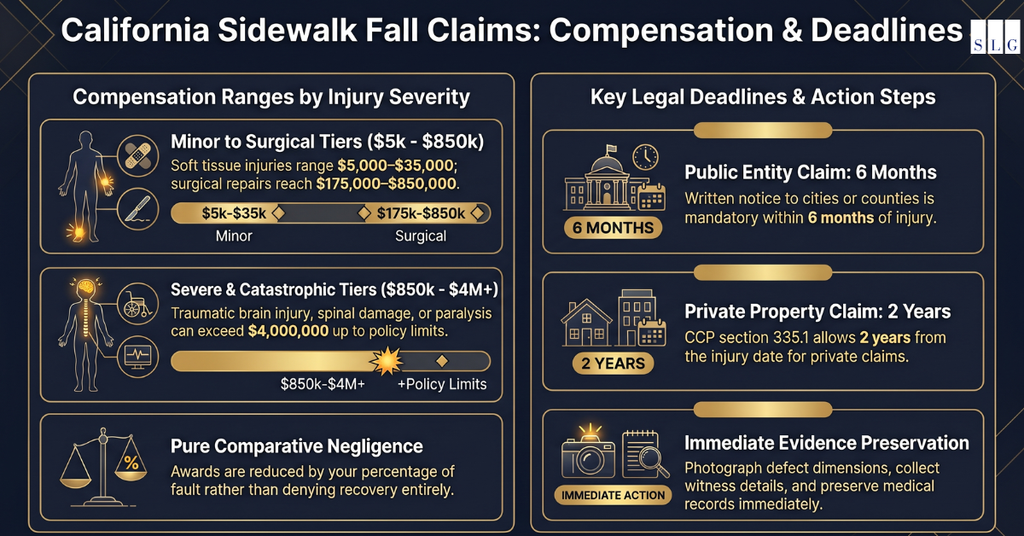
No statute sets a dollar amount for a pavement fall in California, but settlement patterns do follow injury severity. Saeedian Law Group publishes general ranges for California premises liability cases, and they give a workable starting picture. Treat them as ranges, not averages or predictions.
The table below applies those ranges to common sidewalk fall injuries. Each tier lines up with the treatment it usually involves.
| Injury Severity | Common Sidewalk Fall Injuries | General Range (California) |
| Minor soft tissue | Bruising, sprains, and strains from a fall without displacement | $5,000 to $35,000 |
| Moderate | Fractures, concussion, or an imaging-confirmed herniation, with months of care | $35,000 to $175,000 |
| Serious or surgical | Surgical repair, hardware, or ligament reconstruction, with lasting limitation | $175,000 to $850,000 |
| Severe or permanent | Traumatic brain injury, spinal cord injury, or multiple surgeries | $850,000 to $4,000,000+ |
| Catastrophic | Paralysis, amputation, or a fatal fall | $2,000,000 up to policy or asset limits |
These figures come from the firm’s own summary of California settlements and verdicts, so they are estimates and not a government statistic. Actual outcomes depend on liability, notice, venue, insurance coverage, and how well the injury is documented. Past results do not guarantee future outcomes. If the defendant is a city or county, the claim also has to clear the filing deadlines covered below.
Published outcomes show how far real amounts can vary. In Stack v. City of Lemoore, a published 2023 California appellate decision, a jogger caught his toe on a raised sidewalk lip, broke his left wrist, and needed two surgeries. The jury found the sidewalk dangerous, assigned him no share of fault, and awarded nearly $90,000. Settlements against public entities can run higher. A Los Angeles City Council motion in McAdoo v. City of Los Angeles proposed a $425,000 settlement over a January 2020 trip and fall on an uneven sidewalk, subject to the mayor’s approval. The motion fails to describe the injury, and a negotiated city settlement is neither a verdict nor an average.
For a national benchmark, the Bureau of Justice Statistics reported a $98,000 median award for plaintiffs who won premises liability trials in state courts in 2005. That figure covers every kind of premises case, not only sidewalks, and it leaves out claims that settled or lost at trial. Treat all of these amounts as individual outcomes. None predicts what your claim is worth.
How Compensation Differs by Injury Type

Older adults suffer the most when falls happen. According to data from the CDC, over 43,000 people aged 65 and older died due to falls in 2024. Between those years, there was a rise of 21% in the age-adjusted death rate. It went from 64.7 deaths per 100,000 people in 2018 to 78.4 in 2024. The CDC also reports that about 14 million older adults, or 1 in 4, fall each year, and that falls lead to roughly 4.5 million emergency department visits and 1.4 million hospitalizations annually.
Those numbers show why the type of injury drives a claim more than any other single factor. The table below compares common sidewalk fall injuries by typical treatment and by how each tends to affect claim value, without assigning dollar figures.
| Injury Type | Typical Treatment | How It Tends to Affect Claim Value |
| Soft tissue injuries | Rest, physical therapy, and follow-up visits | Lower medical costs and shorter recovery times, though lingering pain can still support non-economic damages. |
| Sprains and torn ligaments | Bracing, physical therapy, and sometimes surgery. | The value increases with the length of time away from work and when surgical repair is needed. |
| Broken bones | Casting, surgery, and rehabilitation | Longer recovery and possible hardware or follow-up procedures increase both economic and non-economic damages. |
| Fractured hip | Major surgery, hospital stay, and extended rehabilitation | Often means significant care costs and a lasting loss of independence, especially for older adults. |
| Spinal injuries | Imaging, specialist care, surgery, and long-term therapy | Possible permanent disability and lost earning capacity are among the higher-value claims. |
| Head and catastrophic injuries | Emergency care, hospital stays, and lifelong support | Ongoing care costs and permanent impairment can lead to the largest claims. |
We don’t list dollar amounts for each row because there is no reputable source that collects reliable data broken down by type of injury. Any number you see online ignores the facts that actually set value, such as your age and treatment record.
Who Is Responsible for a Dangerous Sidewalk in California?
Responsibility depends on who owns or controls the place where you fell. Both private owners and public agencies may be responsible, and the rules differ for each. Sorting the issue out early also tells you which deadline applies.
Private Property Owners and Businesses
Under Civil Code section 1714(a), everyone is responsible for injuries caused by a failure to use ordinary care in managing their property. A store or homeowner can be liable when a defect on its land hurts a visitor. That usually requires that the owner created the problem, knew about it, or should have found it. Under Streets and Highways Code section 5610, owners also have a duty to keep sidewalks in front of their lots clear. Courts have generally said this duty alone doesn’t mean that the neighbor has liability toward passersby either. Premises liability claims therefore turn on details such as who created the defect, who controlled the area, and whether a local ordinance imposes liability.
Cities, Counties, and Other Government Entities
Many sidewalks that are public belong to the city or county, and claims against them follow Government Code section 835. That statute allows liability for a dangerous condition that the entity that created it has caused. This also applies if the entity had actual or constructive notice in time to fix the problem or warn the public. A constructive notice exists if a defect is clear and has existed for such a long time that a reasonable inspection would have revealed it. Section 830 defines the key terms, and section 830.2 says that a trivial defect is not dangerous. Because government claims also carry short deadlines, they need attention sooner than most people expect.
Common Sidewalk Hazards
Sidewalk falls belong to the wider group of premises claims that California property owners face. The hazards behind them are usually easy to name once someone looks closely. Cracked or uneven sidewalk panels catch toes and heels, and raised slabs, often pushed up by tree roots, create sudden trip edges. Damaged curbs and missing curb ramps cause falls at crossings, while poor maintenance leaves debris and broken lighting that hide the danger. A missing warning sign or cone around a known hazard can matter just as much as the defect itself.
“Most sidewalk cases come down to who knew about the defect and for how long. Photographs taken the same day, before anyone repairs the spot, often show what the walkway really looked like,” said Michael Saeedian, founder of Saeedian Law Group.
What Steps Should You Take After a Fall on a Sidewalk?
What you do in the first days shapes the evidence available later, so the order of these steps matters.
After experiencing a fall, it is crucial to seek medical attention immediately and maintain thorough records of your injuries. An examination not only documents your condition but also establishes a connection between your injuries and the incident. Additionally, take photographs of the defect from multiple angles, ensuring to capture the surrounding area, any warning signs, and the lighting conditions. Including a tape measure or a common object in the photos can help illustrate the defect’s dimensions.
Gather contact information for any witnesses present during the incident, as their statements can provide valuable confirmation regarding the duration of the hazard. It is also important to report the fall in writing to the property owner or the relevant city or county authorities and request a copy of any incident report generated. Keeping all correspondence, receipts, and medical bills organized in a single folder will aid in managing your claim effectively.
Lastly, refrain from discussing the accident on social media or online platforms, as such actions could jeopardize your case. Before providing a recorded statement to any insurance company, consult a personal injury lawyer. Early legal representation is vital to preserve evidence and protect your rights throughout the claims process.
Many people delay going to hire a lawyer for quite some time, and by that point accident scenes have already been cleaned up. Early legal representation is important because it helps preserve evidence before it disappears.
How Does Fault Affect Your Compensation?

California follows pure comparative negligence, which was established in Li v. Yellow Cab Co. (1975) 13 Cal.3d 804. According to that rule, your damages are reduced based on the percentage of fault you bear. You’re not excused from recovery just because you share some of the blame. Owners and insurers frequently argue that you were distracted, wearing unsafe footwear, or that you should have seen the defect.
For example, suppose a jury finds your total damages are $100,000 and decides you were 20% at fault. Your award would go down by $20,000 to $80,000. These round numbers serve only as an example and don’t indicate any actual results.
Insurance coverage adds an extra step. The owner’s insurance company pays claims up to its policy limits, and a serious injury can exceed those limits. A lawyer can look into whether other policies or sources of coverage exist before you accept an offer.
What Is the Deadline to File a Sidewalk Fall Claim in California?
Deadlines vary depending on who is responsible for them, and missing one completely can end a claim. This table contrasts the key time limits applicable to private defendants and public defendants.
| Defendant | Deadline | Authority |
| Private owner or business | 2 years from the date of injury | Code of Civil Procedure section 335.1 |
| City, county, or other public entity (claim) | 6 months from the date of injury to present a written claim | Government Code section 911.2 |
| Public entity (lawsuit) | 6 months after written rejection is delivered or mailed, or 2 years from the injury if no notice is given | Government Code section 945.6 |
Under a lawsuit for personal injuries against an individual defendant, there is a two-year limit. For a public entity, you must first present a written claim, and Government Code sections 905 and 910 govern what that claim must contain. The claims process moves quickly, so many people file with help from a lawyer.
Children and those lacking mental capacity may get extra time in comparison to private defendants under Code of Civil Procedure section 352. That tolling does not apply to claims that must go through the Government Claims Act. In those cases, a minor or incapacitated person may apply for late-claim relief under Government Code sections 911.4 and 911.6. The application is due within one year of the injury.
How Does a Personal Injury Lawyer Help With a Fall Claim?
A lawyer deals with the tricky parts of your claim as you focus on recovering from whatever issues you’re facing. That includes identifying the responsible owner or entity, sending any government claim on time, and gathering the financial evidence. Published average settlements in California mix every injury type together, so a lawyer instead compares an offer to your actual bills, records, and future needs.
Cost worries keep many injured people from calling. Saeedian Law Group handles personal injury cases on a contingency basis, so you pay nothing unless you win. That keeps legal fees from becoming a barrier while you focus on treatment.
Ready to Talk to a California Sidewalk Fall Lawyer?
A fall on a sidewalk can leave you with medical bills and missed work, along with questions about who must pay. Your claim relies on strong evidence, the right person to sue, and filing before deadlines pass. Taking action now helps to keep those important pictures and keep memories of witnesses fresh while they are still there.
Since 2009 our Beverly Hills personal injury lawyers team has handled injury claims, and we serve clients from offices in Beverly Hills, Rancho Cucamonga, and Encino. Led by Michael Saeedian, the team has over 16 years of experience dealing with both commercial and pedestrian matters. Contact us today to discuss what has happened and when your deadline is.
Frequently Asked Questions
Our lawyers have over 16 years of experience handling personal injury claims in California. The same questions come up in nearly every first conversation with a client hurt on a walkway. These short answers reflect what we explain to people at the start of a fall claim.
How Long Do I Have to File a Claim After Falling on a Sidewalk in California?
Generally speaking, if there is an injury against a private owner, you have 2 years to deal with that. Against a city or county, you must present a written claim within 6 months.
Can I Recover Compensation If I Was Partly at Fault for My Fall?
Yes, California uses pure comparative negligence, so your award is reduced by your percentage of fault but not denied.
Who Pays If I Trip on a City Sidewalk?
The city, county, or another public entity may be responsible if the defect was a dangerous condition and it had notice. These claims must follow the Government Claims Act procedure.
What Is the Average Payout for a Fall on Pavement?
There is no reliable average because value varies depending on injury severity, treatments received, lost wages, and fault distribution. A lawyer can look at your records and explain which factors apply to your claim.
Can a Child Make a Sidewalk Fall Claim?
Yes, a parent or guardian can bring the claim for a minor, and special tolling and late-claim rules may apply to children and to adults who lack mental capacity.
What Evidence Helps Prove a Sidewalk Fall Claim?
Photos of the defect, along with using a measuring tape, witness testimony, and medical records, all help. Evidence collected shortly after the fall is the most convincing.
This article provides general information about California law and does not establish any attorney–client relationship. Every claim relies on facts specific to your case; you should talk to an attorney who is licensed in California directly about what you are dealing with.

Michael Saeedian founded Saeedian Law Group in 2009 with the goal of providing injured individuals and their loved ones with caring, personalized, and attentive legal representation.