
After an accident, you may not know whether you need a personal injury lawyer. You may be able to handle a simple claim on your own, but some cases become difficult once the insurance company disputes fault or the extent of your injuries. A lawyer can help when there are serious injuries, large medical bills, or questions about who is responsible. The right time to hire one depends on the details of your case.
Saeedian Law Group has represented injured Californians since 2009, which is more than 16 years of personal injury work statewide. We handle injury claims from our Beverly Hills headquarters and our Encino and Rancho Cucamonga offices, all on a contingency fee basis. Contact us for a free consultation before you give any recorded statement.
This guide covers when legal help may be useful, the deadlines that apply to your claim, and what a lawyer may cost.
Understanding Personal Injury Law in California

California personal injury law is based on a simple idea. If someone else’s negligence hurt you, they owe you for what it cost. The difficulty is never the principle. It is proving fault, proving damages, and collecting from an insurance company that would prefer to pay less.
Most personal injury cases settle without a trial. That fact reassures people, and it should not. A settlement is a negotiation, and negotiations reward the side that prepared.
Knowing your legal rights early is important because insurance companies may try to settle your claim before you know the full extent of your losses. Speed almost always favors the insurer. An injured person who does not know what a claim is worth has no way to recognize a low settlement when it arrives.
What Constitutes a Personal Injury Case in California?
A personal injury claim exists when another party’s carelessness causes you harm. You need a duty of care, a breach of that duty, a causal link, and real damages. All four have to be there.
Most cases involve certain common situations. A car accident at an intersection, a car crash caused by a distracted driver, or a slip on an unmarked wet floor. Others involve a dog bite, a truck collision, or a fall on a poorly maintained stairway. Medical malpractice and defective products belong here too, though both follow different rules.
Not every accident becomes a claim. If nobody was careless, or if the harm is limited to property damage, a personal injury lawsuit may not be the right tool. This is one reason an initial consultation is useful even when you expect to be told you have no case. Most personal injury law firms will give you that answer at no charge.
Let’s consider a common example. Imagine you are rear-ended at a red light, your car needs $4,000 of repairs, and your neck aches for a week. That may well be a claim you can settle yourself. Change one fact, so the ache turns out to be a herniated disc needing injections. The same collision now becomes a case worth professional handling.
The Statute of Limitations: Timing Is Key

Every injury claim in California carries a deadline. Missing it ends the matter regardless of how strong your evidence is. Most personal injury claims fall under Code of Civil Procedure section 335.1, which gives you two years from the date of injury. Two years may seem like plenty of time, but medical treatment, investigation, and settlement talks can take much of that time.
Claims involving public entities can have different requirements. Suppose a city bus or a county vehicle caused your injuries. You must then present a written claim within six months under Government Code section 911.2. Miss that and your right to sue usually disappears.
Courts enforce this strictly. In McCurdy v. County of Riverside, a published 2024 decision, a man presented a claim against the county more than six months after it accrued. He argued the deadline was a year, and that three different attorneys had told him so. The Court of Appeal held the six-month period applied. It also held the advice he received did not excuse the delay, and his claim was barred.
That case involved a claim against a public defender’s office rather than a crash. The principle still transfers. Deadlines in such cases are unforgiving, and even professional advice will not rescue a late claim.
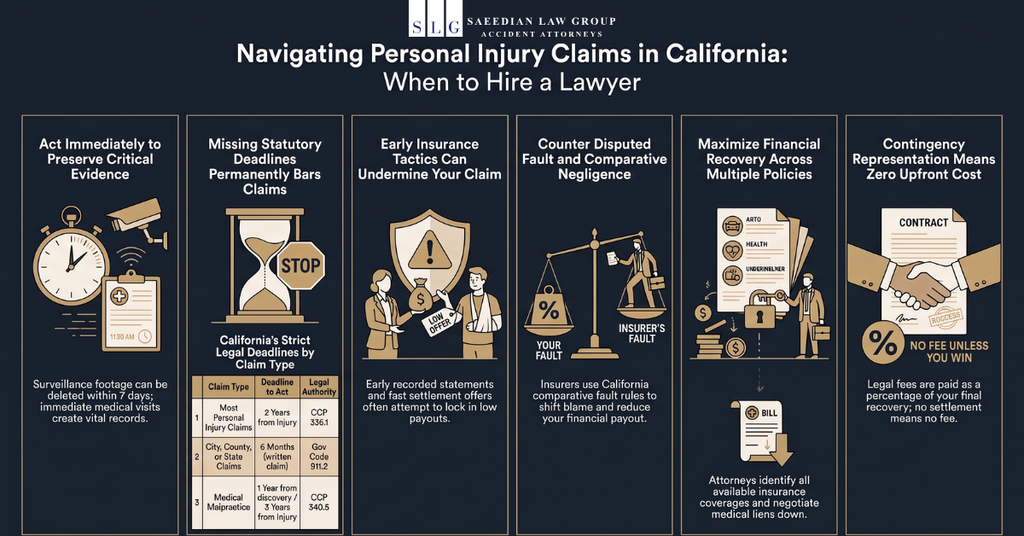
| Claim type | Deadline to act | Authority |
| Most personal injury claims | Two years from the injury | Code of Civil Procedure 335.1 |
| Claims against a city, county, or state | Six months to present a written claim | Government Code 911.2 |
| Medical malpractice | One year from discovery, three years from injury | Code of Civil Procedure 340.5 |
| Property damage only | Three years | Code of Civil Procedure 338 |
When to Consider Hiring a Personal Injury Lawyer
There is no single trigger. There are four situations where handling it alone reliably costs you money. Those are evidence at risk, contested fault, an insurer applying pressure, and injuries with future costs. Most claims that go wrong involve at least one of them. Recognizing yours early is the whole point.
Immediately after an Accident
One important reason to call a lawyer early is to protect the evidence. Surveillance video gets overwritten, vehicles get repaired or scrapped, and witnesses move and forget. A lawyer can send preservation letters within days. That step can help turn your account of what happened into evidence that supports your claim.
Police reports get ordered, witness statements get taken while memories are fresh, and an accident reconstruction specialist can inspect a vehicle before it disappears. You can save evidence yourself, but you cannot compel anyone else to.
The time available may be shorter than you expect. Some stores and restaurants may delete or overwrite security footage within seven days. A vehicle declared a total loss can be sold for salvage within weeks. Once either is gone, what happened becomes a contest between competing recollections. Seek medical care the same day, even if you feel able to walk away. An urgent care center visit creates a dated record connecting your injuries to the accident.
Gaps in medical care are the first thing an insurance adjuster points to when arguing your injuries came from something else. Keep your own file too. Photographs, the police report number, medical records, receipts, and a note of every missed shift will all matter later. A client who arrives with that file already built gives us weeks of momentum.
When Liability Is Disputed
Fault is often harder to determine than it may seem. California uses comparative negligence, so the other side rarely has to prove you caused the accident. They only need to shift a percentage onto you. Every point they move reduces what you recover.
A legal team can be especially helpful when liability is disputed. Building the case means collecting physical evidence and securing witness statements early. It sometimes means retaining an accident reconstruction specialist, or presenting expert testimony to explain how a collision actually happened.
When more than one party may share blame, identifying each of them matters. Multiple parties usually means more available coverage. A delivery driver who hit you may be covered personally and by an employer, and those are two separate policies.
When Dealing with Insurance Companies
Insurers are not villains, but they are businesses with a financial interest in closing your claim cheaply. The tactics are consistent. An early call seeks a recorded statement before you know what is wrong with you. A quick offer arrives before you understand the full extent of your injuries. A broad authorization asks for blanket access to your medical records, and long silences make you anxious enough to accept less.
The recorded statement is where self-represented claims most often lose ground. You are asked whether you are feeling better, and you politely say yes, because that is how people talk. Weeks later that answer sits in a claim file as evidence your injuries resolved. Soft tissue injuries frequently worsen over the first two weeks, so an honest answer given early becomes an inaccurate one.
The details of your case can help you evaluate an offer. The Insurance Information Institute reports that in 2024, the average auto liability claim for bodily injury was $28,278. The average property damage claim was $6,770. Those figures average every severity and do not value your case. They do show how far a first offer of a few thousand dollars can sit from ordinary.
Having a lawyer can change how the insurance company handles your claim. Personal injury lawyers negotiate settlements for a living and know what similar claims resolve for. They can also file suit if talks stall. An adjuster prices a represented claim differently, because the alternative is now a court award rather than a closed file. That single shift often makes a significant difference to the final number.
When Serious Injuries Are Involved
More serious injuries can lead to higher compensation amounts. Severe injuries bring future costs that nobody can see when the first offer arrives. Ongoing treatment, physical therapy, ongoing care, surgery that has not happened yet, and reduced earning capacity all belong in the claim.
Settling before you finish treatment can leave you unsure about your future medical costs. Serious cases also involve non economic damages for pain and long term consequences. Those carry no invoice and are argued rather than added up.
Where injuries are permanent, valuing future needs usually requires treating physicians and sometimes an economist. Future care for a spinal injury can run for decades, and an insurer will not volunteer that figure.
Benefits of Hiring a Personal Injury Lawyer in California

Knowing when to hire a personal injury lawyer in California matters less if you do not know what changes once you do. These are some of the benefits of hiring a personal injury lawyer in California.
Expertise in Local Laws and Regulations
California has rules that may be different from the general advice you find online. Damages for medical costs are limited to amounts actually paid rather than billed. Fault is apportioned by percentage. Claims against public entities run on that six-month clock.
Knowing the local rules can be more helpful than just reading the law. Juries in Los Angeles County and Riverside County value similar injuries differently, and the insurer knows it. An experienced attorney also knows which defense firms try cases and which ones settle on the courthouse steps. Filing decisions and venue shape what a fair settlement looks like in practice.
Maximizing Compensation
Getting the most compensation depends on the facts of your case. It is arithmetic done properly. Fair compensation means documenting every category of loss. That includes medical bills, lost wages, future medical expenses, medical costs still to come, and the human cost of the injury.
It also means finding out what insurance coverage is available. A single car crash may involve the at-fault driver’s policy, an employer’s policy if they were working, and your own underinsured motorist coverage. Our published results include a $5 million recovery in an auto versus truck case. Another reached $2.25 million in an auto versus pedestrian case. Both depended on identifying every available source of recovery rather than accepting the first policy offered.
You also need to consider any liens on your settlement. Health insurers, Medi-Cal, and any doctor who treated you on a lien are repaid from the settlement. Negotiating those reductions is unglamorous work that directly changes what reaches your bank account.
Stress Reduction and Peace of Mind
The practical benefit is often what clients notice most. Someone else handles the paperwork, the deadlines, the adjuster, and the lien negotiations while you concentrate on getting better.
That can be more important than it may seem. Injured people make poor decisions when they are in pain, short of money, and being pressed for an answer. Having a law firm absorb that pressure is often what protects the claim. Knowing a professional is watching the deadlines also lets you sleep.
There is another effect to consider. When an adjuster knows a file is being actively managed, the pace changes. Calls get returned and authorizations get reviewed. The quiet stalling that wears people down tends to stop.
Is It Time to Make the Call?
If you were hurt by someone else’s negligence, the decision is rarely about whether you have a claim. It is about whether you are ready to protect it while the evidence still exists. The deadlines are fixed, the insurer has already started work, and waiting improves nothing. A single conversation costs nothing and tells you where you stand.
Saeedian Law Group handles personal injury and wrongful death claims, including dog bite cases throughout California. We work only on contingency, so you pay nothing unless we recover for you. Call 310.620.6583 for a free consultation and we will tell you honestly whether your case needs a lawyer at all.
Frequently Asked Questions
This section provides answers to common questions about when to hire a personal injury lawyer in California.
How Soon after an Accident Should I Hire a Personal Injury Lawyer in California?
As soon as you are medically stable, and ideally within the first week. Early involvement protects evidence, prevents damaging recorded statements, and ensures no deadline slips past. Delay rarely helps, and with a public entity you may have only six months.
What Are the Benefits of Hiring a Personal Injury Lawyer in California?
You get someone who knows what your claim is worth and who can gather evidence you cannot compel. You also get a negotiator who does this daily. A good lawyer absorbs the administrative work and the pressure. Your claim then gets valued on its full extent rather than on your first estimate.
How Much Does It Cost to Hire a Personal Injury Lawyer?
Most personal injury attorneys, including our legal team, work on contingency. There is no upfront payment and no hourly lawyer fees. The lawyer takes an agreed percentage of the financial recovery, and if there is no recovery you owe no attorney fee. Case costs are normally advanced by the firm and repaid from the settlement, so ask how those are handled before you sign.
What Are Some Signs that I May Need to Hire a Personal Injury Lawyer?
Consider legal guidance if you suffered significant injuries, if your medical expenses are climbing, if fault is contested, or if the insurer is delaying. Another clear sign is an offer that arrives before your treatment has finished. That is rarely a fair deal.
How Can a Personal Injury Lawyer Help Me with My Case?
They investigate, gather evidence, handle the legal process, value your damages, and deal with the insurer directly. If negotiation fails, they file suit and try the case. Much of the value is invisible, because it lies in the mistakes you never make.
Is It Worth Hiring a Personal Injury Lawyer for a Minor Injury?
It is always worth a free case review, even if the answer is that you do not need representation. Some minor injuries turn out to have long term consequences that appear weeks later. An honest firm will tell you when a claim is small enough to handle yourself.
What Should I Look for When Hiring a Personal Injury Lawyer?
Look for experience with cases like yours, genuine trial capability, and clear communication. Ask who will actually handle your file day to day. The right lawyer explains the weaknesses as readily as the strengths. That is what acting in your best interests looks like.
Disclaimer: This article provides general information about California personal injury claims and does not constitute legal advice. Reading it creates no attorney client relationship with Saeedian Law Group. Deadlines and legal options depend on the specific facts of each case, so speak with a licensed attorney about your own situation.

Michael Saeedian founded Saeedian Law Group in 2009 with the goal of providing injured individuals and their loved ones with caring, personalized, and attentive legal representation.