

After an injury, you may be worried about your bills, recovery, and whether hiring a lawyer will leave you with less money. In many cases, a personal injury attorney can help you handle the claim and negotiate with the insurance company. The decision depends on the seriousness of your injuries, the strength of your claim, and the costs involved. Knowing these factors can help you decide whether hiring a lawyer is worth it.
Saeedian Law Group has over 16 years of experience handling California injury claims. Over these years, we’ve assisted injured clients in recovering over $12 million in compensation. Feel free to reach out to us today for a free initial consultation.
This article gives a comprehensive overview of what personal injury law means, steps to take after an injury, and the importance of an experienced personal injury attorney.
What Is Personal Injury Law in California?

Personal injury law is the part of tort law that lets you seek compensation for civil wrongs. A civil wrong is harm one person causes another that the courts can put a price on, separate from any criminal charge. California personal injury covers a car accident, a fall on someone’s property, dog bites, construction injuries, and medical malpractice.
Most accident victims have to deal with this system while they are already struggling with an injury. A crash is a traumatic event, and you are asked to make decisions about it while you are least equipped to. Your basic right is to be made whole. Civil Code section 3333 sets the measure of damages in a tort case as the amount that compensates for all the detriment caused. In practice, a personal injury claim covers medical bills already incurred, future medical expenses, lost wages, lost income, and property damage. It also covers non-economic harm such as emotional distress and mental suffering.
Code of Civil Procedure section 335.1 gives you two years from the date the accident happened to file a personal injury lawsuit. Medical malpractice runs on a different clock under section 340.5. That is three years from injury or one year from discovery, whichever comes first.
Claims against government entities can have additional requirements. If a city, county, school district, or state agency is involved, you get six months. Government Code section 911.2 requires a written claim in that window. That is a prerequisite, not an alternative deadline. Miss it, and the two-year rule will not save you, because you never cleared the step that lets you sue at all.
The process can be confusing because it happens in two stages. Presenting the claim is the first act, and filing a lawsuit is a separate one with its own clock. Once the agency rejects your claim in writing, a fresh six-month period starts for the lawsuit itself. If it never responds in writing, you generally get longer. That makes the rejection letter a document worth reading the day it arrives.
How Do You Prove Negligence and Liability?
Most personal injury cases are based on negligence, which California law breaks down into a few basic points. The Judicial Council publishes the standard civil jury instructions that judges read to juries. Instruction 400 requires proof of three things. The other party was negligent, you were harmed, and their negligence was a substantial factor in causing that harm.
The key issues are whether the person owed you a duty of care and failed to meet that duty. Everyone owes a duty of ordinary care, measured against what a reasonable person would have done in the same situation. A breach occurs when the other party fails to meet the required standard of care. Causation links the breach to your injuries, and damages are what the harm is worth.
Liability is not always entirely one person’s fault. California uses pure comparative negligence, so your share of blame reduces your recovery without ever barring it. A claimant who is forty percent responsible still recovers sixty percent of their damages.
That rule can also affect how much people receive when they handle a claim on their own. Fault percentages can be negotiated. An insurance adjuster has every reason to assign you a larger share when nobody pushes back with evidence. A police report that records the other party’s citation can provide stronger evidence than your account alone.
Where several defendants share fault, Proposition 51 splits the damage types. Civil Code section 1431.2 keeps economic damages joint and several, so one solvent defendant can be pursued for the whole amount. Non-economic damages are several only, meaning each defendant pays strictly in proportion to its own fault.
What Are the Benefits of Hiring a Personal Injury Attorney?
An experienced personal injury attorney brings three things that can be hard to get on your own. The first is valuation. Knowing what a shoulder surgery and six months off work is worth in your county comes from looking at similar settled cases. A calculator cannot provide that information, and general legal knowledge may not be enough. Future medical costs are often difficult to estimate because you have not received those bills yet. A surgery you may need in the future can still be part of your claim today.
The second is evidence. Gathering evidence takes time, and some evidence can be lost if you wait too long. A lawyer can send preservation letters to help prevent important footage from being deleted. It means retaining accident reconstruction experts where liability is disputed and getting treating physicians to record your prognosis. Expert witnesses can provide evidence to support your claim.
The third is pressure. An insurance company may consider the risk of a trial when deciding what to offer. A claim that is ready for trial may be taken more seriously during negotiations. This can be especially important when fault is disputed, or the injuries are serious.
It helps to understand how personal injury attorneys work. Because the fee is a share of the recovery, the firm earns nothing unless you do. That puts your best interests and theirs on the same side. The vast majority of cases never reach a courtroom. An experienced attorney often adds the most value when valuing and negotiating a claim.
Be careful with the statistic you may see quoted online that people with lawyers recover three and a half times more. It is often traced to a 1999 Insurance Research Council survey, but the original report is not publicly available. The IRC is supported by property and casualty insurers and associations, which is worth knowing when you consider its research.
Its 2014 study analyzed more than 35,000 auto injury claims from 12 insurers representing 52% of the U.S. private passenger auto insurance market. The study found that represented claimants received lower average net payments after expenses and legal fees and waited longer for payment. These findings do not mean a lawyer will hurt every claim, but they do show why a simple claim that attorneys always produce higher net recoveries needs more context.
What Does Hiring a Personal Injury Attorney Cost?

Nearly all California injury work runs on a contingency fee basis. There are no upfront fees, and attorney fees come out of the recovery as a percentage. Contingency fees are not fixed by statute in ordinary injury cases, so the percentage is negotiable, and your written agreement governs it.
Legal fees and case costs are different things, and conflating them is the most common misunderstanding we see. Fees are the percentage. Costs are the out-of-pocket spend the case requires. They include filing fees, deposition transcripts, medical records, and expert witness fees. Those fees can run into five figures on a disputed liability case.
Ask two questions before you sign anything. Does the percentage rise after a lawsuit is filed or at trial? Is the fee calculated before or after costs come off the top? The same percentage on the same settlement produces materially different money depending on that order of operations.
Ask a third question too. If the case is lost, do you still owe the advanced costs? Many California firms absorb them, including ours, but that is a term in an agreement rather than a rule of law, so read it.
What Do Liens Do to Your Settlement?
Whoever paid your medical bills while the claim was pending usually has a right to be repaid out of the money. A hospital that treated you can perfect a lien under Civil Code section 3045.2. It attaches whether the money arrives by judgment, settlement, or compromise. Section 3045.3 requires the hospital to give written notice by registered mail before any payment reaches you.
Public payers have stronger rights. Medicare makes conditional payments and must be reimbursed once you settle, a process CMS runs through its Benefits Coordination and Recovery Center. Medi-Cal asserts its own lien for the value of benefits it provided under Welfare and Institutions Code section 14124.71.
Here is the detail worth knowing. Section 14124.72(d) reduces the state’s Medi-Cal lien by twenty-five percent as its share of attorney’s fees. That reduction applies where the claimant has incurred personal liability to pay attorney’s fees and litigation costs. Handle the claim with no lawyer, and you incur no such fees, so that statutory reduction is not in play.
A real case can help you see how this works. In Lomeli v. State Department of Health Care Services, published in 2019, a catastrophically injured child settled for $4,000,000. The state’s gross claim of $367,646.60 was cut by $91,911.65 for attorney’s fees. A further $8,575.35 came off for litigation costs, leaving a lien of $267,159.60.
The table below shows what you might receive from a California settlement with or without a lawyer. These figures are only examples, not predictions, because every case is different.
| What comes out of the settlement | Handling it yourself | With legal representation |
| Attorney fees | None | A negotiated percentage of the recovery |
| Filing fees, records and expert witness fees | You fund them as you go | Advanced by the firm, repaid from the recovery |
| Hospital lien under Civil Code 3045.2 | Repaid in full | Repaid in full |
| Medi-Cal lien | Repaid with no attorney-fee reduction | Reduced 25 percent under section 14124.72(d) |
| Medicare conditional payments | Must be repaid | Must be repaid |
| The break-even question | Your time and your risk | Gross recovery must rise by more than fees plus costs |
““Clients ask what the fee is,” says Daniella Saeedian, a founding attorney at Saeedian Law Group. “The better question is how much the settlement needs to be before the fee pays for itself. On a clear-liability fender bender, it often will not. On a disputed file with a Medi-Cal lien and a surgery, it usually does.”
What Steps Should Be Taken after an Injury?
After an injury, you may be dealing with pain, medical bills, and time away from work. What you do next can affect your recovery and any claim for compensation. Acting quickly can also help protect important evidence and records. Knowing what to do after an injury can help you avoid problems later.
1. Get Medical Attention the Same Day
Seek medical treatment immediately, even when you think you escaped the worst of it. Adjusters read a delay as proof you were not badly hurt. Some injuries turn serious days later, and a same-day record is what connects them to the accident.
2. Document the Scene before It Changes
Photograph vehicle positions, the roadway, and your visible injuries. Collect names and numbers for witnesses, and note where cameras were pointing. Where multiple vehicles are involved, capture every plate.
3. Report It and Get the Paperwork
Call police and obtain the report number, or file an incident report with the property owner or employer. Police reports carry weight with insurers that your own account does not.
4. Tell Your Own Insurer, Carefully
Notify your insurance company as your policy requires. Give the basic facts and decline a recorded statement about injuries until you know your diagnosis.
5. Keep Everything and Plan Ahead
Keep medical records, bills, mileage, and proof of lost wages in one place. Note the critical deadlines early. The six-month government claim window runs while you are still in treatment, and nobody sends a reminder.
When Is Hiring a Personal Injury Attorney Not Worth It?

An honest answer has to include the cases where it is not. If you had property damage with no injury, a lawyer adds little that a claim form cannot achieve. If liability is admitted, you only needed one urgent care visit, and there is no lien, the legal fee may cost more than the value a lawyer adds.
Small claims involving minor injuries are a good example. If the insurer offers $4,000 and your medical bills are $1,200, hiring a lawyer may not be worthwhile. In cases like this, a free consultation and handling the paperwork yourself may be enough.
The situation can be very different when the case is more complicated. Disputed fault, surgery, or a permanent injury may make hiring an experienced personal injury lawyer more useful. So does a government entity defendant, a commercial insurer, a medical malpractice claim, or any lien on the file. The same may be true if the insurance company makes a low settlement offer before you finish treatment. Judging whether an offer is a fair settlement is difficult before your prognosis is written down.
Why Is Hiring an Attorney Worth It in California?
California has some rules that general advice may not cover. Claims against government entities can have a six-month deadline, and this can apply to city buses, county roads, and public hospitals. The process can also involve two separate stages because filing a government claim and filing a lawsuit are different steps with different deadlines.
Medical malpractice is another California-specific issue that can have different deadlines and requirements. Civil Code section 3333.2 caps non-economic damages in claims against medical professionals. That cap rises each January and sits at $470,000 for injury claims and $650,000 for wrongful death in 2026.
Insurance coverage can limit how much compensation you can recover. California has relatively low minimum auto liability limits, so a serious injury claim can exceed the at-fault driver’s policy limits. The other party’s insurance policy may not be the only coverage available. An umbrella policy or commercial insurance may provide additional coverage, depending on the circumstances.
Ordinary injury claims have no such cap, which is a point competing pages routinely blur. A car accident claim in California faces no statutory ceiling on pain and suffering. Knowing which regime your personal injury case falls under changes its value before anyone negotiates anything.
Does Your Claim Clear the Break-Even?
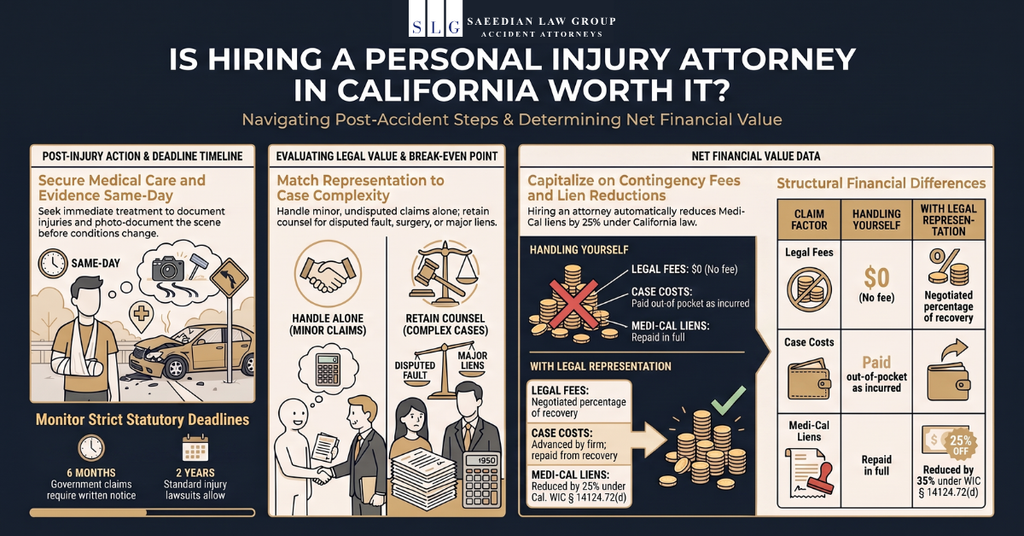
Work the break-even rather than the slogan. Hiring pays when representation lifts the gross recovery by more than the fee and costs combined. That is likeliest with disputed fault, serious injuries, or any lien sitting on your file. The deadlines are the one thing you cannot undo later, so check those first, whatever you decide.
Saeedian Law Group has helped injured victims across California pursue compensation for their losses. Our experienced team reviews each case carefully, gathers the necessary evidence, and works with insurance companies to seek a fair settlement. Contact us today to learn the best next step to take.
Frequently Asked Questions
This section provides answers to common questions about whether hiring a personal injury attorney in California is worth it.
How Much Does a Personal Injury Attorney in California Cost?
You pay nothing upfront. A California personal injury attorney works for a percentage of the recovery, and that percentage is negotiable rather than set by law. Confirm in writing whether it rises once a lawsuit is filed, and whether costs come off before or after the fee is calculated.
What Qualifications Should I Look for in a Personal Injury Attorney in California?
Start with the California State Bar, where you can confirm any lawyer’s license number, admission date, and discipline history for free. Then ask how many comparable cases they have taken to trial, not just settled. Find out which lawyer will run your case week to week, not just who signs you up.
How Long Does It Take to Settle a Personal Injury Case with a California Attorney?
Simple claims often resolve within a few months of finishing treatment. Serious injuries take longer because your case cannot be valued until your condition stabilizes. Cases against government entities add months at the start for the claim process.
Do I Need a Personal Injury Attorney for a Minor Injury in California?
Often not. If fault is admitted, treatment was brief, and no lien exists, you can usually handle the insurance claim yourself. Get a free consultation anyway before you sign a release, because a release is final even if symptoms return.
What Is the Average Settlement Amount for Personal Injury Cases in California?
There is no official figure. No California court or agency publishes settlement averages, because settlements are private and most are never filed with a court. Any range you find online is a marketing estimate rather than data, and it cannot tell you what your own injury claim is worth.
Disclaimer: Nothing here is legal advice, and reading it does not constitute legal advice or create an attorney-client relationship with Saeedian Law Group. This article states California law as of September 2026, and statutes, damage caps, and filing deadlines change over time. The figures used in the table and examples are illustrations, not predictions, and no past result guarantees any future outcome. Speak with a licensed personal injury attorney about the facts of your own case before acting on anything written here.

Michael Saeedian founded Saeedian Law Group in 2009 with the goal of providing injured individuals and their loved ones with caring, personalized, and attentive legal representation.