
Auto accident settlements rarely exceed the policy limits when you are negotiating a straightforward claim with the at-fault driver’s insurance, because the insurer has no obligation to pay more than the coverage provided. They exceed policy limits far more often in serious injury cases, where several routes past that ceiling exist.
Those routes include claims against multiple defendants, your own underinsured motorist coverage, umbrella policies, the at-fault driver’s personal assets, and a bad faith claim against an insurer that unreasonably refused a reasonable settlement. Which of those applies depends on the coverage in play, the severity of your injuries, and how the claim is handled in its first few weeks.
At Saeedian Law Group, our personal injury attorneys work from Beverly Hills and handle car accident claims across California. We have represented injury victims and their families for more than 16 years, and our firm has recovered over $100 million for clients in verdicts and settlements. Call us for a free consultation, and we will identify every layer of insurance coverage that may apply to your accident before you respond to any adjuster.
Below we cover California’s minimum liability coverage, what actually happens when damages exceed policy limits, the specific ways an injury victim can reach additional compensation, and the steps that keep those options open.
California Auto Insurance Requirements: An Overview
As a general rule, all motorists on California roadways must carry liability insurance coverage. This liability coverage helps pay for property damage and injuries to others in an auto accident where you are at fault, which is not always the rear driver in a rear-end collision.
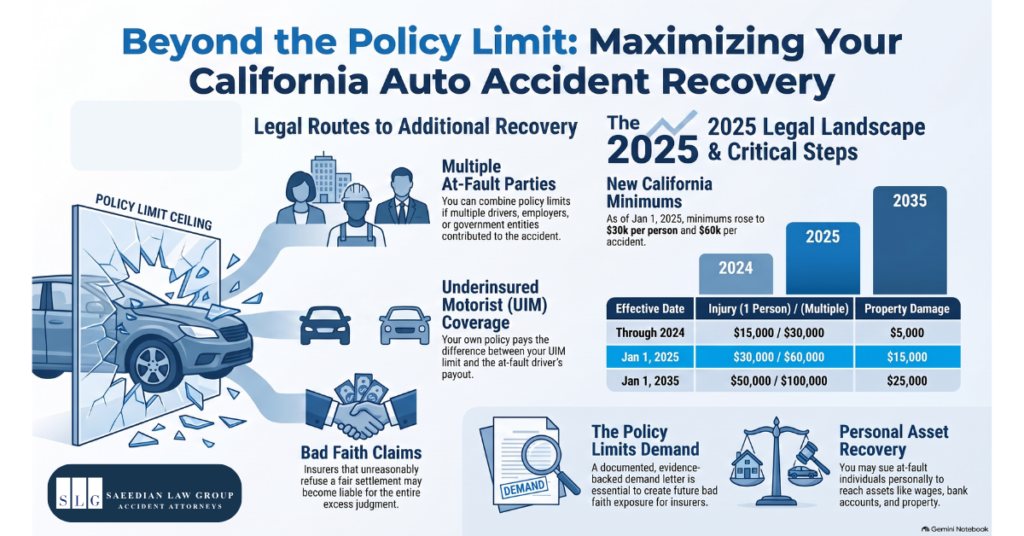
California raised its minimum liability coverage for the first time since 1967. Under Vehicle Code section 16056, the minimum coverage limits that took effect on January 1, 2025 are $30,000 of bodily injury coverage for the death or injury of any one person, a $60,000 per accident limit where more than one person is hurt, and $15,000 for property damage. The previous figures of $15,000, $30,000, and $5,000 applied only through the end of 2024, so an older policy that has since renewed now carries the higher limits.
The statute schedules another increase. On January 1, 2035, the amounts will rise again, to $50,000 per person, $100,000 per accident, and $25,000 for property damage. You may, of course, purchase higher coverage limits, and many people do. These are simply the minimums required by California law.
It is worth understanding what a minimum policy actually buys. A single overnight hospital stay with imaging and a surgical consult can approach $30,000 on its own, which means this standard coverage can be exhausted by one person’s medical expenses before treatment has properly begun. Where there are multiple victims in the same crash, the per-accident limit is divided among them.
What Happens When a Car Accident Claim Exceeds Insurance Limits?
You might be wondering what happens when a car accident claim exceeds insurance limits. If so, you are not alone. A policy limit is exactly that, a ceiling on coverage. If someone is at fault for causing an auto accident, their insurer is generally required to pay out only up to the coverage limit under the insurance policy.
This holds true even where the medical expenses incurred by accident victims far exceed the insurance policy limits, and it is why a $30,000 policy and a $300,000 injury are such a common and painful combination. It is also why car accident settlements so often land at a number that has nothing to do with what the claim is actually worth.
However, this does not mean you must accept the amount of the policy limit and nothing more. If the insurance payout does not cover all of your expenses arising out of an auto accident, you may be able to sue any at-fault individuals personally in court, and several other sources of recovery may be available alongside that.
What Happens If Someone Sues You for More Than Your Insurance Covers?
If someone sues you for more than the amount of your insurance policy limit, it is important to stay calm and seek legal counsel. There may be a number of legal defenses available to help reduce the amount you owe personally, and your own insurer generally owes you a duty to defend.
Additionally, the rule of comparative negligence applies to liability in California car injury claims. This means that each party is only liable for damages in proportion to their percentage of fault. For instance, suppose Joe injures Jack in a car crash that resulted in $100,000 of damages for Jack. However, Jack is found to be 40% at fault for the crash and for his own injuries. This would mean that Joe is liable for only $60,000, not the entire $100,000 in damages.
An excess judgment can reach your personal assets, including wages, bank accounts, and in some circumstances real property, subject to California’s exemption rules under the Code of Civil Procedure. This is also the situation in which your own insurer’s conduct becomes relevant, because an insurer that refused a reasonable settlement within limits may end up responsible for the excess itself.
So, How Often Do Auto Accident Settlements Exceed the Policy Limits?

In short, it depends on the facts and on how early the claim is handled properly. When negotiations are with an opposing party’s insurance company, settlements do not exceed policy limits very often. In most cases, the insurer simply has no legal obligation to pay more than the maximum amount stated in the auto insurance policy, and an adjuster who offers policy limits early has done what the contract requires.
The picture changes in serious injury cases. Where there are catastrophic injuries, permanent disability, extensive property damage, multiple victims, or a wrongful death, the total cost routinely runs past a minimum policy. In this case, the question stops being whether the limits are enough and becomes which additional coverage can be reached. In numerous cases, the answer involves more than one insurer.
If you pursue a legal claim against one or more parties who caused your injuries, the chances are greater that a settlement could exceed any single defendant’s insurance limits. For instance, suppose Nathan, Klaus, and Jerry all contributed to your injuries, and each only has $30,000 in coverage. Further, suppose your injuries total $90,000. If you make a successful claim against each defendant, you could feasibly recover the full compensation you are owed by combining all three insurance limits.
Six Ways a Recovery Can Exceed the At-Fault Driver’s Policy Limits
Understanding these routes is what separates a claim that stops at the limits from one that does not. The table below summarizes them, and the discussion that follows explains the two that matter most.
| Source of recovery | When it applies | What it typically adds | Key limitation |
| Multiple at-fault parties | More than one driver, an employer, or a government entity contributed | Each defendant’s own policy limits, combined | Requires proving fault against each party separately |
| Your underinsured motorist coverage | Your UIM limit is higher than the at-fault driver’s liability limit | The difference between the two figures | Offset by what the at-fault driver’s insurer pays, not stacked on top |
| Umbrella policies | The at-fault driver or their employer carries excess coverage | Commonly $1 million or more above the primary policy | Only discoverable through disclosure or discovery |
| The at-fault driver’s personal assets | An excess judgment is entered, and the defendant has reachable assets | Varies widely, and is often minimal | Exemptions and bankruptcy frequently make collection impractical |
| A bad faith claim | The insurer unreasonably refused a reasonable within-limits demand | Potentially the entire excess judgment | Requires a properly made policy limits demand on the record |
| MedPay and health coverage | You carry medical payments coverage or health insurance | Immediate payment of medical bills regardless of fault | Health plans commonly seek reimbursement from your settlement |
Your Own Underinsured Motorist Coverage
This is the most overlooked source of additional compensation, and the one most often misunderstood. Under Insurance Code section 11580.2, a vehicle is underinsured when it is insured for less than the uninsured motorist limits carried on the injured person’s own insurance policy.
The mechanic catches people out. California underinsured motorist coverage does not stack on top of the other driver’s payment. Your insurer’s maximum liability is your UIM limit less the amount already paid by or for the party legally liable. If you carry $100,000 in UIM coverage and the at-fault driver’s insurer pays its $30,000 limit, your own policy can add up to $70,000, not another $100,000.
If your UIM limit is equal to or lower than the other driver’s liability limit, the coverage adds nothing at all, which is why matching your UIM limit to the state minimum leaves you with no real protection. The California Department of Insurance publishes a consumer guide covering how these coverages fit together.
A Bad Faith Claim Against the Insurer
California law has long held that a liability insurer owes its policyholder a duty to accept a reasonable settlement within policy limits. If the insurer unreasonably refuses and a judgment is entered above the limits, the insurer can be held responsible for the entire judgment, not just its policy limit. That principle comes from two important California Supreme Court decisions: Comunale v. Traders & General Insurance Co., 50 Cal.2d 654 (1958) and Crisci v. Security Insurance Co., 66 Cal.2d 425 (1967).
In Comunale, the insured’s truck struck two pedestrians. The insurer had policy limits of $10,000 per person and $20,000 per accident, but it refused to defend the insured and rejected a $4,000 settlement offer even though there was a substantial risk of a verdict above the policy limits. The jury ultimately awarded $25,000 to Mr. Comunale and $1,250 to his wife. The California Supreme Court held that an insurer that wrongfully refuses a reasonable settlement within the policy limits can be liable for the entire judgment, including the amount exceeding the policy limits.
The California Supreme Court reinforced that principle in Crisci v. Security Insurance Co. In that case, the insured had only $10,000 in liability coverage, while the injured claimant sought $400,000. The insurer rejected settlement offers of $10,000 and $9,000 and instead offered $3,000. A jury later awarded the claimant $101,000, leaving the insured exposed to $91,000 beyond her policy limits. The California Supreme Court affirmed an award against the insurer for the excess amount and additional damages for the insured’s mental suffering.
The mechanism only works if it is set up correctly. A properly documented policy limits demand, supported by medical records and a realistic valuation and given a reasonable time to respond, creates the record that a bad faith claim later depends on. A demand made carelessly, or one the insurer could not reasonably evaluate in the time allowed, gives the insurer a defense.
Michael Saeedian, who founded our firm and has handled these claims for more than 16 years, puts it directly. “The chance to exceed the limits is usually created in the first sixty days, not at trial. If the demand goes out complete, documented, and with a fair deadline, the insurer has a decision to make. If it goes out thin, they have an excuse, and that excuse is worth the entire difference.”
What Is a Policy Limits Demand?

A policy limits demand is a written offer to settle the entire claim for the at-fault driver’s available limits. It matters for two reasons. If the insurer accepts, the injury victim receives the maximum amount available under that insurance policy without litigation. If the insurer refuses without a reasonable basis, it has exposed itself to liability for any excess judgment.
A complete demand generally includes the police report, the full set of medical bills and records, documentation of lost wages and lost income, proof of property damage and car repairs, and a clear statement of the damages claimed. Serving it early, while treatment records are current, keeps the pressure where it belongs.
What Damages Can I Recover?
In most cases, you can pursue a legal claim for damages covering hospital bills, rehabilitation costs, and prescription medications. You can also recover lost wages and any loss in earning capacity. Pain and suffering is recoverable as well, and in cases involving permanent disability it frequently becomes the largest component of the claim. Where an accident is fatal, surviving family members may bring a wrongful death claim, which follows its own rules.
Recovering in the aftermath of a California auto accident can be costly, and in many cases your actual expenses may exceed the applicable insurance policy limits. If you are not sure what damages you may be entitled to recover, contact an attorney. An experienced personal injury attorney can help you assess your potential damages and your options for pursuing compensation.
How Long Do You Have to Act?
California generally allows two years from the date of the accident to file a personal injury lawsuit, and two years from the date of death for a wrongful death claim. If a public entity vehicle or a dangerous road condition contributed, you must present a written government claim within six months before you can file suit at all.
The practical deadlines are shorter. Underinsured motorist claims are governed by your own policy and commonly require prompt written notice and your insurer’s consent before you settle with the at-fault driver. Settling the liability claim without that consent can forfeit your UIM coverage entirely.
What Steps Protect Your Ability to Exceed the Limits?
The routes described above close quickly if the early steps are missed. This sequence keeps them open.
Step 1: Get Treated and Keep Treating
Gaps in treatment are the first thing an insurer uses to discount a claim. Consistent medical care creates the record that supports the value of serious injuries.
Step 2: Identify Every Policy in Play
Request the declarations pages for the at-fault driver, any vehicle owner, any employer if the driver was working, and your own auto insurance policy. Umbrella policies and employer coverage are frequently the difference between a capped claim and a full recovery.
Step 3: Notify Your Own Insurer in Writing
Put your carrier on notice of a potential underinsured motorist claim early, and read the consent-to-settle provision before you accept anything from the other driver’s insurer.
Step 4: Document Damages Completely
Assemble medical bills, wage loss records, repair estimates, and evidence of how the injuries have changed daily life. A demand is only as strong as what supports it.
Step 5: Make a Properly Supported Policy Limits Demand
Send a complete, well-documented demand with a reasonable response deadline. This is the step that creates bad faith exposure if the insurer refuses without justification.
Step 6: File Suit Before the Deadline
If the insurer will not resolve the claim, filing preserves your rights and opens discovery into coverage, assets, and the insurer’s own claim handling.
How a California Auto Accident Attorney Can Help
Navigating an auto accident personal injury claim can be stressful and time-consuming, and it can be difficult knowing where to begin if you are unfamiliar with the complexities of civil procedure. In many situations, it is advantageous to hire legal counsel to pursue your claims. The same layered coverage analysis applies to truck and rideshare crashes, where commercial policies often sit well above standard coverage.
A well-versed auto accident attorney gathers the evidence needed to support your case and assesses your claims to determine your potential damages and each party’s liability. They also negotiate with opposing parties, their insurers, and their legal counsel. Where settlement offers or policy limits are insufficient to cover your damages, an attorney can pursue a lawsuit, locate additional coverage, and evaluate whether an insurer’s handling of the claim exposes it to a bad faith claim.
Who Should You Talk To When the Limits Are Not Enough?
Discovering that the at-fault driver carried minimum coverage is not the end of the analysis, though it is where many claims quietly stop. Several factors decide whether your financial recovery ends at that number. This often includes how many parties contributed, what your own policy provides, whether an umbrella policy sits behind the primary one, and how the at-fault driver’s insurer responds to a properly made demand. Most of those factors are still moving in the weeks right after a crash.
At Saeedian Law Group, we handle these claims on contingency, so you owe nothing unless we recover on your claim. Our attorneys handle the legal process from investigating the accident and gathering evidence to negotiating with insurers and pursuing the compensation you deserve. Contact us for a free consultation.
Frequently Asked Questions
This section provides answers to common questions about auto accident settlements in California.
How Often Do Auto Accident Settlements Exceed the Policy Limits in California?
In routine claims, rarely, because the at-fault driver’s insurer has no duty to pay above the coverage provided. In serious injury cases, it is far more common, since recovery is assembled from several sources rather than one. Multiple defendants, your own underinsured motorist coverage, umbrella policies, and a bad faith claim against an insurer that refused a reasonable demand can each take the total past a single policy’s ceiling.
What Is the Minimum Liability Coverage in California?
Since January 1, 2025, the minimums are $30,000 for injury or death of one person, $60,000 per accident for more than one person, and $15,000 for property damage. Those figures replaced the $15,000, $30,000, and $5,000 limits that had stood since 1967, and they rise again in 2035.
Can I Sue the At-Fault Driver Personally for the Amount Above Their Insurance?
Yes. An excess judgment can be pursued against the at-fault driver’s personal assets. In practice, collection is often limited because California exemption rules protect certain property and many defendants have little to reach, which is why other coverage is usually the more productive route.
Does My Underinsured Motorist Coverage Stack on Top of the Other Driver’s Policy?
No. California underinsured motorist coverage pays the difference between your UIM limit and what the at-fault driver’s insurer pays, not an additional full limit. If your UIM limit is not higher than the other driver’s liability limit, it adds nothing, which is the strongest argument for carrying UIM well above the state minimum.
What Is a Bad Faith Claim and When Does It Apply?
A bad faith claim arises when an insurer unreasonably refuses a reasonable settlement within policy limits and an excess judgment follows. California law can then hold the insurer responsible for the full judgment rather than only its limit. It depends on a properly documented policy limits demand having been made and refused.
Will My Health Insurance Cover Medical Bills if the Policy Limits Run Out?
Usually yes, and medical payments coverage on your own policy can pay immediately regardless of fault. Be aware that health plans and MedPay carriers commonly assert a right to reimbursement from your settlement, so the gross recovery and what you keep are different numbers.
Legal disclaimer: This article is provided for general informational purposes only and does not constitute legal advice. Reading it does not create an attorney-client relationship with Saeedian Law Group. California insurance requirements and case law change over time, and the outcome of any claim depends on its specific facts. Prior results do not guarantee or predict a similar outcome in any other matter. Consult a licensed California attorney about your situation. This content is published by Saeedian Law Group, a California law firm with an office in Beverly Hills, California.

Michael Saeedian founded Saeedian Law Group in 2009 with the goal of providing injured individuals and their loved ones with caring, personalized, and attentive legal representation.