
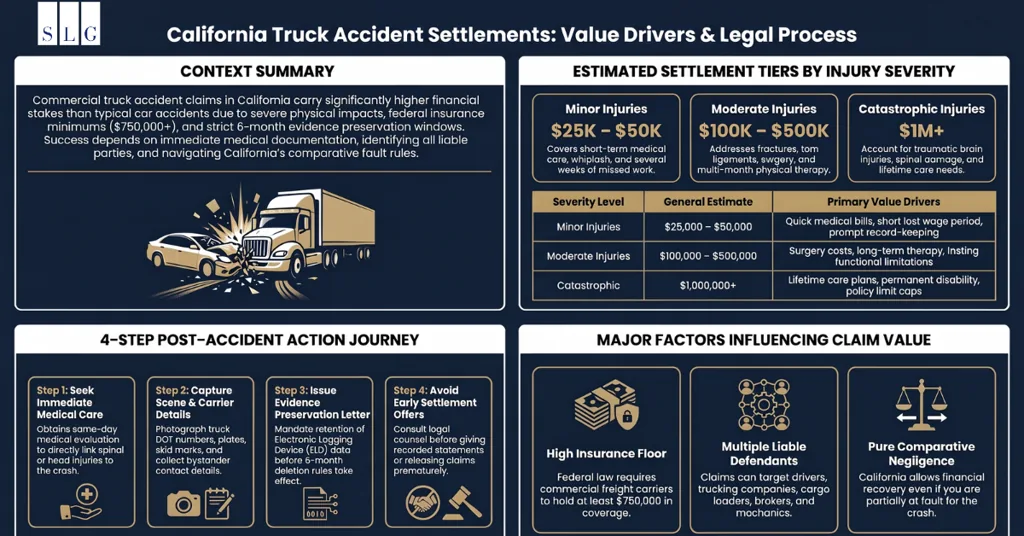
General estimates for a California truck accident settlement vary widely: about $25,000 to $50,000 for minor injuries, $100,000 to $500,000 for moderate injuries, and over $1,000,000 for severe or catastrophic ones. No single average is reliable because the reported numbers mix in confidential deals along with very large verdicts and all severities of injuries of every severity. The value of what you're claiming depends very much on how seriously you got hurt, who was responsible, and how much insurance protection backs that truck.
Since 2009, Saeedian Law Group has been representing injured truck accident victims in California. Our truck accident lawyers work on a contingency fee basis, so if we do not recover for you, you do not pay a fee. Contact us today to talk through what happened before you decide anything.
This article covers why truck cases differ from car cases, how severity and fault shape value, who can be held liable, and what to do in the first days after a crash.
Why Do Truck Accident Settlements Run Larger Than Car Accident Settlements?

Truck claims tend to involve more serious injuries, more insurance, and more defendants than a two-car collision. A loaded tractor-trailer outweighs a passenger car many times over, so the people in the smaller vehicle absorb the force.
Insurance is the second difference. Under 49 CFR 387.9, a carrier for hire moving ordinary freight across state lines must carry at least $750,000 in financial responsibility. Under Vehicle Code section 34631.5, California sets the same combined single limit of $750,000 for most carriers of freight. By comparison, under the California DMV insurance requirements plan, each ordinary driver would cost only $30,000 per person. Those are floor levels for coverage, not predictions of payouts.
Then there is the number of parties. A driver, a trucking company, a broker, a shipper, and a maintenance contractor can each carry a separate policy. If you want to compare side by side, start with the average car accident settlement in California.
What Is the Average Truck Accident Settlement in California?
Any single average can be misleading for three reasons. Most truck settlements are confidential, so the public never sees them. The cases that do get reported skew toward the largest verdicts, and a handful of huge awards pull any average far above what most claims bring. Injuries also range from bruising to paralysis, so one number blends cases that have nothing in common.
Taking these limitations into account, the table below shows rough estimates by severity level that vary greatly from case to case. They do not predict what any claim will result in. Prior results do not guarantee a similar outcome.
| Severity band | Medical picture | General estimate (varies widely) | What drives value? |
| Minor injuries | Bruising, whiplash, and other minor soft tissue injuries that resolve with short-term care | About $25,000 to $50,000 | Medical bills, several weeks of missed work, timely documentation |
| Moderate injuries | Fractures, torn ligaments, or injuries needing surgery and months of therapy | $100,000 to $500,000 | Medical expenses, lost wages, any lasting limitations |
| Severe or catastrophic injuries | Traumatic brain injuries, spinal cord damage, amputations, permanent disability | Over $1,000,000 | Lifetime care, lost earning capacity, policy limits, number of liable parties |
Two people with the same diagnosis can land far apart because of fault, coverage, and how well the damage was documented. Fatal crashes follow a separate wrongful death framework, covered below. Information about long-term costs is found elsewhere under catastrophic injury compensation in California.
What Factors Decide How Much a Truck Accident Claim Is Worth?
Severity of injury and permanency are important factors. Generally speaking, insurance companies and lawyers wait until you have reached maximum medical improvement, when recovery is stable, before assessing future care costs.
Economic losses that are well-documented hold significant importance. Medical bills and lost wages persuade only as far as the records behind them go, and gaps in medical treatment give an adjuster room to discount the claim.
Fault still matters. California follows pure comparative negligence under Li v. Yellow Cab Co. (1975) 13 Cal.3d 804, so your recovery is reduced by your share of fault, but being partly responsible does not bar the claim. Insurance limits set a practical upper limit on how much a defendant can pay out. Clear evidence of negligence can put real pressure on the defense.
What Damages Can You Recover After a Truck Accident?

California distinguishes damages into economic ones and others. Economic damages are the losses with a receipt: current and future medical expenses, lost wages, loss of earning capacity, and property damage. A lot of people ask about who pays medical bills after a car accident when a claim is still pending.
Non-economic damages cover what has no bill: pain and suffering, loss of enjoyment of life, and emotional distress that flows from the injury.
Punitive damages are less common. Under Civil Code section 3294, they require clear and convincing evidence of oppression, fraud, or malice, and against a company the conduct generally must involve an officer, director, or managing agent.
What Injuries Are Common in Truck Accidents?
There is a mismatch between the injuries sustained. Fractures, crush injuries, and severe injuries to the neck and back are common. Impact forces can cause traumatic brain injuries without a visible head wound, so a traumatic brain injury claim often turns on testing months later.
Severe spinal cord injuries occur. A spinal cord injury claim considers long-term care, not just covering bills at the moment. Severe injuries like these typically need long-term treatment that involves surgery along with physical therapy over many years.
Who Can Be Held Liable for a Truck Accident?
The truck driver is the obvious defendant but rarely the only one. Under respondeat superior, an employer can be responsible for an employee's negligence on the job, which brings in the trucking company. Some companies label their drivers as independent contractors in order to avoid responsibility, but this depends on whether those labels are correct and factual.
Other liable parties rely on the evidence. Candidates include a cargo loader who failed to secure freight, a shop that missed worn brakes, a broker that chose an unsafe carrier, and a parts manufacturer. Not every case involves multiple parties, but each additional responsible party can result in more coverage.
Proposition 51, codified at Civil Code section 1431.2, shares responsibilities among its members. Each defendant pays non-economic damages only in proportion to its fault, while economic damages remain recoverable from any liable defendant. It doesn't relieve an employer of responsibility for negligence by its drivers.
How Does California Law Affect a Truck Accident Claim?
The deadline for filing comes first. Under Code of Civil Procedure section 335.1, you generally have two years to sue for an injury or wrongful death. If there is a government vehicle involved or if you're dealing with a dangerous public road, Government Code section 911.2 requires that you submit a written claim within six months. The statute of limitations in California has exceptions, so please check dates early.
California does not put a dollar cap on damages in a typical truck accident. There are other places where caps exist, such as limitations on non-economic damages in medical malpractice cases.
Civil Code section 3333.4, known as Proposition 213, bars non-economic damages in some motor vehicle cases. It applies to an injured person who owned an uninsured vehicle involved in the crash, could not show financial responsibility while driving, or was convicted of drunk driving for that accident. Medical bills and lost wages remain recoverable, and exceptions exist.
Wrongful death claims follow Code of Civil Procedure section 377.60. The process starts with surviving spouses or domestic partners and children of the deceased. Values in these cases depend on different losses, which our page on wrongful death settlements breaks down.
What Evidence Strengthens a Truck Accident Claim?
Truck cases contain records that carriers control and may not keep indefinitely. The table below lists the main evidence types and how fast each can disappear.
| Evidence type | What it shows | Timing and notes |
| Scene photos and video | Vehicle positions, skid marks, road conditions | Collect the same day; marks and debris fade quickly. |
| Police reports | Witness names, the carrier, officers' observations | Vehicle Code section 20013 generally keeps the report out of trial evidence, but it helps identify people to interview. |
| Electronic logging device (ELD) records | Hours of service and duty status | Carriers must keep records of duty status for at least six months under 49 CFR 395.8(k); send a preservation letter early. |
| Engine control module or black box data | Speed, braking, other vehicle data before impact | Many commercial trucks transport it; no federal rule mandates it on heavy trucks. |
| Dash camera or telematics video | What the driver observed and did, if the carrier has that information. | Name it in the preservation letter. |
| Maintenance and inspection records | Whether brakes and tires were kept in order | Request service histories and inspection reports. |
| Medical records and bills | Injuries, treatment, cost | Follow your care plan so gaps cannot be used against you. |
Records of duty status matter because of timing. Under 49 CFR 395.8, carriers must keep those records and supporting documents for at least six months, and a carrier may discard them after that. Drivers can annotate or edit ELD entries under federal rules, so the logs are a starting point for investigation. A preservation letter asks the carrier in writing to keep those records and the vehicle data. Hours of service limits set by the Federal Motor Carrier Safety Administration are used to check the logs against.
The NHTSA event data recorder rule in 49 CFR Part 563 doesn't apply to light vehicles but rather to trucks that are heavier. Investigators can still pull data from an engine computer, which is covered in our post on what a commercial truck's black box records.
Location matters too. According to SCAG's 2023 goods movement presentation, sections of I-10, I-15, SR-60, and SR-91 averaged more than 25,000 trucks going through each day. Freight routes going from east to west along SR-60 and I-10 connect big clusters of warehouses in San Gabriel Valley and Inland Empire. A Southern California crash can involve a delivery carrier, a port trucker, or a warehouse operator, and a Los Angeles truck accident attorney can request records from each one.
What Steps Should You Take After a Truck Accident?
What you do in the initial days following a truck accident is crucial for shaping your claim. First, call 911 and get medical attention. Injuries from a crash can be deceptive, particularly those affecting the head and spine, and having a same-day medical record links these injuries to the accident. Additionally, documenting the accident scene is vital; take photographs of the vehicles involved, the truck's markings and DOT number, skid marks, and any visible injuries. Make sure to collect contact information from witnesses as well.
Next, gather all pertinent information from the driver and the carrier. This includes noting the company name, license plate number, insurance details, and the driver's name. It's also essential to keep thorough records of everything related to the accident. Save all bills, receipts, and pay stubs, and maintain a daily log of how you feel. Following your care plan is equally important, as missed appointments can provide the defense with an argument against your claim.
Lastly, exercise caution when dealing with insurers. Remember that the insurance adjuster represents the carrier's interests, so it's wise to decline any recorded statements until you have consulted a lawyer. Engaging a truck accident attorney early in the process can be beneficial, as they can send a preservation letter before the six-month deadline and help you navigate all necessary deadlines effectively.
What Mistakes Can Lower Your Settlement?
Accepting the first offer is the most common one. An offer comes before treatment is finished and may not pay for future expenses either; signing a release typically ends the claim. It's difficult to price recovery as it's happening, and the person making an offer can't price it either.
Delaying medical care comes next. A gap between the crash and your first visit lets the defense argue something else caused the injury, and stopping care early can look like proof you recovered.
Failing to keep records leaves a strong claim resting on your word against a corporation's. Your last error is missing a deadline. A government claim has a six-month notice window, and a standard lawsuit generally has two years, and once either passes, the claim can be barred.
How Does the Settlement Process Work?
The legal process starts with investigation and medical care. Your attorney gathers records, sends preservation letters, and identifies every responsible party and every applicable policy, while you stay in care until your condition is stable enough to value.
Then there is another demand. Once you reach maximum medical improvement, your attorney sends the insurance companies the medical records, wage documentation, and liability evidence, and settlement negotiations follow, often over several rounds. If talks stall, a personal injury claim can move into a lawsuit, and you can read about how long a personal injury lawsuit takes in California. Payment follows a signed release and resolution of liens, such as health insurer reimbursement.
Ready to Talk With a California Truck Accident Attorney?
No single average can tell you what your California truck accident claim is worth, because severity, fault, coverage, and documentation set the value. Evidence such as ELD records can be discarded once a federal six-month retention period ends, and California's filing deadlines are easy to miss. Talking to a lawyer sooner leaves more options open.
Saeedian Law Group has been handling personal injury cases in California since 2009, and we have our experienced truck accident lawyers working from offices in Beverly Hills, Rancho Cucamonga, and Encino. We work on a contingency fee basis, so if we do not recover for you, you do not pay a fee. Contact us today or call (310) 288-3000 for a free consultation.
Frequently Asked Questions
We deal with lots of truck accident claims, so we hear the same questions asked by most truck accident victims who call about them. Your facts can change the answers, so read them as general information.
How Long Does a Truck Accident Settlement Take?
That depends on what the injuries are and how many people are involved. Claims with minor injuries can resolve in months, while truck accident cases with permanent injuries or several defendants can take a year or longer, mostly because settlement waits for maximum medical improvement.
Can I Recover If I Was Partly at Fault?
Yes. California uses pure comparative negligence. So if you're partially at fault, that reduces what you can recover rather than completely barring you from recovery altogether. Proposition 213 limits when people can get damages in limited situations.
Is There a Cap on Truck Accident Damages in California?
Not in a typical truck accident injury case. Limits that do apply come from other places, such as available insurance.
What Is the Deadline to File a Truck Accident Lawsuit?
Under Code of Civil Procedure section 335.1, the usual time limit for filing a claim related to injury or wrongful death is two years. A written claim should be submitted within six months if there's involvement from any governmental body.
Do I Need a Truck Accident Attorney?
You are not required to hire one, but truck claims involve federal regulations, multiple insurers, and records that can disappear within months. Having a free consultation can help you decide if you want to hire an attorney and pursue compensation.
Important: This article provides general information on how to file claims for truck accidents in California and is not intended as legal advice. Reading this information doesn't create any attorney-client relationship with Saeedian Law Group. The dollar estimates stated here are illustrative only, vary widely, and do not predict the outcome of any claim. Different deadlines and legal options vary depending on unique facts in each case. So talk to an attorney who is licensed to practice law where you live before doing anything based on this information.

Michael Saeedian founded Saeedian Law Group in 2009 with the goal of providing injured individuals and their loved ones with caring, personalized, and attentive legal representation.