
A settlement amount from another motorcycle accident does not tell you what your case is worth. The amount you may receive depends on your injuries, medical costs, lost income, fault, and available insurance. California law can also affect how much you recover. Looking at these factors can give you a better idea of how motorcycle accident settlements are determined.
Saeedian Law Group has represented injured Californians since 2009, with more than 16 years of personal injury and wrongful death work statewide. We handle motorcycle accident claims from our Beverly Hills, Encino, and Rancho Cucamonga offices on a no-fee unless we recover basis. Call us for a free consultation, and we will tell you which factors are working for and against your claim.
Below you will find what actually drives the number, three worked scenarios, the two California rules nobody mentions, and the evidence that decides it.
Factors Affecting Motorcycle Crash Settlement Amounts

A settlement is an agreement to close a claim for an agreed sum, with no admission of fault and no trial. Most motorcycle accident cases end this way, because both sides prefer a known number to a jury.
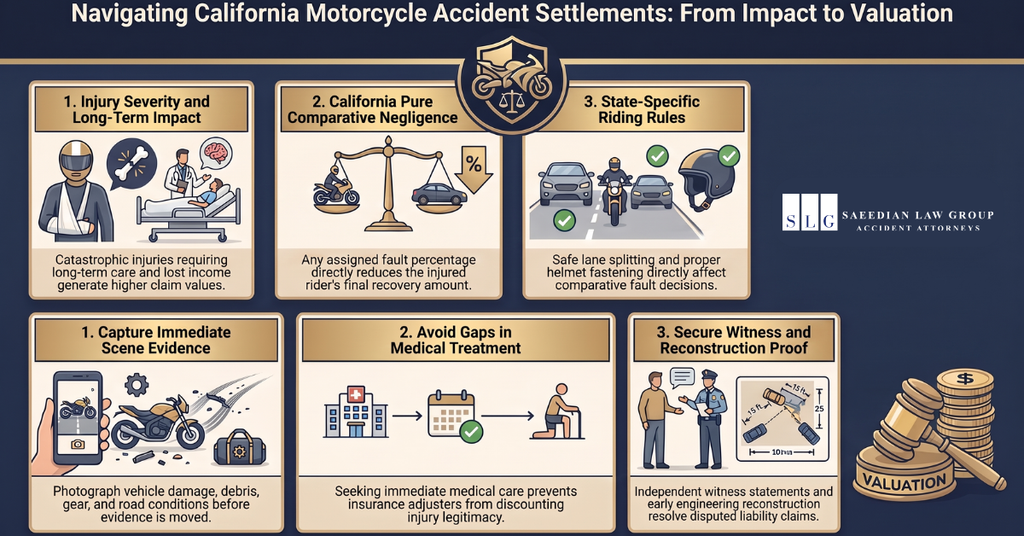
Five key factors influence settlement figures. The severity of the injury is one of the biggest factors in a settlement. Catastrophic injuries such as traumatic brain injuries, spinal injuries, and amputations may require years of medical care and can lead to lost income and other costs. Less serious injuries that heal within a few weeks usually involve fewer medical expenses and losses.
Injuries can vary greatly, and the severity of the injury can have a major effect on the settlement amount. Minor injuries that heal within a few weeks are generally less costly than serious injuries, such as fractures that require surgery. Severe injuries can lead to long-term medical care, lost income, and other expenses. Motorcycle riders also have less protection than people inside cars, so their injuries can be more serious in some crashes.
Fault comes second. California uses pure comparative negligence, so any share assigned to the injured rider reduces the recovery proportionally rather than ending it. Careless driving by the other motorist has to be established, not assumed.
The effect on your daily life comes third. A broken wrist may affect a surgeon’s work more than it affects someone who works in an office. In serious cases, the income you may lose over time can be higher than your medical bills. Fourth is evidence. A documented claim is worth more than a merely true one. That sounds cynical until you watch an insurance company discount a real injury for want of a scan.
Fifth, and something many people do not consider at first, is the insurance policy limit. California’s minimum liability coverage is $30,000 for injury to one person. A catastrophic claim against a minimum-limits driver reaches that ceiling quickly, whatever the case is worth on paper.
Motorcycle riders are unusually exposed to that arithmetic. In 2023, the motorcyclist fatality rate was 31.39 per 100 million vehicle miles traveled, against 1.13 for car occupants. That is nearly 28 times higher, and 6,335 riders were killed, 15 percent of all traffic deaths.
Two California Rules that Change the Number
This is one area where California motorcycle accident settlements can differ from those in other states. The first is lane splitting. Vehicle Code section 21658.1 defines it as riding between rows of stopped or moving vehicles in the same lane. It also directs the Highway Patrol to publish safety guidelines. California is alone in addressing it in statute this way.
That can affect how fault is decided. In some states, an insurer may argue that lane splitting was illegal. In California, lane splitting is allowed, so the question is whether the rider did it safely under the circumstances. The insurer would then need to show that the rider’s actions contributed to the crash.
The second is the helmet law, and the details are what many people overlook. Section 27803 requires a helmet for the rider and passenger. It then defines wearing one as having it on the head, fastened with the straps, and fitting without excessive movement.
So a helmet perched loosely or unbuckled may not satisfy the statute at all. Expect an adjuster to ask how the helmet was fastened, because noncompliance feeds straight into a comparative fault argument.
The federal data explains why insurers push so hard on it. In states without a universal helmet law, 51 percent of riders killed in 2023 were not wearing one. In states with such a law, including California, the figure was 10 percent.
Motorcycle Accident Settlement Amounts with Examples

The examples below show how different factors can affect a settlement. They are fictional examples, not actual cases. The amounts are only for illustration and do not predict what any particular claim may be worth.
1. Minor Injuries, Clear Liability
For instance, imagine a driver turning left across a rider’s path at low speed. The rider falls, breaks a collarbone, and makes a full recovery after ten weeks of physical therapy. The police report clearly shows that the driver caused the crash.
In a case like this, the rider may have medical bills, lost wages from time away from work, and a pain-and-suffering claim. Since liability is clear and the injury has healed, the claim may be resolved within a few months.
2. Severe Injuries with Long-Term Impact
Imagine a pickup truck pulling out from a side road and hitting a motorcycle rider. The rider suffers a brain injury and a shattered femur, spends several weeks in the hospital, and cannot return to their usual work.
In this situation, the settlement may depend heavily on what the rider will need in the future. Ongoing medical care, physical therapy, lost earning capacity, and permanent disability can far exceed the costs already incurred. The claim may take longer to resolve because the rider’s long-term medical needs must be clearer before those losses can be calculated. Insurance policy limits may also determine how much compensation is available.
3. Disputed Liability
Suppose a rider is struck while lane splitting in slow traffic. The driver says the rider appeared from nowhere, while there are no independent witnesses and the police report does not assign fault.
The case may then depend on accident reconstruction and physical evidence. The insurer may argue that the rider was partly responsible for the crash. Under California’s pure comparative negligence rule, any percentage of fault assigned to the rider can reduce the compensation they receive. In cases like this, early collection of evidence can become especially important.
| Scenario | What drives the value | What limits it |
| Minor injuries, clear fault | Medical bills, short-term lost wages | Modest injury, quick recovery |
| Severe injuries, long-term | Future medical care and lost earning capacity | The at-fault driver’s policy limits |
| Disputed liability | Reconstruction evidence and witness statements | The fault percentage assigned to the rider |
Real cases are usually more complicated than these examples. In Martinez v. Department of Transportation, a published California appeal, a rider lost control after striking a raised curb. He argued the design was a dangerous condition particularly hazardous to motorcycles. The case ran to trial and then to appeal, which is a useful reminder that a defendant with resources will fight.
When the Crash Is Fatal
Motorcycle crashes end in death far more often than car accident claims do, which is why a page about settlements has to address it. Where a rider does not survive, the claim changes shape entirely.
Surviving family members bring a wrongful death claim in their own names rather than continuing the rider’s case. California limits who may do so, generally the spouse, domestic partner, and children, with other relatives qualifying in narrower circumstances.
What is recoverable also changes. Family members recover the financial support the rider would have provided and the loss of companionship, rather than the rider’s own pain. A separate survival action can cover losses the rider suffered before death.
These claims are valued very differently from injury claims, and fatal injuries do not automatically produce the largest settlements. A young earner with dependents generates a far larger economic loss figure than an older rider with none. That surprises families, and it is worth understanding early.
Critical Evidence in Motorcycle Crash Cases

Photographs matter more in motorcycle cases than in car cases, because the bike itself records the impact. Photograph the machine before it is moved or repaired, the road surface, any debris field, and the final rest positions.
Police reports can be useful evidence, but they do not decide who is legally at fault. Officers reconstruct from statements taken minutes after a crash, and riders are often being treated rather than talking to anyone. Correcting a report later is possible but harder than getting it right at the scene.
Witness memories can fade quickly, so statements from people who are not connected to either side can be especially useful. Get the names and phone numbers of witnesses before they leave the scene. Expert opinions can come later, and an accident reconstruction engineer may help determine what happened when the drivers disagree about fault.
In a disputed motorcycle accident case, physical evidence can be more useful than conflicting statements. Skid marks, damage to both vehicles, and the location of debris can help a reconstruction engineer determine how the crash happened. This is why photographs taken at the scene can be so important.
Helmet and gear condition can also provide useful evidence. Damage to the helmet or protective gear can help show the force and direction of the impact. Also save any dashcam or helmet camera footage. Nearby business cameras, which are commonly overwritten within days.
Getting immediate medical attention is evidence too. A gap between the crash and your first medical treatment is the easiest thing for insurance adjusters to attack. Riders who feel fine on adrenaline create one constantly.
“The insurer’s first move in a motorcycle file is almost always the rider’s own conduct,” says Michael Saeedian, founding attorney at Saeedian Law. “Speed, the helmet, lane position. Answering that properly takes photographs from the scene, not recollection six months later.”
Common Questions About Motorcycle Crash Settlements
There is no reliable average settlement figure for these cases, and any page quoting an average motorcycle accident settlement precisely is estimating. Settlements are private, no public body collects them, and the published ranges you find are usually one firm’s own results rather than a survey.
What can be said is that the spread is enormous. Minor injuries that fully resolve settle for a few thousand dollars. Life-altering injuries to a young rider can reach eight figures. Knowing where your own claim sits requires the three inputs above: prognosis, fault, and available coverage.
Negotiation is possible and expected. A first offer is a position rather than a valuation, and countering with documents rather than adjectives is what moves it. Legal representation matters most where liability is disputed or injuries are permanent.
The settlement process itself runs in a predictable order. You treat, your attorney gathers the medical records and wage documentation, a demand goes to the insurer, and negotiation follows. A motorcycle accident lawsuit is filed only when that fails, or a deadline forces it, and most personal injury cases still settle afterward.
Timing surprises people. A straightforward injury claim may resolve in months. A claim involving serious injuries cannot be valued until the medical picture is stable, which often means a year or more. Accepting a final settlement before then is the one mistake that cannot be undone.
Two things to check before choosing an experienced motorcycle accident lawyer. Ask how many motorcycle files the firm has taken to trial rather than settled, and ask who will handle yours day to day. Motorcycle accident results depend on the work done in the first month, not the name on the letterhead.
Is the Offer in Front of You Actually Fair?
You cannot answer that from a number alone, and neither can any page listing other people’s settlements. Compare it against your own documented losses, your prognosis, and the coverage available behind the at-fault driver. If your treatment is unfinished, the honest position is that nobody knows yet, including the adjuster who made the offer. Preserve evidence from the scene while that question is still open.
Our legal team at Saeedian Law Group handles motorcycle claims across Los Angeles and Southern California, and we bring in reconstruction experts early where fault is contested. We work on contingency, so there is no fee unless we recover for you, and the consultation costs nothing. Call us today to learn the next possible steps to take.
Frequently Asked Questions
This section provides answers to frequent questions about a motorcycle crash settlement.
Can You Provide Examples of Motorcycle Crash Settlement Amounts?
The scenarios above show how the factors interact, deliberately without attaching figures. Real settlement amounts vary from a few thousand dollars to many millions depending on injury severity, fault, and available insurance coverage. Most settlements are confidential, so published examples are usually a firm’s own selected results rather than anything representative. Treat any specific number you see online as marketing until you can check it.
What Factors Influence the Amount of a Settlement?
Injury severity and permanence carry the most weight, followed by medical expenses and future medical care, lost wages, and lost income. Then comes fault, since pure comparative negligence reduces recovery by your own percentage. Property damage and emotional distress form part of it. The practical ceiling is usually the at-fault driver’s insurance policy limits rather than what the claim is theoretically worth.
Are There Real Cases I Can Actually Read?
Yes, though settlements rarely appear and published decisions are mostly appeals. Martinez v. Department of Transportation is a genuine California motorcycle case you can read in full. Court records are public, unlike settlements, which is why the figures circulating online are so hard to verify. A qualified attorney can also tell you how comparable cases in your county have actually resolved.
How Can I Estimate What My Case Is Worth?
Wait until your doctors can describe your long-term prognosis, because pricing a claim before then guesses at the largest component. Add the medical bills, projected future medical expenses, and lost earnings, then account for pain and suffering. Check that against the available liability coverage. An experienced motorcycle accident lawyer will run the same exercise and compare it to real outcomes.
What Should I Consider Before Accepting an Offer?
Whether it covers what is still coming rather than what has already happened. Future medical needs, further surgery, ongoing physical therapy, and any permanent limitation on your work. A settlement closes the claim permanently, so you cannot return for more if the injury worsens. Have someone check the offer against your medical records before you sign anything.
How Do I Choose the Right Lawyer for a Motorcycle Case?
Look for a motorcycle accident law firm that runs these files regularly rather than a general practice that takes them occasionally. Motorcycle claims carry defenses that car cases do not, particularly around helmet use and lane position, and experienced motorcycle accident lawyers expect them. Ask how many motorcycle cases the firm has tried, not settled.
Then ask practical questions. Who handles your file day to day. How quickly the firm retains a reconstruction expert where fault is contested. Whether they will tell you honestly if a claim is not worth pursuing.
Most personal injury lawyers work on contingency, so an experienced personal injury lawyer costs nothing to consult. An experienced attorney will also show you what a fair settlement looks like. Fair compensation in your case, not a headline figure from someone else’s.
Disclaimer: This article is general information about California motorcycle accident claims and does not constitute legal advice. Reading it does not create an attorney-client relationship with Saeedian Law Group. The scenarios described are illustrations only and are not based on any actual case. No figure or range stated here predicts the outcome of any claim. Speak with a licensed attorney about your own situation before acting on anything here.

Michael Saeedian founded Saeedian Law Group in 2009 with the goal of providing injured individuals and their loved ones with caring, personalized, and attentive legal representation.