

Lower back pain after a car accident can derail a person’s work, sleep, and daily life for months or years, and the settlement that follows has to account for all of it. A severe back injury caused by a car accident, neck or back impact, often requires medical care for years and may justify an auto accident lawsuit when insurance offers fall short of the actual losses.
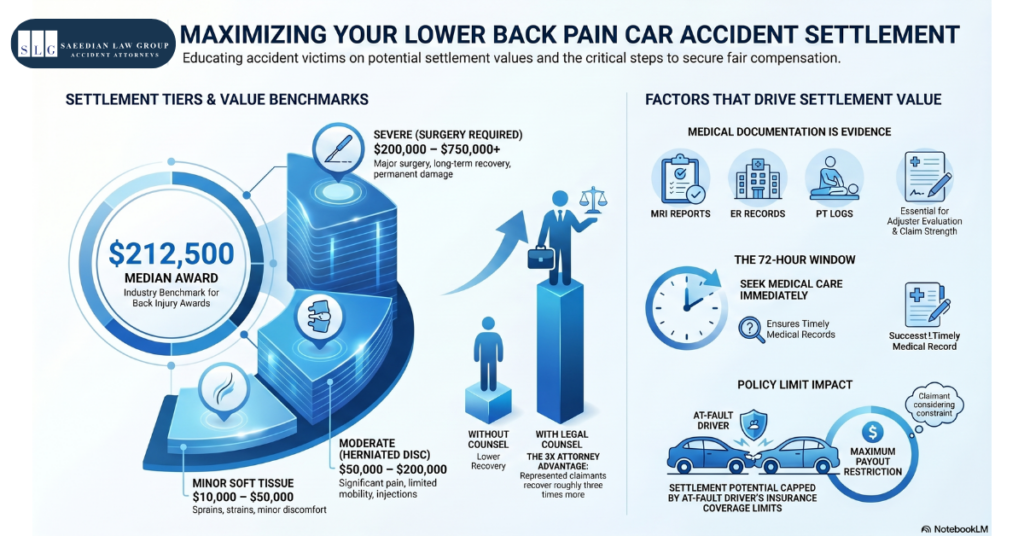
Reported settlements for these cases range from roughly $10,000 for minor soft tissue injuries to well over $1,000,000 for severe back injuries with permanent disability, with the median back injury award sitting around $212,500 according to widely cited industry data. The exact lower back pain car accident settlement depends on injury severity, medical bills, lost wages, future medical expenses, the strength of the medical documentation, and the comparative fault rules of the state where the case is filed.
At Saeedian Law Group, our personal injury attorneys have represented California car accident victims with neck and back injuries since 2009. We have handled cases ranging from minor lumbar strain to herniated disc injuries to severe spinal cord damage. You can contact us today for a free case evaluation.
This guide explains the realistic settlement value, the factors that drive it up or down, and the steps an injured person should take to protect their right to fair compensation.
Understanding Lower Back Pain After a Car Accident
The lumbar spine carries most of the body’s weight and absorbs much of the force in a collision. When a car crash sends the body forward, sideways, or up off the seat, the soft tissues, joints, and discs of the lower back are often the first parts of the spine to give. The same biomechanics that produce neck whiplash can also strain the lumbar spine, so a person can suffer neck pain and lumbar injury from a single crash.
Neck injuries and back injuries often appear together in the same patient, which is why personal injury law treats them as a single “back or neck injury” category in most settlement statistics. The most common lower back injuries from a motor vehicle accident include muscle strains and sprains of the lumbar paraspinal muscles, herniated disc injuries (most often at L4-L5 or L5-S1), facet joint injury, pinched nerve symptoms (sciatica), and, in higher-energy crashes, spinal fracture or vertebral compression fractures.
The most severe cases involve spinal cord damage, which can produce permanent loss of motor function below the level of injury. Symptoms vary widely. Some car accident victims feel pain immediately. Others wake up the next morning with stiffness that builds into chronic back pain over days or weeks. Common pain symptoms include localized dull or sharp pain, muscle spasm, reduced range of motion, radiating leg pain when a nerve root is involved, and numbness or tingling along a dermatome.
Symptoms that do not improve within a few weeks should prompt repeat imaging, because herniated disc injury cases sometimes look like a simple strain at first. Untreated lower back injuries can lead to long-term complications that are far more expensive than the original treatment would have been. A herniated disc that goes untreated can progress to nerve root compression that requires surgery years later.
A facet joint injury can develop into chronic facet syndrome with ongoing pain management needs. Even a minor soft tissue injury, when ignored, can lead to chronic pain through deconditioning and abnormal movement patterns. The psychological effects matter too. Chronic pain is closely linked to depression, anxiety, and sleep disturbance, and the inability to work or care for family members compounds the strain.
Insurance adjusters often underestimate these effects, which is one reason an experienced personal injury attorney can change a settlement outcome. Early diagnosis and treatment do two things at once. They give the injured person the best medical outcome, and they create the medical records that drive a strong settlement value. A gap in treatment, even when caused by missed work or family obligations, is something insurance adjusters routinely use to argue that the injury was not serious.
Average Settlement for Lower Back Pain in Car Accidents
Reported settlement values for lower back injury claims fall into roughly four tiers. Minor soft tissue injuries that resolve with conservative care typically settle between $10,000 and $50,000. Moderate injuries involving a herniated disc managed without surgery, often with physical therapy and epidural steroid injections, commonly settle between $50,000 and $200,000.
Severe injuries requiring surgery, such as a herniated disc requiring surgery or spinal fusion, often settle between $200,000 and $750,000 in cases with clean liability. Catastrophic injuries involving spinal cord injury or permanent disability frequently settle in the seven figures, sometimes well above $1,000,000 when insurance limits and asset coverage allow.
For comparison, neck injury settlement medians sit in a similar range, which is why most back injury settlement data is grouped with the neck or back injury category in published studies. Average settlement amounts for any single category vary widely depending on whether the injuries were serious injuries with surgery or minor strains, so the average settlement value is less informative than the median for someone trying to predict their own case.
The average is always higher than the median because a small number of catastrophic cases pull it upward. For an ordinary lower back pain car accident settlement, the median is a more useful benchmark than the average settlement amount. The average car accident settlement figure published in industry reports tends to mislead readers, because a handful of catastrophic recoveries can shift the average well above what most people will actually receive.
Factors Influencing Lower Back Pain Settlement Values
Lower back pain settlement values after a car accident can vary widely depending on several important factors. Below are some major factors that can significantly impact how much one can receive from a lower back pain settlement.
Severity of Injury
Injury severity is the largest driver, but several other factors matter materially. Past medical expenses, future medical expenses, lost wages, and loss of earning capacity all add to the economic damages. Pain and suffering damages, calculated either as a multiplier of the medical bills or on a per-day basis, can equal or exceed the economic losses in serious cases.
Comparative Fault Rules
Comparative fault rules of the state where the case is filed can reduce the settlement by the plaintiff’s share of blame. California uses pure comparative negligence, so an injured driver who is 30 percent at fault can still recover 70 percent of their damages.
Insurance Coverage Limits
Insurance coverage can also affect settlement values. When the at-fault driver carries only California’s minimum bodily injury coverage of $15,000 per person, the case is capped at that policy unless the injured person can tap their own underinsured motorist coverage. Commercial defendants with $1,000,000 or more in coverage open up a much larger settlement range.
Medical Documentation
The medical record is the single most important piece of evidence in a back injury claim. Insurance adjusters and defense lawyers cannot see the pain. They can only read what the treating physicians wrote, and the records have to demonstrate ongoing pain, functional limitations, and a credible plan of medical care that ties the injury to the crash.
Strong medical documentation usually includes the emergency room records from the day of the crash, the imaging reports from any MRI or CT scan, the treating orthopedist’s or neurologist’s narrative notes, and a complete physical therapy log. It also includes every receipt covering medical bills incurred during medical treatment, and any pain management records documenting epidural steroid injections or facet blocks.
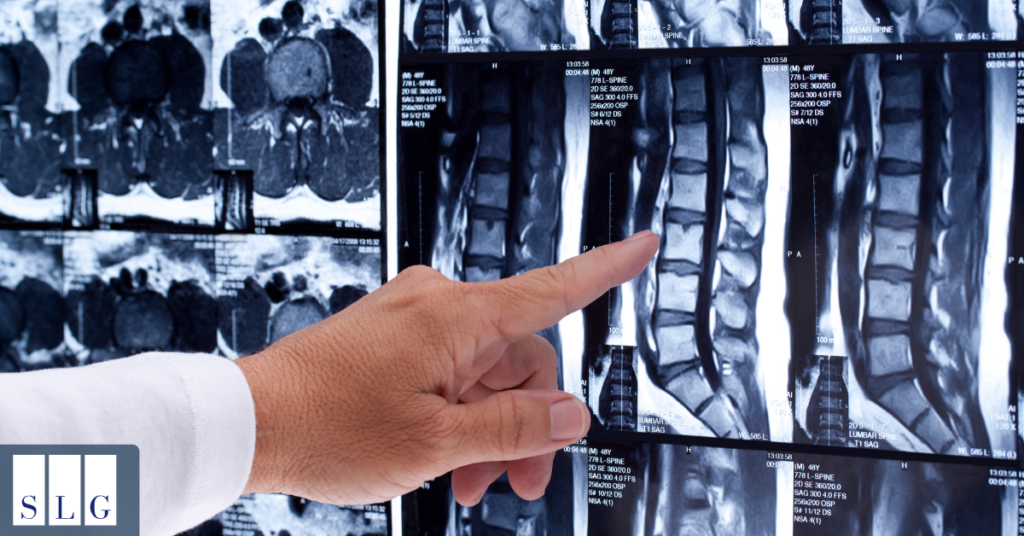
Records of every plaintiff’s injuries should be kept in chronological order so the timeline of treatment matches the claim narrative. Where a herniated disc is involved, the MRI report tying the disc protrusion to a specific nerve root carries particular weight.
Expert testimony fills the gaps where the records alone are not enough. A treating physician or independent expert can explain the mechanism of injury, confirm that the back injury is causally connected to the crash, and project future medical needs in a way that a jury or adjuster will understand. For surgical cases, an expert opinion on whether the surgery was necessary and what permanent impairment it produced is usually decisive.
Liability and Evidence
A strong settlement requires more than medical proof. The liability evidence has to make clear who was at fault. The strongest liability files include the police reports from the scene, witness statements, photographs of the vehicle damage and the accident location, dashcam or surveillance footage where available, and the at-fault driver’s insurance information. Cell phone records can be subpoenaed in distracted driving cases.
When liability is disputed, an accident reconstruction expert can analyze skid marks, impact angles, and vehicle damage patterns to produce a written opinion on speed, fault, and avoidability. The cost of an expert is often a fraction of the difference it makes to the settlement.
Role of Legal Representation
Research has it that injured claimants represented by attorneys recover roughly three times more on average than unrepresented claimants, even after legal fees. The reason is simple. Insurance companies have full-time adjusters and defense lawyers trained to keep payouts down. An injured person handling their own claim is negotiating from the weaker side.
Experienced personal injury lawyers also know what comparable cases have settled for, where insurers will push back, and when to file suit to break a stalled negotiation. Most personal injury claims, including lower back pain car accident cases, are handled on a contingency basis, which means an injured person can hire a skilled attorney without paying anything up front.
Steps to Take After a Car Accident

What an injured person does in the first hours and days after a crash has a measurable effect on the eventual settlement value. The single most important step is to seek medical attention promptly, even when symptoms feel mild. Lower back injuries often worsen over the first 48 to 72 hours, and any delay between the crash and the first medical visit becomes ammunition for insurance adjusters to argue the injury came from somewhere else.
The accident should also be reported to the police, and a copy of the police report should be obtained as soon as it is available. If anyone at the scene has visible injury or significant property damage, California law generally requires a report.
Documentation and Evidence Collection
Photographs are often the cheapest and most useful evidence in the file. They should cover the vehicles, the position of the cars, the road and weather conditions, any visible injuries, and the contents of the cars if airbags were deployed or interior surfaces were struck. The injured person should also note and collect contact information of any witnesses, the other driver’s insurance information, the vehicle’s license plate, and the responding officer’s name and badge number.
After leaving the scene, the injured person should keep a recovery journal with daily pain levels, medications taken, activities missed, sleep quality, and emotional state. This kind of medical documentation, kept contemporaneously, becomes powerful evidence in negotiation and trial because it captures the day-to-day reality that medical records alone do not.
The injured person should also avoid two common mistakes. First, do not give a recorded statement to the other side’s insurance company. Adjusters are trained to ask questions whose answers can be used to reduce the claim. Second, do not accept a fast settlement offer before the full extent of the back injury is known. Many serious back injuries do not declare themselves until weeks after the crash, and an early settlement closes the door on later medical needs.
Seek Professional Legal Advice Today

A lower back pain car accident settlement depends on a long list of factors, but the most important ones are injury severity, the strength of the liability evidence, the available insurance coverage, and the experience of your lawyer.
Realistic settlement values range from $10,000 for a minor soft tissue injury to seven figures for severe injuries with permanent disability, with the median back injury award near $212,500. Acting quickly, getting consistent medical care, and avoiding early offers from insurance adjusters are the three habits that most often protect an injured person’s recovery.
Saeedian Law Group serves car accident victims throughout Southern California, including Beverly Hills, Los Angeles, San Diego, and Riverside. Our team works on contingency, which means you pay nothing unless we recover compensation for you. To speak with one of our injury lawyers, call 310.288.3000 or visit our Beverly Hills personal injury page for more on how we handle back and neck injury cases.
Frequently asked questions
Below are common questions about lower back pain settlement values and their respective answers.
How Much Compensation Can I Get for Lower Back Pain After a Car Accident?
Settlement amounts vary widely, from roughly $10,000 for minor soft tissue injuries that resolve with conservative care to well over $1,000,000 for severe back injuries with permanent disability. The median back injury award reported across industry data sets is approximately $212,500. The actual figure for your case depends on injury severity, total medical expenses, lost wages, the available insurance coverage, and the strength of the medical records and liability evidence.
How Is the Settlement Amount for Lower Back Pain from a Car Accident Determined?
Insurance adjusters and lawyers calculate the settlement value by adding the economic damages (past medical expenses, future medical expenses, lost wages, loss of earning capacity, and property damage) to the non-economic damages, which compensate for pain and suffering. The non-economic figure is often estimated using a multiplier of one and a half to five times the medical bills, depending on the severity and permanence of the injury. Comparative fault rules and policy limits can reduce the final number.
How Long Does it Take to Receive a Settlement for Lower Back Pain From a Car Accident?
A simple case with clear liability and a fast medical recovery can sometimes settle within a few months. More serious cases, especially those involving herniated disc injury cases, surgery, or disputed liability, more often take twelve to twenty-four months. Cases that go to trial can take longer. The most important factor is reaching maximum medical improvement, because settling before the full medical picture is known almost always leaves money on the table.
What Factors Are Considered in Determining a Settlement for Lower Back Pain?
The major factors are injury severity, the cost of past and future medical care, the impact of the injury on the plaintiff’s ability to work, the duration and intensity of ongoing pain, the quality of medical documentation, the strength of the liability evidence, and the available insurance coverage. State law also matters. California’s pure comparative negligence rule lets an injured person recover even when partially at fault, with the recovery reduced by their fault percentage.
Can I Negotiate the Settlement Amount for My Lower Back Pain From a Car Accident?
Yes. Insurance companies almost always open with an offer below what the case is worth, and negotiation is expected. The strongest negotiating position comes from full medical documentation, a clear written demand, and a credible willingness to file a personal injury lawsuit if negotiations stall. An experienced personal injury lawyer typically handles the negotiation, which historically produces better outcomes than self-representation.
Is it Common to Receive a Settlement for Lower Back Pain From a Car Accident?
Yes. Lower back pain is one of the most frequently reported injuries in car accident claims, and the vast majority of these injury cases are resolved through settlement rather than trial. Recovery depends on showing that the back injury was caused by the crash and on documenting the medical care, lost wages, and ongoing pain in a way that supports the demand.
What Should I Do If I Experience Lower Back Pain After a Car Accident?
Seek medical attention right away, even if the pain feels manageable, because early diagnosis improves both the medical outcome and the strength of the case. Keep every medical bill and treatment record, follow the treatment plan your doctors recommend, and avoid giving recorded statements to the at-fault driver’s insurance company before speaking with an attorney. A car accident lawyer offering a free consultation can review the facts and explain your options without obligation.
Disclaimer: This article is for general information and does not constitute legal or medical advice. Past results do not guarantee future outcomes. Every back injury claim turns on its own facts, applicable state law, and the available evidence. For advice on your specific situation, contact a licensed California personal injury attorney.

Michael Saeedian founded Saeedian Law Group in 2009 with the goal of providing injured individuals and their loved ones with caring, personalized, and attentive legal representation.