
Truck accidents are more common in California than in any state except Texas. This is partly because of its large population, busy highways, and extensive commercial transportation network. A fully loaded semi weighs around 80,000 pounds, and in almost every fatal crash, the people who die are in the other vehicle. Understanding how often these accidents occur can help highlight the risks truck drivers and other road users face.
At Saeedian Law Group, our personal injury attorneys handle truck collision claims across California. We have represented injured Californians and their families for more than 16 years, and our firm’s results include a $5 million recovery in an auto-versus-truck case. Call us for a free consultation today.
Below we cover how often these crashes happen, where and why they happen, the federal rules that govern truck drivers, who can be held responsible, and the steps that protect a claim.
California Truck Accident Statistics

California is home to several major port cities. These are import destinations where goods are loaded onto tractor-trailers and transported across the country. As a major agricultural producer, California also ships food to other states. Because of the high number of semi-trucks on its highways, California carries one of the heaviest commercial crash burdens in the country.
The NHTSA fact sheet on large trucks for 2023 puts the national picture in context. Across the country that year, 5,472 people were killed, and an estimated 153,452 were injured in crashes involving large trucks, and 5,375 large trucks were involved in fatal crashes. The national death toll fell 8 percent from 5,969 in 2022, so the trend is downward, though the totals remain high.
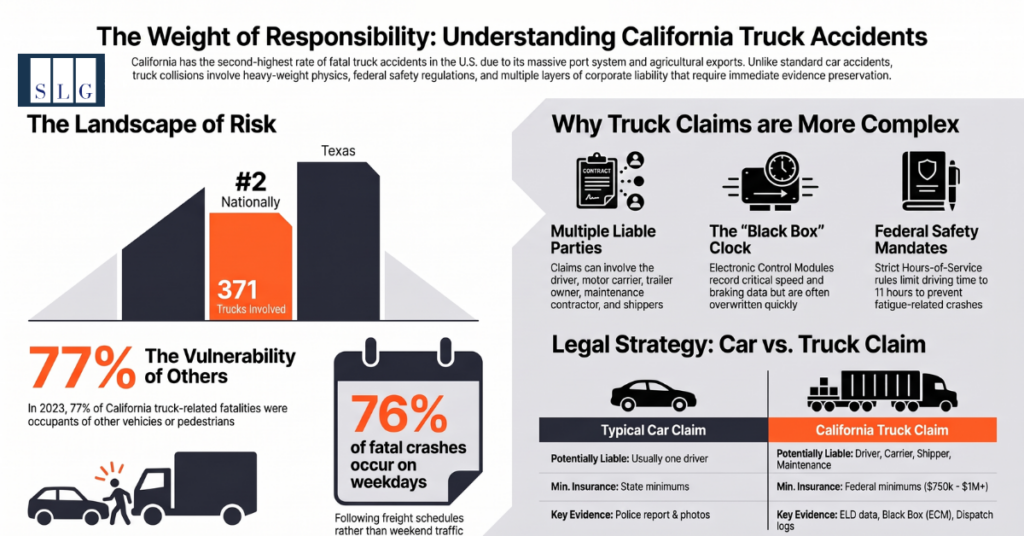
California accounted for 371 of those 5,375 trucks, or about 6.6 percent of the national total, second only to Texas at 705. The breakdown of who dies is the part most people get wrong. Of the 392 people killed in California large-truck crashes in 2023, 304 were occupants of other vehicles, 62 were pedestrians or cyclists, and 26 were occupants of the trucks themselves. California was one of only three states, alongside Texas and Florida, where more than 50 pedestrians and cyclists were killed in large-truck crashes.
Nationally, the same pattern holds. Seventy percent of the people killed in large-truck crashes in 2023 were in other vehicles, 12 percent were pedestrians or cyclists, and 18 percent were truck occupants. When a semi and a passenger car collide, physics decides the outcome before anyone touches the brakes.
Where and When Truck Accidents Happen
Federal data shows these crashes are not evenly distributed across the map or the calendar. Fifty-five percent of fatal large-truck crashes in 2023 happened in rural areas, and 25 percent happened on interstates. That combination points at long-haul corridors rather than city streets, which in California means routes like Interstate 5 through the Central Valley and Interstate 10 heading east out of the Inland Empire.
Timing follows freight schedules rather than weekend traffic. Seventy-six percent of fatal large-truck crashes occurred on weekdays, between 6 a.m. Monday and 5:59 p.m. Friday. This is the opposite of the pattern for passenger vehicle fatalities, which cluster on weekends and at night.
Within California, collision volume tracks population and freight density. The California Office of Traffic Safety crash rankings let you compare cities and counties directly, and Los Angeles County consistently records the highest raw collision numbers in the state. That is a function of size and traffic volume rather than unusually dangerous roads, and it is why so much of this litigation runs through Los Angeles courts.
What Causes Truck Accidents in California
Understanding how truck accidents happen can help drivers avoid getting involved in one. Defensive driving and awareness of truck limitations go a long way toward keeping you and your passengers safe.
Large trucks require far greater distance to stop, so cutting one off in traffic increases your chances of being rear-ended by a vehicle that physically cannot slow down in time. These trailers also carry much larger blind spots, which means that if you are traveling close alongside one, there is a good chance the driver cannot see you at all. Riders face the same problem in even sharper form, as our California motorcycle accident practice sees regularly.
On the truck’s side, the recurring causes are familiar. Reckless or negligent driving covers speeding and failing to signal a lane change. Driving under the influence of drugs or alcohol appears in a smaller share of truck crashes than you might expect, since only 4 percent of large-truck drivers in fatal crashes in 2023 had a blood alcohol concentration at or above .08, compared with 24 percent of passenger car drivers.
Distracted driving, including phone use behind the wheel, remains a persistent factor. Improperly maintained vehicles cause their own category of crash, particularly failed brakes and tire blowouts. Fatigue rounds out the list, and drowsy driving impairs reaction time in ways comparable to alcohol.
One federal statistic cuts against the assumption that truck drivers are uniformly reckless. Drivers of large trucks involved in fatal crashes in 2023 were less likely than any other vehicle group to have prior license suspensions or revocations, at 6.4 percent compared with 12.2 percent for passenger car drivers. The problem is less about outlier drivers and more about weight, distance, and schedule pressure.
Federal Regulations That Govern Truck Drivers
The Federal Motor Carrier Safety Administration regulates commercial truck safety, including how long drivers may operate before a mandatory rest period and the qualifications required to obtain and keep a commercial driver’s license.
The hours-of-service limits are specific, and they matter enormously in litigation. Under 49 CFR 395.3, a driver of a property-carrying vehicle may not drive without first taking 10 consecutive hours off duty, may not drive after a period of 14 consecutive hours following that rest, and may drive no more than 11 hours within that window. A driver must also take a 30-minute break once 8 hours of driving time have passed. On top of the daily limits, a driver may not operate after 60 hours on duty in 7 consecutive days, or 70 hours in 8 consecutive days for carriers running every day of the week.
These numbers create a paper trail. Electronic logging devices record duty status automatically, which means a driver who exceeded the 11-hour limit generally cannot hide it, provided the records are demanded before the carrier’s retention period expires.
Although a passenger car driver carries responsibility for defensive driving, a truck driver who violates safety standards or otherwise operates the vehicle recklessly or negligently carries responsibility for the crash and the resulting injuries.
Who Can Be Held Liable After a California Truck Accident?

This is where truck cases diverge sharply from ordinary car accident claims. A collision with a passenger vehicle usually involves one negligent driver and one insurance policy. A collision with a commercial truck can involve half a dozen potentially responsible parties, each with separate counsel and separate coverage.
The driver is the obvious defendant. The motor carrier that employs the driver is usually the more significant one, both because it carries far larger policy limits and because it may be directly negligent in its own right through negligent hiring, inadequate training, or pressuring drivers to run past their hours. The company that owns the trailer may be separate from the carrier. A maintenance contractor may have serviced the brakes. A shipper or loading company may have loaded the cargo improperly, causing a rollover. A parts manufacturer may be liable if a tire or coupling failed.
Michael Saeedian, who founded our firm and has handled these cases for more than 16 years, points to the timing problem. “The truck’s electronic control module holds speed, braking, and throttle data from the seconds before impact, and carriers are not required to preserve it forever. We send a spoliation letter within days, because a case built on the black box is a different case from one built on memory.”
How a Truck Claim Differs From a Car Accident Claim
The table below compares the two, because the differences drive nearly every strategic decision in a truck case.
| Feature | Typical car accident claim | California truck accident claim |
| Potentially liable parties | Usually one driver | Driver, motor carrier, trailer owner, maintenance contractor, shipper, parts manufacturer |
| Insurance available | State minimum liability upward | Federal minimums start at $750,000 and commonly reach $1 million or more |
| Governing rules | California Vehicle Code | Vehicle Code plus the Federal Motor Carrier Safety Regulations |
| Key evidence | Police report, photos, witness accounts | All of that, plus electronic logging data, the engine control module, maintenance files, driver qualification file, and dispatch records |
| Evidence risk | Low, most records persist | High, carrier records are subject to retention limits and can be overwritten |
| Investigation | Often handled by adjusters | Carrier rapid response teams frequently reach the scene within hours |
That last row is the one injured people underestimate. Major carriers dispatch investigators and defense counsel to serious crash scenes the same day, while the injured person is still in an emergency room.
What Should You Do After a Truck Accident?
Your safety and that of your passengers comes first. Beyond that, the following sequence protects both your health and any future claim.
Step 1: Call 911 and Accept Medical Evaluation
Request medical assistance immediately. A local police officer will also respond, and injuries from a heavy-vehicle impact frequently present hours or days later, so accept evaluation even if you feel able to walk away.
Step 2: Let the Officer Document the Scene
Responding officers collect road conditions, witness statements, and an analysis of the likely cause. The official collision report becomes foundational evidence for building a case against the at-fault party.
Step 3: Photograph What the Report Will Not Capture
Photograph the truck’s cab and trailer from several angles, including any company name, USDOT number, and license plates. Those identifiers establish which carrier operated the vehicle, which is not always obvious and is occasionally disputed later.
Step 4: Collect Witness Contact Information
Independent witnesses matter more in truck cases because commercial defendants contest liability more aggressively. Get names and phone numbers before people disperse.
Step 5: Do Not Give a Recorded Statement
The carrier’s insurer may call within a day. You are not obligated to give a recorded statement, and doing so before you understand the extent of your injuries rarely helps you.
Step 6: Contact an Attorney Promptly
The evidence that decides truck cases sits in the carrier’s possession and is subject to retention limits. A preservation demand has to go out early to be effective.
Step 7: Track Every Cost and Symptom
Keep medical records, bills, repair estimates, proof of lost income, and a simple daily note on pain and limitations. Contemporaneous records carry more weight than recollection months later.
How Long Do You Have to File a Truck Accident Claim in California?
California generally allows two years from the date of injury to file a personal injury lawsuit, and two years from the date of death for a wrongful death claim. The exception that catches people out involves government defendants. If a public entity vehicle or a dangerous road condition contributed to the crash, you must present a written government claim within six months before you can file suit at all. Because commercial cases often reveal additional defendants during investigation, the practical deadline for starting work is far earlier than the legal one.
Who Should You Call After a California Truck Accident?
Most people do not walk away from a collision thinking about hiring a lawyer, and that is understandable. What makes commercial truck crashes different is that the other side is already working. The carrier’s investigators, adjusters, and defense counsel are assembling their version of events while you are still being treated, and the records that would support your version sit on their servers.
Our attorneys at Saeedian Law Group handle these claims from our Beverly Hills office and throughout California, including our Los Angeles truck accident practice. We identify every party that may share responsibility, demand preservation of the carrier’s electronic and paper records, and work with reconstruction specialists where liability is contested. We take these cases on contingency, so there is no cost to you unless we recover on your claim. Contact us for a free consultation and bring the collision report if you have it.
Frequently Asked Questions
This section provides answers to common questions about truck accidents in California.
Which State Has the Most Semi Truck Accidents?
Texas. In 2023, 705 large trucks were involved in fatal crashes in Texas, which is 11.4 percent of the national total and roughly double California’s 371. Texas also recorded the highest number of large-truck occupants killed at 153, the highest number of other-vehicle occupants killed at 493, and the highest number of pedestrians and cyclists killed at 84. California ranks second on nearly every one of these measures, with Florida close behind.
Where Do Most Accidents Happen in California?
By raw volume, Los Angeles County records the most collisions of any county in the state, which reflects its population and traffic density rather than uniquely hazardous roads. For fatal truck crashes specifically, the federal pattern points away from cities. Fifty-five percent of fatal large-truck crashes nationally occurred in rural areas, and 25 percent occurred on interstates, which in California means the long freight corridors through the Central Valley and the Inland Empire. The Office of Traffic Safety publishes rankings that let you compare your own city or county directly.
What Is the Deadliest State to Drive In?
It depends on how you measure. By total deaths, Texas and California lead because they are the largest states with the most drivers and the most miles traveled. By rate, meaning deaths per capita or per mile driven, the picture reverses and largely rural states in the South and Mountain West rank highest, since higher speeds, longer emergency response times, and lower seat belt use all push fatality rates up. A raw count tells you where the most crashes occur. A rate tells you where a given trip carries more risk.
What Is the Leading Cause of Accidents in California?
Unsafe speed is consistently recorded as one of the leading primary collision factors in California crash data, appearing in more collisions than any other single cause. Speed compounds every other risk, since it lengthens stopping distance and increases the force of impact. For heavy commercial vehicles, the effect is amplified because an 80,000-pound truck traveling even slightly too fast for conditions needs considerably more room to stop than the driver behind it expects. Impaired driving, distraction, and improper turning follow as recurring factors.
Legal disclaimer: This article is provided for general informational purposes only and does not constitute legal advice. Reading it does not create an attorney-client relationship with Saeedian Law Group. Crash statistics cited reflect the reporting years indicated and may change as data is updated. Prior results do not guarantee or predict a similar outcome in any other matter, and every case depends on its own facts. Consult a licensed California attorney about your situation. This content is published by Saeedian Law Group, a California law firm with an office in Beverly Hills, California.

Michael Saeedian founded Saeedian Law Group in 2009 with the goal of providing injured individuals and their loved ones with caring, personalized, and attentive legal representation.