
Yes, health insurance generally covers motorcycle accident injuries, including emergency care, hospital stays, and rehabilitation. However, insurance coverage can come with restrictions, delays, or exclusions depending on your policy and other insurance options available.
If you or your loved ones have been involved in a motorcycle accident, dealing with medical bills can make recovery even harder. The financial strain of treatment, hospital stays, and rehabilitation can be overwhelming, which is why understanding your insurance coverage is so important.
At Saeedian Law Group, we’ve helped personal injury victims in California recover more than $100 million in compensation. With over 16 years of experience, our motorcycle accident lawyers can help you maximize health insurance policies, negotiate with insurers, and challenge unfair denials. Reach out to us today for a free consultation and let us fight for the compensation you deserve.
In this blog, we’ll walk you through what health insurance covers after a motorcycle accident, what it doesn’t cover, and how other types of insurance can help protect you.
Will Health Insurance Cover Motorcycle Accident Injuries?
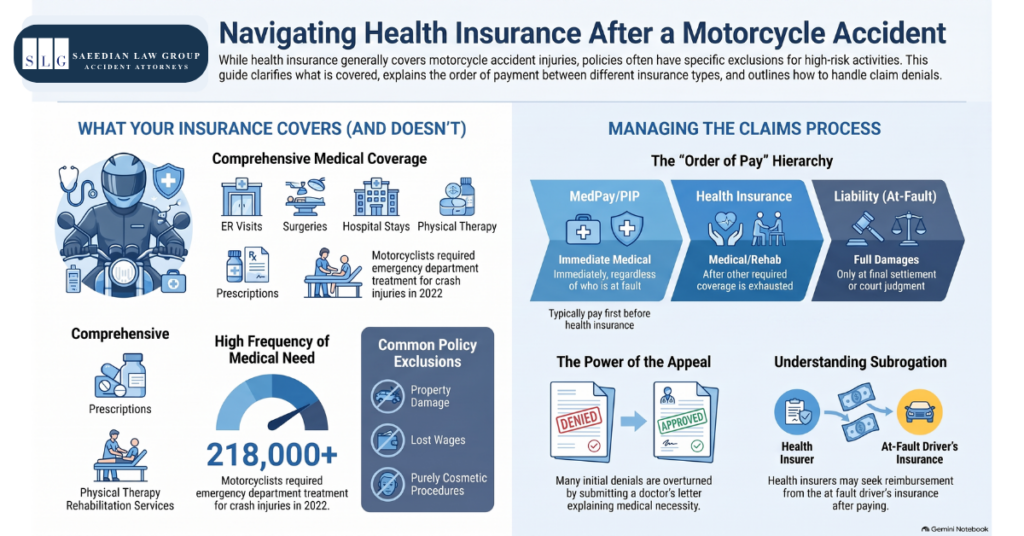
Yes, health insurance can cover motorcycle accident injuries, just as it does for illnesses or other types of accidents. In 2024,6,228 motorcyclists were killed in traffic crashes in the United States, accounting for 16% of all traffic fatalities. Also, in 2022, more than 218,000 motorcyclists were treated in U.S. emergency departments for crash injuries, showing how frequently these accidents require medical attention. Most health insurance plans are designed to help pay for necessary medical treatments, surgeries, rehabilitation, and even follow-up care.
However, some policies may impose certain restrictions if the policies categorize motorcycle riding as a high-risk activity. Such exclusions are more common with specialized or short-term health insurance plans. In addition, because motorcycle accidents often lead to severe or costly injuries, insurers may investigate claims more carefully and coordinate with other available coverage to manage their payouts.
In cases where another driver was at fault, your health insurance may initially cover your medical expenses. But later, they may seek reimbursement from the at-fault driver’s auto insurer through a process called subrogation. Although this doesn’t stop you from receiving treatment, it can complicate the order in which different insurers pay.
What Does Health Insurance Cover After a Motorcycle Accident?
Health insurance typically covers the medical care you need after a motorcycle accident, beginning at the roadside and continuing through recovery. Emergency treatment is covered, which includes ambulance transport, the emergency room visit, diagnostic scans such as X-rays, CT, and MRI, and initial stabilization. Hospitalization follows, covering surgeries, ICU care, medications, and overnight stays if they are required.
Once you are discharged, your plan should continue paying for follow-up medical care such as doctor visits, wound care, and specialist consultations. Rehabilitation services are covered as well, including physical therapy, occupational therapy, and speech therapy when brain or spinal injuries are involved. Prescription medications that manage pain, prevent infection, or support long-term recovery fall under your plan, as does medical equipment like crutches, braces, or wheelchairs when a doctor prescribes them as part of your treatment.
What Health Insurance Will Not Cover After a Motorcycle Accident
Sometimes, there are clear limits on what health insurance will not cover for motorcycle accident injury victims. Understanding these exceptions is important since you might need other types of insurance or legal claims to handle them.
Property damage is the first gap. Repairs or replacement of a motorcycle damaged in an accident fall under your auto insurance or the at-fault driver’s liability coverage, not your health plan. Lost income is the second, and to recover lost wages you would need disability insurance or compensation through a legal claim.
Pain and suffering or emotional distress form a third category, and these liability claims are typically pursued through a personal injury lawsuit or a settlement with the responsible driver’s insurance company. Purely cosmetic or optional procedures round out the list, because if a surgery is for appearance only, such as removing a scar that doesn’t affect mobility or health, most plans classify it as elective and may deny coverage.
Even within medical treatment, health insurance may not fully cover certain services like experimental therapies, alternative treatments, or long-term nursing care if they fall outside your plan’s benefits
Sometimes, even when coverage applies, your medical insurance may insist that other available benefits, such as MedPay or Personal Injury Protection, are used first before your health plan begins paying.
However, there are also other gray areas that health insurance may or may not cover, depending on medical necessity. An example is elective surgery. If the surgery is considered medically necessary, health insurance will typically cover it. But most insurers may require documentation from your doctor showing that the procedure is essential for recovery.
When Can Coverage Be Denied for Motorcycle Accident Claims?
There are situations where a health insurance company can deny or limit payment for motorcycle accident claims. These denials generally fall into three categories – policy exclusions, coordination of benefits, and claim issues.
Policy Exclusions
Short-term or limited health insurance policies may not cover injuries from high-risk activities, including motorcycle riding. Although most standard health insurance doesn’t single out motorcycle accidents, some of these limited plans do. Similarly, if you were riding without a helmet in a state where it’s required by law, some health insurance companies may limit payouts based on contributory negligence, especially in liability claims.
Coordination of Benefits
If you have MedPay or PIP on your motorcycle policy, your health insurance coverage may refuse to pay until you use up those benefits first. Additionally, if another driver caused the accident, your own health insurance might still cover your treatment initially. But they’ll later seek repayment from the at-fault driver’s insurer.
For example, if the at-fault driver is on duty for a public entity, such as a public city bus, you may have to recover damages through a bus accident claim. Remember that personal injury claims against a government agency must follow the California Tort Claims Act (CTCA) (please check the comment I added to this, about linking).
Similarly, your insurer may seek repayment for health coverage from the at-fault party if the motorcycle injuries involved a car accident. To make these claims faster and more successful, it’s best to work with a car accident attorney or a personal injury lawyer.
Claim Issues
If your policy lapsed for non-payment, your insurer may reject the claim for coverage. In the same vein, if you were using your motorcycle for commercial purposes, like delivery, without proper coverage, they may also reject the claim. Additionally, the claim can be rejected if you engaged in illegal activity, such as reckless speeding or DUI.
What to Do If Health Insurance Denies Coverage
If your medical insurance denies coverage after a motorcycle accident, you can challenge the denial. But to successfully overturn the decision, you must understand the right actions to take and when to take them.
Start by reviewing the denial letter carefully. The health insurance policy must explain why they denied the claim. Common reasons include policy exclusions, lack of medical necessity, coordination of benefits with motorcycle insurance, or missing documentation. Whatever the case, make sure you understand the reason before taking any further steps.
Next, gather all relevant documentation. Get your medical records, accident report, doctor’s notes, and any correspondence with the insurer. If the denial was due to missing paperwork, resubmitting complete documentation may resolve the issue quickly.
It’s always helpful to consult with a motorcycle accident or insurance attorney early in the process. They can evaluate whether the denial was lawful and help you pursue further appeals or legal remedies. They can also coordinate with your motorcycle insurance or the at-fault driver’s insurer to recover costs if your health plan refuses payment.
Michael Saeedian, who founded our firm and has represented injured riders for more than 16 years, sees the same pattern every week. “A denial letter is an opening position, not a verdict. Most riders read one, assume the door is shut, and never appeal. The ones who send a doctor’s letter explaining medical necessity often get the same claim paid within weeks.”
The next step is to request an internal appeal. Most insurers have an internal appeals process. You can submit a written appeal with supporting evidence, such as a letter from your doctor explaining why the treatment is necessary. Most times, you have to adhere to their strict deadlines, usually 30–180 days, so act promptly.
If the internal appeal is unsuccessful, you may have the right to request an external review by an independent third party. Under the Affordable Care Act (ACA), insurers must accept the decision of the external reviewer, which cannot be influenced by the insurance company.
If health insurance will not pay after all these efforts, you might have to explore alternative coverage options. Check whether your motorcycle insurance includes MedPay or PIP. If another driver was responsible, their liability coverage may ultimately pay for your medical expenses, even if your health insurer denied the initial claim.
What are the Common Injuries in Motorcycle Accidents?
Motorcycle accidents tend to cause more severe injuries than car accidents because riders have little physical protection. Head and brain injuries are the most serious, and traumatic brain injuries, concussions, and skull fractures occur frequently, especially when riders are not wearing helmets. Even with a helmet, a severe impact can cause long-term brain damage.
Spinal cord and back injuries are also common, and damage to the spine can lead to herniated discs, chronic pain, or even paralysis, with significant effects on the victim’s mobility and quality of life. Fractures and broken bones follow, because the rider’s body often hits the ground or another object directly, which leaves the arms, legs, ribs, and pelvis vulnerable.
Road rash and soft tissue damage occur when a rider’s skin scrapes along the pavement, producing deep abrasions that may lead to infections or nerve damage and can cause permanent scarring if not properly treated. Internal injuries complete the picture, since the force from direct hits on objects can damage organs such as the lungs, liver, or kidneys. Internal bleeding is particularly dangerous because it might not be obvious right after the crash.
How Does Motorcycle Insurance Affect Your Medical Bills?
In California, MedPay coverage on your motorcycle insurance policy can help cover your medical bills immediately after the accident. MedPay usually pays for ambulance rides, ER treatment, hospital stays, and sometimes funeral expenses, no matter who caused the accident. The benefit is that these funds are available right away, which can reduce the amount you need to claim through your health insurance.
Moreover, if another driver was at fault, their liability insurance may ultimately be responsible for your medical expenses. If you only carry liability coverage on your motorcycle and no MedPay, your health insurance will usually be your primary safety net, leaving you responsible for deductibles, co-pays, and costs outside your policy.
Meanwhile, some states allow or require PIP on no-fault auto insurance. For instance, the Washington State Office of the Insurance Commissioner states that insurance companies must offer PIP as an optional coverage. This gives individuals the option to buy or reject it in writing.
PIP goes further than MedPay because it may also cover lost wages and certain rehabilitation costs. If you have PIP, it often pays before your health insurance does, helping you avoid large upfront bills. However, note that PIP only applies to a car insurance claim in most cases.
Which Policy Pays Your Medical Bills First?
Most riders have more than one source of payment available and do not realize it. The order in which those sources pay changes how much comes out of your own pocket and how long you wait. The table below compares the options.
| Coverage | What it pays for | When it pays | Does it depend on fault? | Do you repay it? |
| Health insurance | Emergency care, surgery, hospital stays, rehabilitation, prescriptions | After other required coverage is exhausted, subject to deductible and co-pays | No | Often yes, through subrogation against the at-fault driver |
| MedPay on your motorcycle policy | Ambulance, ER, hospital care, sometimes funeral expenses | Immediately, with no deductible in most policies | No | Usually no |
| Personal Injury Protection | Medical bills plus lost wages and some rehabilitation costs | Before health insurance, where the state allows it | No | Usually no |
| At-fault driver’s liability coverage | Medical bills, lost income, property damage, pain and suffering | At settlement or judgment, often months later | Yes | No |
| Disability insurance | A portion of lost income while you cannot work | After a waiting period set by the policy | No | No |
The practical takeaway is that MedPay and PIP pay fastest, health insurance carries the largest bills but usually wants reimbursement later, and only the at-fault driver’s liability coverage reaches the losses no medical plan touches.
How Do You File a Motorcycle Accident Insurance Claim?

To file a successful motorcycle accident claim, you need to understand the right steps to take and what to look out for. Here, we’ve provided a comprehensive step-by-step guide to help you.
Step 1: Seek Medical Attention First
You should prioritize your health and safety before the claim. Even if the injuries seem minor, seek medical attention immediately for a proper check-up. Meanwhile, getting medical records right after the motorcycle crash can serve as essential evidence for your insurance claim.
Step 2: Notify Your Insurance Company Promptly
It’s important to notify your health insurance provider immediately after the accident. If your motorcycle was damaged, contact your auto insurance company too. Provide basic details like the time, place, and parties involved, but avoid admitting fault when you first report the claim.
Step 3: Gather and Preserve Evidence
Take photos of the accident scene, your motorcycle, other vehicles, road conditions, and visible injuries. You should also gather witness contact information and request a copy of the police report. This documentation strengthens your claim and helps in cases of liability dispute.
Step 4: Consult With a Motorcycle Accident Attorney
An experienced motorcycle accident lawyer or personal injury attorney can explain your rights and protect you from unfair insurance practices. They also help maximize compensation if another party was at fault. In addition, they handle communication with the at-fault driver’s insurance so you can focus on recovery.
Step 5: Submit the Claim with Supporting Documents
Your insurer will guide you through the paperwork. You’ll usually need to provide a copy of the police report, medical bills and records, repair estimates for your motorcycle, proof of lost wages, etc. Some insurers allow online uploads, while others require mailed or faxed documents.
Step 6: Work with the Adjuster
An insurance adjuster will investigate your claim, review records, and may inspect your motorcycle. Cooperate fully, but be careful not to give statements that downplay your injuries or suggest that you’re at fault.
Step 7: Follow Up Until Resolution
You should stay in contact with your insurers and respond to requests for information quickly. Once the investigation is complete, the insurer will issue payment or explain any denial. If you disagree, you can appeal or pursue legal options.
Step 8: Keep Copies of Your Records
Maintain organized files of every bill, medical report, insurance form, and communication. They can come in handy if you need to seek compensation through a personal injury lawsuit or settlement.
Need Guidance on Motorcycle Accident Insurance?
Suffering an injury in a motorcycle accident can change your life in an instant, and the cost of treatment can add to the financial burden. If you’re wondering, does health insurance cover motorcycle accident injuries? The short answer is yes. But while it can cover much of your medical care, it doesn’t cover everything, and knowing where its limits end is key to protecting your finances.
If you’ve been hurt in a motorcycle accident, don’t try to handle the insurance process on your own. Our personal injury lawyers at Saeedian Law Group are committed to guiding you through the claims process and fighting for the compensation you deserve. Contact us today for a free consultation and let our skilled attorneys guide you every step of the way.
Frequently Asked Questions (FAQ)
With more than 16 years of experience in working with motorcycle accident victims, our personal injury lawyers at Saeedian Law Group have provided comprehensive answers to the most common questions you may have about medical coverage, insurance responsibilities, and costs.
What Types of Injuries From Motorcycle Accidents Are Usually Covered by Health Insurance?
Medical insurance covers emergency care, hospital stays, surgeries, rehabilitation, and prescription medications. This includes common injuries such as broken bones, traumatic brain injuries, spinal cord damage, and road rash. For an auto insurance claim, you may have to refer to your auto insurance provider.
What Other Insurance Options Can Help Cover Motorcycle Accident Injuries?
Motorcycle insurance can include MedPay or PIP, which help pay medical bills and sometimes lost wages. If the accident was not your fault, the at-fault driver’s liability insurance may cover your treatment. Disability insurance or a personal injury claim may also provide compensation beyond what health insurance pays.
Do Motorcycle Insurance Rules Vary by State?
Yes, rules differ significantly by state. Some states allow or require PIP coverage on motorcycle policies, while others make it optional or unavailable. State helmet laws and liability thresholds also affect how claims are handled and who pays for medical expenses.
What Are Typical Medical Costs After a Motorcycle Accident?
Costs vary widely, but serious accidents can easily exceed tens of thousands of dollars. Emergency room visits, surgery, and hospital stays often cost around $20,000–$50,000 or more, while severe cases involving brain or spinal injuries can exceed $100,000. Rehabilitation and long-term care add even more to the total.
Who Pays if You’re at Fault in a Motorcycle Accident?
If you’re at fault, your health insurance generally covers your medical treatment, subject to your coverage limits and cost-sharing rules. Your liability coverage on your motorcycle policy would pay for the other party’s injuries or damages. Without MedPay or PIP, you may have higher out-of-pocket payments.
Will My Health Insurance Cover Me in a Motorcycle Accident?
In most cases, yes. Standard health insurance does not exclude motorcycle accidents and will cover your hospital bills, surgeries, and rehabilitation. However, you’ll still be responsible for non-medical costs, deductibles, co-pays, and coinsurance.
How Much Are Most Motorcycle Accident Settlements?
Settlement amounts depend on the severity of injuries, fault, medical expenses, and lost wages. Minor injury cases may settle for $10,000–$30,000, while severe cases involving permanent disability or catastrophic injuries often reach hundreds of thousands or even millions. Every case is unique, so outcomes vary widely.
Legal disclaimer: This article is provided for general informational purposes only and does not constitute legal advice. Reading it does not create an attorney-client relationship with Saeedian Law Group. Insurance policy terms, coverage requirements, and California law vary and change over time, and the outcome of any claim depends on its specific facts. Prior results do not guarantee a similar outcome. Consult a licensed California attorney about your situation.

Michael Saeedian founded Saeedian Law Group in 2009 with the goal of providing injured individuals and their loved ones with caring, personalized, and attentive legal representation.