
If you’ve been injured in a rear-end collision, you may be wondering how much your case is worth. There is no fixed average settlement because every accident is different. Factors like your injuries, medical bills, lost income, and who was at fault can affect the amount you receive. A personal injury attorney will listen to your situation and expertly evaluate your claim.
At Saeedian Law Group, our attorneys are dedicated to the rights of injured Californians and will give you the individualized attention and care you deserve. With over 16 years of experience, we understand what it takes to build a strong case and fight for the compensation you deserve. Contact us today for a free case evaluation.
This article focuses on the average settlement for a rear-end collision, key factors influencing settlement value, and steps to take to maximize your settlement.
What Is an Average Settlement for a Rear-End Car Accident?
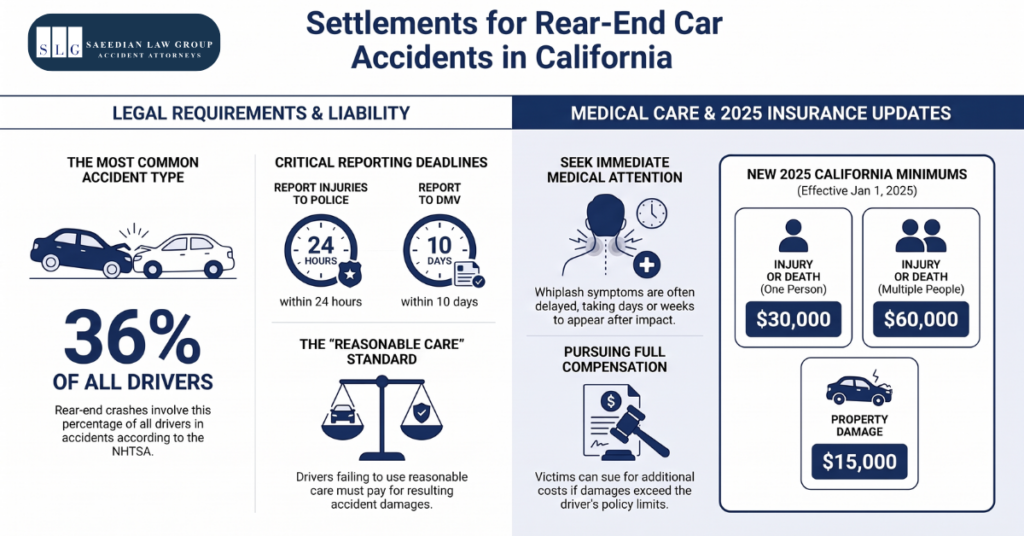
According to the NHTSA, rear-end collisions are the most frequently occurring type of car accident. Of all drivers experiencing a crash in 2000, 36% were involved in rear-end crashes. After a car accident, you should first report the accident to law enforcement. The law requires drivers to report accidents involving injuries to the city police or California Highway Patrol within 24 hours. You must also report the accident to the DMV within 10 days. Then you should seek medical care.
Injuries like whiplash are common in rear-end collisions and often do not appear until days or weeks after a crash. Your health insurance should help with emergency care until the at-fault party is identified.
Next, California law requires the driver who failed to drive with reasonable care to pay for the damages they caused. The police, the insurance companies, or the courts decide each driver’s share of the responsibility. When you file a claim with the at-fault driver’s insurance, they will likely offer you an amount to settle out of court.
Every California auto insurance policy must include at least $30,000 in coverage for the injury or death of one person. It must also include $60,000 for more than one person in an accident, and $15,000 for property damage. These minimums rose on January 1, 2025, up from the old 15/30/5 limits. If your costs exceed the at-fault driver’s policy limits, you can sue them for additional costs. The insurance company’s settlement offer should compensate you for all the damages caused by the at-fault driver but will not often exceed the policy limits.
Factors Influencing the Average Settlement for a Rear-End Collision in California

Several factors shape the settlement value of a rear-end collision claim. Injury severity is the most significant factor. A minor case with soft tissue injuries settles for far less than a crash that causes permanent injuries or catastrophic injuries.
Medical treatment timing is also important. If you seek medical attention right away and follow your treatment plan, your medical records tie the injury to the crash. Gaps in care give the insurance company a reason to question your claim.
Fault is another key factor. California uses a pure comparative negligence system, so your share of blame reduces your recovery. Clear evidence, such as the police report, witness statements, and photos from the accident scene, helps prove the rear driver caused the crash.
Common Types of Injuries in Rear-End Collisions and Their Settlement Ranges
Rear-end crashes cause a wide range of harm. Whiplash and other soft tissue injuries are the most common, but severe injuries also happen. The injury type strongly affects settlement value, because more serious injuries mean higher medical costs and longer recovery.
The table below shows typical settlement ranges, illustrative only. It is not a promise of value. Real settlement amounts depend on injury severity, treatment, liability, and the at-fault driver’s insurance. Two similar cases can settle for very different amounts.
| Injury Type | Severity | Illustrative Settlement Range | Notes |
| Whiplash / soft tissue damage | Minor to moderate | $5,000 to $50,000 | Often resolves with physical therapy |
| Back and neck injuries | Moderate to severe | $50,000 to $300,000 | Herniated discs raise the value |
| Nerve damage | Moderate to severe | $75,000 to $350,000 | Depends on lasting symptoms |
| Traumatic brain injuries | Severe | $250,000 to several million | Long-term care drives value |
| Spinal cord injuries / permanent disability | Catastrophic | $1 million and up | Lifetime care and lost income |
Past results do not guarantee future outcomes. Every rear-end collision case turns on its own facts. For example, in a 2021 San Diego whiplash case, a jury awarded about $10,000. In April 2025, a Los Angeles jury awarded $32.8 million to a man rear-ended at 65 mph. He needed spinal fusion and had a brain injury.
Back and Neck Injuries Settlement Examples
In rear-end collision cases, back and neck injuries are among the most common results. A whiplash strain may resolve in a few weeks and settle for a few thousand dollars. A herniated disc that needs injections or surgery sits much higher, with extensive medical bills. Multiple spinal injuries, or a serious back injury with chronic pain, can push a settlement into six figures or more.
What Should the Average Settlement for a Rear-End Collision Cover?
Before accepting any insurance settlement, you should consider what damages you can recover if you file a lawsuit against the at-fault driver. As Daniella Saeedian, a personal injury attorney plainly puts it “You only have one chance to settle your claim. Make sure you know what it’s really worth first.” The law allows you to receive compensation for the economic and non-economic damages you sustained in the accident.
Economic damages typically cover your past and future medical expenses and lost wages if you miss work. They also cover lost income and lost earning capacity if you cannot work as before. You can recover the cost of car repairs, vehicle repairs, or replacement costs. That includes the loss of use of your car while it is repaired. The loss of your ability to provide household services counts too.
The compensation for damage to your vehicle can be either the amount necessary to repair the vehicle or the vehicle’s actual cash value (ACV), depending on the policy. You may also experience other losses that are not as easy to quantify, called non-economic damages.
Non-economic damages should compensate you for harm that is harder to measure. This includes past and future physical pain, mental suffering, and loss of enjoyment of life. It also covers disfigurement, physical impairment, inconvenience, grief, anxiety, humiliation, and emotional distress. A pain and suffering claim covers your physical pain and mental suffering. These pain and suffering damages are real losses under California law. A rear-end crash can leave both emotional and physical distress.
If the settlement offer does not fairly compensate you for these damages, you should not accept it. Instead, you should contact an attorney with experience to negotiate with the insurance companies. You are entitled to a fair settlement.
What If I’m Partially at Fault for an Accident?
Any driver who fails to drive with reasonable care can be at fault for an accident. California law follows pure comparative fault when it comes to responsibility. Pure comparative fault means that you can still recover damages caused by another driver even if you are partially at fault. Your percentage of fault will reduce the amount the other party must pay.
For example, consider your damages from the accident are $100,000. If you are 10% at fault and the striking driver is 90% at fault, the striking driver will pay only $90,000 of the damages. Keep in mind that if your insurance company determines that you are 51% or more at fault, your premium may go up when you renew your policy.
How Long Do I Have to Consider a Settlement Offer?
You can decide to take the first settlement offer you receive, but your damages are likely still accruing. If you have filed a lawsuit and the insurance company offers a settlement, the offer will expire within 30 days or on the day of trial. If you have not yet filed a lawsuit, California requires you to file a claim for personal injury within two years of the accident. Once you accept a settlement offer, you cannot change your mind. The insurance company then has 30 days to pay you the agreed-upon amount.
How to Maximize Your Rear-End Collision Settlement in California

A strong claim is built, not found. What you do after the crash shapes how much you can recover. These steps help protect the value of your rear-end collision claim.
1. Seek Medical Attention Early
See a doctor the same day if you can. Whiplash and soft tissue damage often surface days later. Prompt care links your injuries to the crash and starts the medical records that support your claim.
2. Document Everything
Save medical bills, proof of lost income, and repair estimates for your car. Photos of the accident scene, the police report, and witness statements all strengthen your case. A journal of your daily pain helps show the human cost.
3. Get Experienced Legal Representation
Insurers handle car accident claims and personal injury claims every day, and you likely do not. Experienced legal representation levels the field. A personal injury lawyer values your claim, handles settlement negotiations, and knows when an offer is too low.
4. Avoid Common Mistakes
Some choices quietly shrink a car accident settlement. Do not delay medical treatment, skip appointments, or post about the crash online. Do not give a recorded statement or accept the first offer before you understand the full extent of your injuries.
5. Know When to File Suit
Most claims settle, but not all. When an insurer refuses fair compensation, filing a personal injury lawsuit can push it to negotiate. Your attorney can advise you on the legal process and the right time to act.
How Can Saeedian Law Group Help After an Accident?
The true value of your damages is likely more than the average settlement for a rear-end collision in California. Only an experienced attorney can advise you on the value of your claim. Nonetheless, you have the right to recover fully for the damages you sustain in an accident.
At Saeedian Law Group, we refuse to sell any case short. We recognize that every client’s case is unique and deserves individual attention and care. Our record shows over $12 million in verdicts & settlements recovered for our clients, including convincing insurance to pay policy limits. Call us for a free consultation today, and let us negotiate with the insurance company while you focus on healing.
Frequently Asked Questions
This sectionprovides answers to common questions about average settlements for rear-end collisions in California.
How Much Can I Expect from a Bad Rear-End Accident?
There is no fixed number. A bad rear-end accident with severe injuries can settle for six or seven figures. Car accident settlement amounts vary widely. Injury severity, treatment, liability, and insurance coverage all shape the final settlement value.
What Is a Good Settlement Offer for a Back Injury?
A good offer covers all your losses, not just your current medical bills. It should account for future medical care, lost income, and pain and suffering. A minor strain settles far lower than a herniated disc that needs surgery.
What Should I Do with a $500,000 Settlement?
First, pay any medical liens and legal fees from the settlement. Then plan for future medical costs tied to your injuries. Many accident victims speak with a financial advisor about a structured settlement for long-term needs.
How Much Will I Get from a $50,000 Settlement?
A $50,000 settlement is not what lands in your pocket. Medical bills, liens, and attorney fees come out first. What remains depends on those costs. A figure like this often reflects moderate injuries or minor injuries treated without surgery.
Disclaimer: This blog is for informational purposes only and is not legal advice. Reading this content or contacting Saeedian Law Group does not create an attorney-client relationship. Past results do not guarantee future outcomes. Every case is different.

Michael Saeedian founded Saeedian Law Group in 2009 with the goal of providing injured individuals and their loved ones with caring, personalized, and attentive legal representation.