

Imagine you’re injured because a city bus ran a red light or your car is damaged by an unmarked pothole on a state highway. In such situations, when the responsible party is a government agency, you can file a claim for damages under the California Tort Claims Act (CTCA).
The CTCA governs how and when you can seek compensation from public agencies or government employees, including cities, counties, and state agencies. So, you need to understand how this law works before taking legal action against a public entity.
At Saeedian Law Group, we’ve helped individuals affected by personal injury in California recover over $100 million in compensation. With 16+ years of experience, our team of expert personal injury lawyers can help you file a claim under the CTCA or represent you in court to get the compensation you deserve. Book a free consultation with us today.
In this blog, you’ll learn what the California Tort Claims Act is, when it applies, how to file a claim under the CTCA, important deadlines to watch for, what damages you may be entitled to, and five pro tips for submitting a strong claim that gets taken seriously.
What Is the California Tort Claims Act?

The California Tort Claims Act (CTCA) is a state law that governs how and when individuals can sue government entities or public employees in California for damages. It was enacted to provide a structured process for bringing claims against public entities such as cities, counties, school districts, state agencies, and their employees.
This Act covers personal injury, property damage, and other losses allegedly caused by the negligence or misconduct of a public employee or agency. The idea is to balance the public’s right to seek compensation for harm caused by governmental negligence with the need to protect government operations from constant lawsuits.
When Does the California Tort Claims Act Apply?
The California Tort Claims Act applies specifically when someone wants to sue a government body or public employee in California. This includes state agencies like Caltrans or California State University, city governments, counties, public schools, and local government agencies. It also includes public hospitals, universities, and special service districts such as those for water or fire.
The CTCA also applies when injury or damage is caused by public employees carrying out their job. If an employee was acting within the scope of their official duties, then the injured party can hold the government responsible for what happened.
For example, if someone is involved in a slip and fall accident because a city worker fails to set up a safety barrier, the city may be liable. If someone gets injured in a bus accident caused by a public bus driver on duty, the transit agency could be sued under the Act.
When the CTCA Does Not Apply
The CTCA does not apply if the harm was caused by a government employee acting outside their job duties or for personal reasons. Moreover, the CTCA also does not apply if the defendant is private or non-governmental. However, if the harm in question is caused on public property or by public services, the CTCA typically controls the process of filing a claim.
For example, say someone trips and falls on a broken sidewalk while walking in a city neighborhood. They suffer a serious ankle injury and need medical care. If the broken sidewalk is part of a city-maintained property, the claim would fall under the CTCA.
But if the broken sidewalk was in front of a private store and the damage to the sidewalk can be attributed to the store owner’s neglect, the claim would be against a private party, and the CTCA would not apply. The injured person could proceed with a regular personal injury lawsuit, without needing to file a claim with the government.
So the key difference is who is responsible for maintaining the property or causing the harm. If it’s the government, you must follow the CTCA process. If it’s a private party, you go through the regular court system.
Immunity vs. Liability: When Can You Sue the Government?
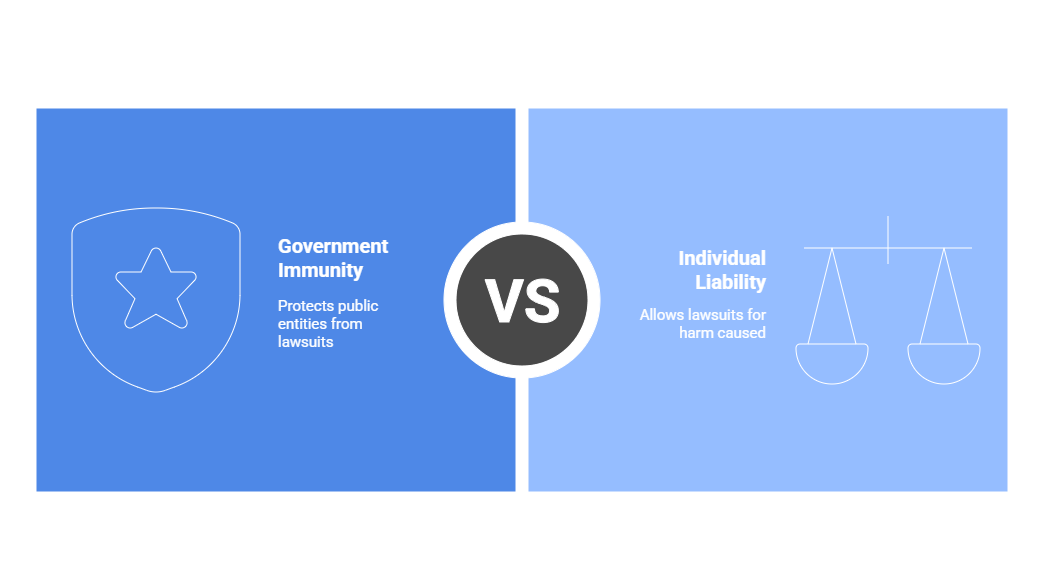
Government immunity means that public entities and employees are protected from certain lawsuits, even if harm occurred. The CTCA begins with a general rule of sovereign immunity, meaning you usually cannot sue the government unless a law says you can.
This protection exists to avoid draining public funds through endless legal claims and to let public agencies make difficult decisions without fear of constant lawsuits. Immunity is especially strong in cases involving policy decisions, discretionary actions, and law enforcement conduct.
When Does the Government Exercise Immunity?
There are situations where the government exercises immunity and cannot be sued no matter how serious the injury. Examples of such situations include:
- Discretionary Acts: This refers to choices made by public officials or agencies based on policy or budget. You can find this in the California Government Code § 820.2 (2024).
- Misrepresentation or Fraud: You generally cannot sue the government for financial harm based on incorrect information or advice it gave you, according to California Government Code § 818.8 (2024)
- Judicial and Prosecutorial Acts: Judges, prosecutors, and other officials are immune from suits based on decisions made as part of their official duties. This is known as judicial immunity.
Liability Exceptions: When the Government Can Be Sued
The CTCA also specifies various situations where public entities can be sued for damages. Such situations are known as statutory exceptions to immunity. These exceptions allow victims to seek compensation, but the rules are complex. And even within these categories, the agency might still raise immunity defenses, especially if the act involved discretion or law enforcement. Some examples include:
- Dangerous Condition of Public Property: If a sidewalk, park, stairwell, or other government property is not safe and that hazard causes injury, the government agency may be liable. This is also known as premises liability. But the claimant must prove that the governmental entity knew or should have known about the condition and failed to fix it.
- Negligence by Public Employees: If a government employee injures someone while doing their job, the agency may be liable for that employee’s negligence.
- Failure to Perform a Duty Imposed by Law: If a statute requires a public agency to take specific action and an injury results from the government’s failure to act, the agency may be liable.
What Are the Requirements for a Tort Claim?
Before you can file a lawsuit against a government entity or public employee in California, you must file a valid claim first. If you file a lawsuit without first submitting a claim, your case will likely be dismissed. That’s why you must understand the requirements of a tort claim to preserve your right to sue.
To meet the requirements of a tort claim under the CTCA, you must:
- File the claim with the right agency
- File it within the proper time limit, and
- Include all required information.
1. Who Must File the Claim
The claimant must be someone directly affected, or a legal party who represents them. You cannot file a claim on behalf of someone else without legal authority. If the injured person has died, their family or estate may file the claim on their behalf. Businesses or property owners can also file claims if their property was damaged by government actions.
2. What the Claim Must Include
To be valid under the CTCA, a claim must include the following information as specified in the California Government Code § 910:
- Name and post office address of the claimant
- The post office address where the claimant wants notices to be sent.
- Date, place, and time of the incident
- Description of what happened that caused the injury or damage
- Description of the injury or loss suffered
- Name of the public employee(s) involved, if known
- Dollar amount of damages claimed, if under $10,000
- For damages over $10,000, the claimant should state whether the case is a “limited civil case” (under $25,000)
3. What is the Deadline for Filing a Claim Under the CTCA?
In most cases, you must file the claim within six months of the incident or discovery of the injury. This statute of limitations applies to claims involving injury, death, or personal property damage. If the claim involves a breach of contract, the statute of limitations is one year.
If you miss the deadline, you can request to file a late claim, but you must show good cause and still file within one year of the event. Nonetheless, bear in mind that courts rarely grant late claims unless there’s a valid reason, such as physical or mental incapacity.
4. Where to File the Claim
You must file the claim with the correct public agency, not with the court. Each government body (city, county, or state) may have its own claim form and rules. If you send the claim to the wrong agency, it may be ignored or returned. For example, state-level claims such as those involving Caltrans or CHP, go to the Government Claims Program run by the California Department of General Services. Local claims go directly to the city, county, or district office.
Exceptions to the Claim Requirements
The CTCA provides special rules for claimants who are minors or mentally incapacitated. The law recognizes that such people may not be able to protect their legal rights on their own.
If the injured person is under 18 years old, a parent, guardian, or another legally authorized adult must file the government claim on their behalf. However, the content and deadlines of the claim stay the same, even though the injured person is a minor.
If a person suffers from a mental incapacity that prevents them from understanding or managing their legal affairs, the claim may still be filed by a guardian, conservator, or legal representative. If no one is appointed yet, someone close to the person, like a family member, can take steps to file the claim or request court appointment as conservator.
If the deadline is missed by either a minor or a mentally incapacitated person, a late claim application can be submitted under Government Code § 911.4. This request must still be filed within one year of the incident. The late claim application must clearly explain the reasons for the delay and why the claimant should be allowed more time.
If the public agency denies the late claim application, the claimant can file a petition in superior court asking for permission to proceed. Courts are more flexible with minors and incapacitated adults, but the burden still falls on the claimant to prove their case.
How to File a Claim Under the California Tort Claims Act

If you’ve been hurt or suffered a loss because of something a city, county, or state agency did, this is your first official step. Here’s a detailed step-by-step approach to filing a successful injury claim under the CTCA.
- Confirm that the CTCA applies to your case – Remember that the CTCA applies only for a person seeking compensation for damages caused by a public entity or public employee. If the claim involves a private company or individual, you may file a regular civil lawsuit without going through the government claim process.
- Use the appropriate government claim form and include required information – Many agencies provide a government claim form on their websites. But if not, you can use the general State of California Government Claim Form (Form 902). Make sure to include all required information as listed in the previous section.
- File the claim with the correct public entity – You must send the written government claim to the agency responsible for the injury. For example, if your car was damaged on a state highway, send it to Caltrans through the state’s Government Claims Program. Check the agency’s website to see whether they accept claims by mail, in person, or online. Address your form to the city clerk, legal department, or risk management office, depending on the agency. Remember, DO NOT file the claim with the court.
- Wait for a response and follow up on deadlines – After you file a government claim, the agency has 45 days to respond. They may accept the claim, reject it in writing, or ignore it. If they reject it in writing, you have six months from the denial date to file a lawsuit in court. If they don’t respond at all, the claim is considered denied, and you have two years from the date of the incident to file suit.
- Consider working with an attorney – Although filing a government claim may seem straightforward, the process can be complex, especially if the case involves serious injuries, multiple agencies, or unclear responsibility. An experienced personal injury attorney understands the California Government Code and can help you understand whether your case falls under the CTCA. They also make sure your claim includes all required details, and ensure that deadlines are met.Working with an attorney also comes in handy if your claim is denied and you decide to sue. Government agencies often have legal teams defending them, so having a lawyer can help level the playing field.
What Types of Damages Can Be Recovered Under the California Tort Claims Act?
In general, you can file a CTCA claim for economic and non-economic damages as long as the claim meets the requirements. In personal injury cases, such compensatory damages may include:
- Medical expenses – hospital bills, doctor visits, medications, rehab costs
- Lost wages – income lost due to missed work from the injury
- Loss of future earning capacity – if you can no longer work or must take lower-paying work
- Property damage – such as a damaged car, phone, or other belongings
- Pain and suffering – for physical pain and emotional distress
- Disability or disfigurement – including permanent injury or loss of function
- Wrongful death damages – funeral costs, loss of financial support, and emotional loss to surviving family members.
5 Tips for Filing a Strong Government Claim
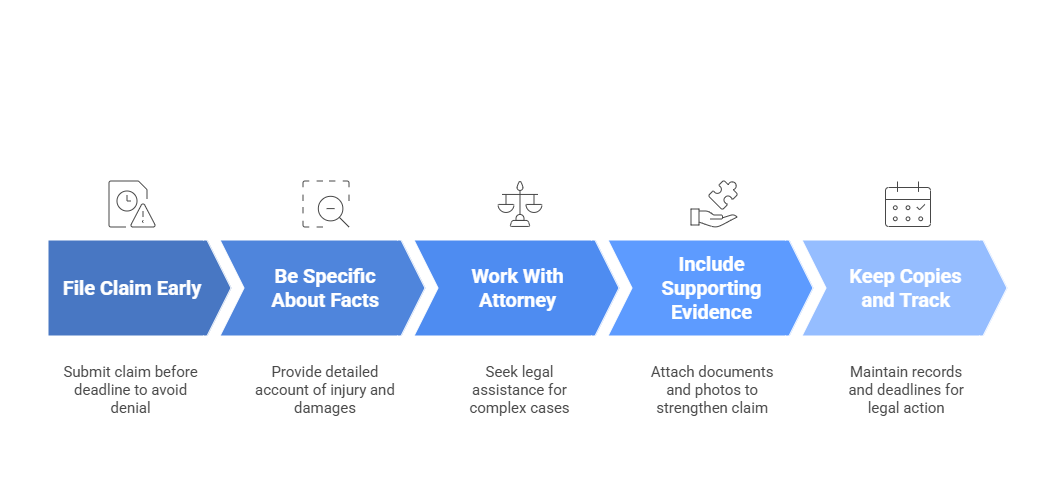
A well-prepared claim can lead to a quick settlement or set the foundation for a strong lawsuit later. That’s why we’ve curated these pro tips to help you avoid common mistakes and make sure your claim is taken seriously from the start.
1. File Your Claim Early
Waiting too long increases the risk of missing the deadline altogether. But if you file early, you’ll have time to fix mistakes or provide missing information before your claim is automatically denied. If you’re not sure which agency is responsible, early action gives you the chance to clarify and redirect your claim if needed.
2. Be Specific About Facts and Damages
Avoid vague statements like “I was injured” or “I lost money.” Instead, give a general description of how the injury happened, what body parts were affected, and how much you’ve had to pay for medical care. If you lost income or damaged property, include exact numbers. This level of detail helps the agency understand the seriousness of your claim.
3. Work With an Experienced Attorney
This is especially important in complex cases involving serious injuries, multiple agencies, or unclear legal liability. Even one missed detail can affect whether your claim is accepted or rejected.
4. Include Supporting Evidence If Possible
Although you’re not required to attach evidence to your claim, doing so can make it stronger. For example, in a premises liability case, you can add photographic evidence or the contact information of an eyewitness. Formal documents like police reports, repair bills, or hospital records are also helpful. These materials help support your story and may lead to faster investigation or settlement.
5. Keep Copies and Track All Deadlines
Make copies of everything you submit, including the claim form and any attachments. Moreover, use certified mail or another method that gives you proof of delivery. Keeping accurate records helps make sure that you don’t miss your chance to take legal action if needed.
Need Legal Help With Your California Tort Claims Act Claim?
Filing a claim against a public entity in California is not the same as filing a standard lawsuit. The CTCA sets specific rules, deadlines, and legal exceptions that could make or break your case. Therefore, make sure you understand who can be sued, when immunity applies, what your claim must include, and how to handle delays or denials so you can protect your right to compensation.
If you or your loved one sustains any injury due to government negligence, don’t wait or go through the claims process alone. Saeedian Law Group is here to help. Our team of personal injury lawyers has the legal experience needed to handle government claims and can guide you through every step. Book a free call with us today.
Frequently Asked Questions
We understand how challenging filing a government claim can be, especially if you’ve never done it before. That’s why we’ve provided straightforward answers to some of the most common questions about the CTCA and how the process works.
What Is the Statute of Limitations for the California Tort Claims Act?
For most personal injury and property damage claims, you must file a government claim within six months of the incident. If the claim is rejected, you have six more months to file a lawsuit in court.
What Happens if You Miss the Deadline to File a California Tort Claim?
If you miss the six-month deadline, you may request to file a late claim within one year, but it must be approved by the government. If your late claim is denied and no exception applies, you may lose your right to sue entirely.
What Happens After You File a Government Claim?
The agency has 45 days to accept or reject your claim. If the government rejects it in writing, you have six months to file a lawsuit. If they don’t respond, your claim is considered denied, and you typically have two years from the incident to sue.
Do I Need a Lawyer to File a Government Tort Claim in California?
Although a lawyer is not strictly required, working with an experienced personal injury attorney can be very helpful. An attorney can help you meet deadlines, avoid mistakes, and present a stronger claim from the start.
Can I Sue a Public School for Negligence?
Yes, but you must follow the CTCA process. This means filing a claim with the school district within six months of the incident and then waiting for a response before filing a lawsuit.
Can I Sue a Government Employee Personally?
You usually cannot sue a government employee personally if they were acting within the scope of their job. The public agency is typically held responsible instead. However, if the employee acted outside their duties or committed intentional misconduct, they may be personally liable.
What Is the Tort Law in California?
Tort law in California allows individuals to recover money for harm caused by another’s wrongful act, such as negligence, injury, or property damage. The California Tort Claims Act adds special rules when the person at fault works for the government.
What Are the Four Things Required to Prove That a Tort Occurred?
To prove a tort, you must show that:
- A legal duty was owed
- Such duty was breached
- The breach caused harm, and
- You suffered actual damages.
All four elements must be present. Without any of them, the claim is likely to fail.

Michael Saeedian founded Saeedian Law Group in 2009 with the goal of providing injured individuals and their loved ones with caring, personalized, and attentive legal representation.