
Car accident injury compensation in California is calculated using economic damages as a base, multiplied by non-economic factors, then adjusted based on your share of fault under the state’s pure comparative negligence rules. Using this formula, most California car accident injury claims settle somewhere between $5,000 and $25,000 for minor injuries, with more serious injuries often resulting in higher payouts.
Need help pursuing your car accident claim? Our experienced car accident attorneys at Saeedian Law Group have helped California car accident victims calculate and secure compensation for both economic and non-economic damages. Schedule a free consultation today to discuss your case, estimate compensation, and pursue fair compensation.
In this article, you’ll learn how to calculate injury compensation, how damages are categorized, what evidence supports an injury claim, and practical tips to help you pursue the best possible outcome after a crash.
How Car Accident Injury Compensation Is Calculated in California
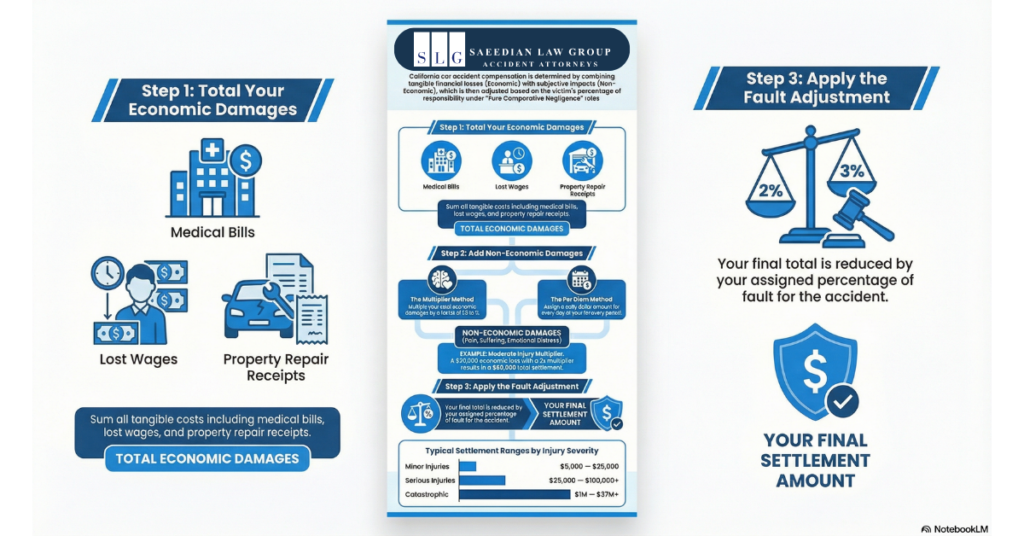
In California, car accident injury compensation is determined by combining economic and non-economic damages and adjusting the total based on fault under the state’s pure comparative negligence rules.
1. Economic Damages
These cover documented tangible financial losses. They include:
- Medical expenses: Past and future costs for hospital stays, therapy, medications, and other medical treatment related to the accident.
- Lost wages: Income missed due to time off work and potential reduced earning capacity if injuries affect long-term employment.
- Property damage: Costs to repair or replace vehicles and other personal property affected in the car accident.
While most car accident settlements don’t reach seven figures, economic and other damages can add up quickly. In a high‑profile construction accident case involving the California Department of Transportation (Caltrans), a construction worker suffered a catastrophic brain injury after being struck by a motorist while working on a roadside project.
The injury left him quadriplegic and unable to speak, requiring lifelong medical care and support. After litigation, Caltrans agreed to pay $37.4 million to the plaintiff to cover future expenses, ongoing medical care, and other damages.
2. Non-Economic Damages
Pain and suffering address the physical discomfort, emotional distress, and reduced quality of life caused by the accident. The two main methods for calculating these damages are the multiplier method and the Per Diem method.
The first multiplies the total economic damages by a factor, usually between 1.5 and 5, depending on the injury severity. While the Per Diem method assigns a daily dollar rate for each day of recovery. For example, $200 per day for 100 days of recovery results in $20,000 in pain and suffering damages.
3. Fault Adjustment: California’s Comparative Fault Rule
California follows a pure comparative negligence rule, allowing injured parties to recover damages even if they are mostly at fault, with awards reduced proportionally to their percentage of responsibility. Fault is apportioned among all parties involved, totaling 100%, based on evidence like witness statements and accident reconstruction. Courts or juries determine each party’s share under California Civil Code Section 1714.
So under California law, any award is reduced by the percentage of fault assigned to the injured party. For instance, if you are 20% at fault, your compensation is reduced by 20%. While some rules prevent recovery if you are mostly at fault, the pure comparative negligence system allows victims to recover a portion of their car accident compensation even if they share some responsibility.
Methods Used to Calculate Pain and Suffering Damages

When determining car accident compensation in California, pain and suffering damages can be among the most complicated to calculate. Unlike medical costs or lost wages, which have clear dollar amounts, pain and suffering accounts for the emotional distress, physical pain, and mental suffering caused by a car accident injury.
California law allows victims to seek compensation for pain and suffering damages, and most insurance companies use one of two primary methods: the multiplier method or the per diem method.
1. The Multiplier Method
The multiplier method starts with totaling all economic damages, such as medical expenses, property damage, and lost wages, then multiplying by a factor of 1.5 to 5 based on injury severity and recovery time. Minor soft-tissue injuries use lower multipliers (1.5 – 2), while severe cases like fractures or surgeries warrant higher ones (3 – 5)
Here’s how to calculate car accident injury compensation using the Multiplier method:
Imagine a victim has medical bills totaling $15,000 and lost wages of $5,000, for total economic damages of $20,000. If the injuries are moderate, the insurance adjuster might apply a 2x multiplier, resulting in pain-and-suffering damages of $40,000. Combined, the car accident settlement would be $60,000.
The multiplier is usually higher for serious injuries like broken bones, traumatic brain injuries, or severe soft tissue injuries, and lower for minor injuries.
2. Per Diem Method
The per diem method assigns a daily rate for physical pain and emotional distress, often your daily wage or a reasonable amount like $100-$300, then multiplied by recovery days or lifetime impact for chronic issues.
Here’s how to calculate car accident injury compensation using the Per Diem Method:
Suppose a car accident victim experiences pain and suffering for 100 days. The insurance adjuster or personal injury lawyer might assign $200 per day. Using the per diem method, the pain and suffering damages would be $200 x 100 = $20,000.
When combined with medical costs and lost income, assuming hospital bills are $10,000 and lost wages are $5,000, the total car accident compensation is $35,000.
The per diem method is often preferred when the injury severity and recovery period are clear and well-documented in medical records. It gives accident victims a concrete way to recover pain and suffering.
Evidence Used to Calculate Car Accident Compensation

To determine a fair car accident settlement in California, insurance companies and personal injury attorneys rely on solid evidence that documents both economic damages and pain and suffering. Key types of evidence include:
1. Accident Scene Documentation
Police reports, photos of the accident scene, and witness statements help confirm the crash’s circumstances and who was at fault. This evidence is also critical under California’s comparative negligence rules, which can reduce compensation based on the injured party’s share of fault.
2. Vehicle and Property Damage Records
Receipts for repair costs or documentation of a vehicle’s replacement value are used to establish property damage. This ensures that car accident victims are reimbursed for losses beyond medical and income-related damages.
3. Medical Records and Bills
Medical records and bills are essential for proving medical expenses and the extent of bodily injuries. These documents show the car accident injuries sustained, the medical treatment received, and any future medical expenses that may be required. Hospitals, doctors, and therapists provide detailed invoices, which also help in calculating pain and suffering damages.
4. Proof of Lost Wages and Income
Documentation of lost wages and lost income is necessary to calculate the financial impact of time missed from work. Pay stubs, tax returns, and employer statements provide evidence of income lost due to the accident. If the injuries affect long-term earning capacity, projections and expert testimony may be used to establish future losses.
5. Statements from Experts and Treating Professionals
In complex cases, skilled attorneys may use expert reports to quantify pain and suffering, evaluate the long-term impact of injuries, or estimate future medical costs. Experts can also testify about injury severity, physical injuries, or traumatic brain injuries, strengthening a personal injury claim.
6. Insurance and Policy Information
Information about insurance coverage and policy limits helps victims understand the maximum amount available for settlement and can influence negotiations with insurance adjusters. This ensures that victims pursue additional compensation where justified.
The Car Accident Claim and Settlement Process
Understanding the steps for recovering car accident compensation helps accident victims know what to expect and ensures that personal injury attorneys can maximize fair settlement outcomes.
1. Immediate Aftermath
Immediately after a car accident, safety comes first, so seek medical attention and contact law enforcement if needed. As much as you can, document the accident scene with photos, notes, and witness information. Prompt action helps preserve evidence for your car accident claim and protects your rights under California law.
2. Case Evaluation
Medical records and documentation of car accident injuries are collected during this phase. Remember that treatment details, medical bills, and any future medical expenses are critical for calculating economic damages. Meanwhile, a good accident attorney should help you assess the severity of your injuries, pain and suffering, and lost wages to determine the potential for personal injury compensation.
3. Demand and Negotiation
Once the personal injury claim is evaluated, a demand package is prepared and sent to the insurance company. This includes medical bills, accident reports, proof of lost income, and calculations of pain and suffering. Insurance adjusters review the claim and may offer a settlement. Negotiations often follow until both parties agree on a fair settlement.
4. Litigation if Necessary
If the insurance company refuses to offer a reasonable settlement, a personal injury lawsuit may be filed. At this point, your personal injury attorney will need all evidence gathered from the point of the accident down to the receipts of repairs and other damages. Litigation can increase the likelihood of maximum compensation, especially for severe or catastrophic injuries or disputes over fault under California’s comparative negligence rules.
How to Maximize Car Accident Injury Compensation

To maximize car accident injury compensation in California, follow these steps to avoid common pitfalls and strengthen your case.
Seek Proper Medical Treatment
Get medical attention and insist on evaluation even for minor symptoms, as delayed care weakens claims by suggesting injuries aren’t serious. Continue all prescribed therapy to reach maximum medical improvement (MMI). Also, document everything, including bills, records, and prognoses, for accurate future cost projections.
Preserve Evidence
If you can, photograph the scene, vehicles, injuries, and road conditions right away, and collect witness contacts and police reports. Secure dashcam/black box data and expert reconstructions to solidify fault percentages, preventing insurance companies from shifting blame. This will help build a strong liability case, which is crucial for multi-party comparative fault scenarios.
Avoid Common Claim Mistakes
Certain actions can reduce your car accident compensation:
- Accepting early settlement offers: Insurers lowball before full damages emerge (e.g., ongoing therapy or lost wages). So wait until MMI and consult an experienced car accident attorney to negotiate full value.
- Posting accident details on social media: Photos or updates can be twisted to claim you’re uninjured or at fault. Keep the documents from the scene private.
- Giving recorded statements to insurers: Untrained responses admit partial fault or downplay injuries. To be safe, direct all contact through a personal injury lawyer.
Finally, hiring experienced car accident attorneys early can reduce the time it takes to get a settlement and significantly increase settlement amounts. With the right legal representation, you can secure substantially higher payouts, often 3 to 4 times more, compared to what you might settle on if you represent yourself.
Need an Expert California Accident Lawyer to Help You Get Fair Compensation?
After a car accident, you may be dealing with pain, medical bills, and lost income. In addition to this physical and emotional stress, figuring out the claims process can be overwhelming, especially when insurance companies downplay your injuries to minimize payouts.
The skilled attorneys at Saeedian Law Group can guide you through every step of your car accident claim, from gathering evidence and calculating pain and suffering damages to negotiating a fair settlement or taking your case to court if necessary. Schedule a free consultation today and let us help you pursue the compensation you deserve for your car accident.
FAQs About Calculating Car Accident Injury Compensation
Over the years, our experienced accident attorneys at Saeedian Law Group have helped car accident victims across California pursue fair compensation. Drawing from their experience, they’ve shared answers to the questions most often asked by people navigating a car accident claim.
How to calculate an insurance car accident settlement?
To calculate insurance car accident settlement claims, sum up economic damages (medical bills, lost wages, property repair) then add non-economic via multiplier (e.g., $15,000 medical x 3 = $75,000 pain) or use the per diem method discussed above ($200/day x recovery days). After these, deduct your fault percentage under pure comparative rules, and you’ll get a rough estimate of your potential settlement.
What is the statute of limitations for car accidents in California?
The statute of limitations for car accidents in California is 2 years from the accident date for personal injury claims. Meanwhile, property damage claims have a three-year limit.
How much compensation will I get for a car accident?
There is no fixed amount for car accident compensation. Settlements could range from $5,000 (minor vehicle damage) to millions for catastrophic injuries. Factors that determine how much you will get include medical costs ($15,000 average), lost wages, and pain multipliers (1.5-5x economic damages).
What are the types of compensation available after a car accident?
Victims can seek economic damages, including hospital bills, repair costs, and lost wages, as well as non-economic damages like pain and suffering, emotional distress, and reduced quality of life. In rare cases, punitive damages may also be awarded if the at-fault party’s conduct was especially reckless.
How long does it take to settle a car accident claim in California?
Settlement timelines vary. Minor injuries and clear liability may allow a car accident settlement in a few months, while cases involving serious injuries or disputed fault can take a year or more, especially if litigation becomes necessary.
Can you still recover compensation if you were partly at fault?
Yes. Under California’s pure comparative negligence system, you can recover a portion of your car accident compensation even if you share some fault. Your settlement is reduced based on your percentage of responsibility, but partial recovery is generally allowed.

Michael Saeedian founded Saeedian Law Group in 2009 with the goal of providing injured individuals and their loved ones with caring, personalized, and attentive legal representation.