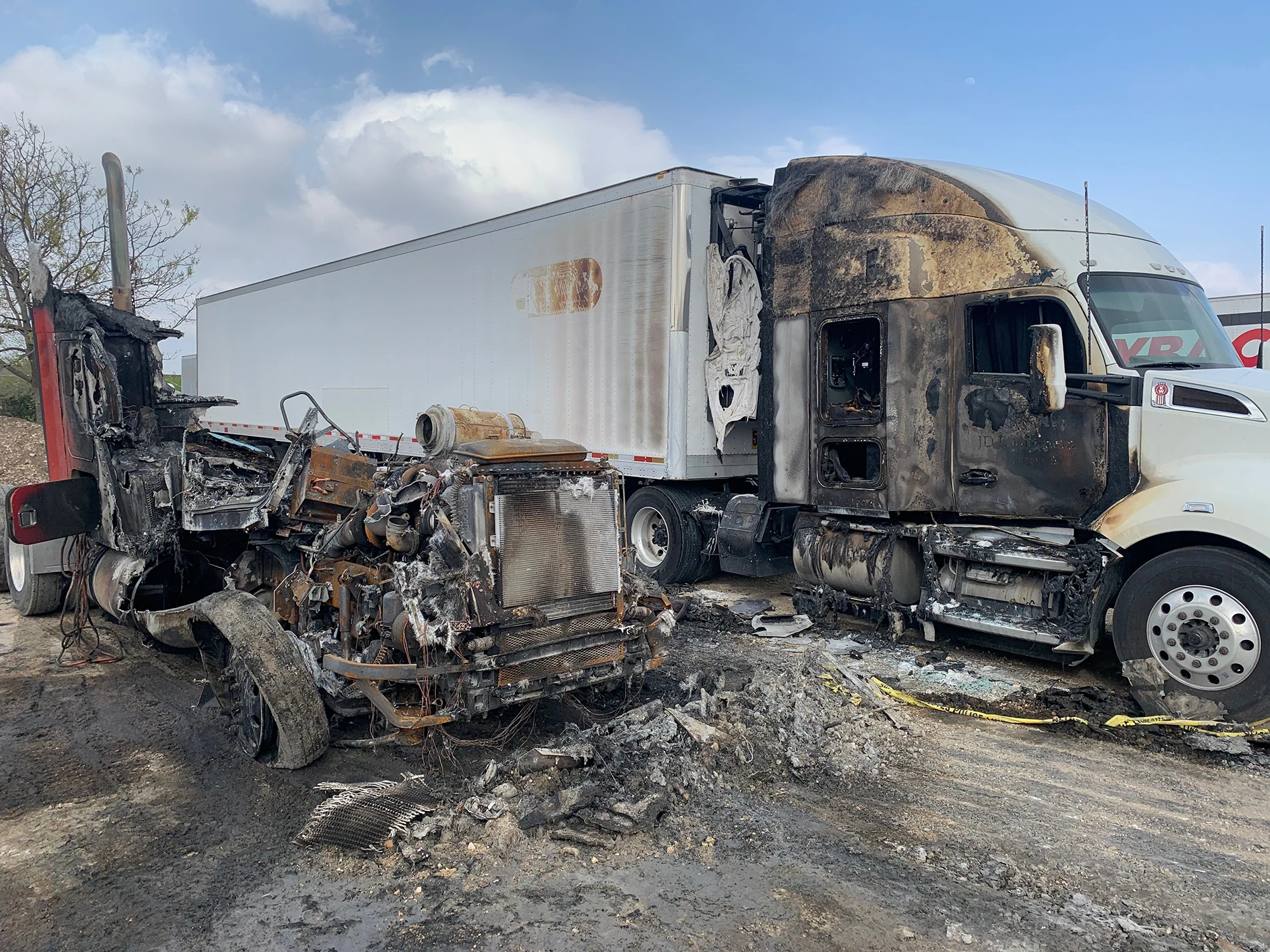
Corona Truck Accident Lawyer for Crashes on the 91 and the 15
If a big rig, box truck or delivery truck hit you in Corona, the claim usually runs through a trucking company and its insurer, not just the person behind the wheel. Federal trucking rules govern the logs and maintenance files a carrier keeps, and some of those can be discarded within months. Where the crash happened also matters: it decides who wrote the report, which public agency might share the blame, and where a lawsuit would be filed. This page walks through each of those points for Corona.
Saeedian Law Group handles truck crash cases for people hurt in Corona. We don't have an office in Corona. The closest one is in Rancho Cucamonga, at 8916 San Bernardino Road, about 19 miles away by car. The main office is in Beverly Hills. Your first consultation is free, and most people begin with a phone call.
The 91 and the 15: where Corona's truck crashes happen
Corona sits on the Riverside County end of State Route 91, the freeway that links the Inland Empire with Orange County through the Santa Ana Canyon. Interstate 15 crosses the 91 on the east side of town, and SR-71 joins the 91 near the county line. Caltrans publishes truck estimates for each freeway segment. Its 2024 table gives these daily figures for Corona:
| Point on the freeway (Caltrans 2024 estimate) | All vehicles a day | Trucks a day |
|---|---|---|
| SR-91 at the SR-71 junction, west Corona | 250,000 | 16,275 |
| SR-91 at Main Street | 242,000 | 15,754 |
| SR-91 at McKinley Street, east Corona | 229,000 | 17,610 |
| I-15 at the SR-91 junction | 205,000 | 11,501 |
On those 91 segments, 46% of the trucks have five or more axles. On the 15 at the junction, it's 45%. Trucks with five or more axles are mostly tractor-trailers, so close to half the trucks passing through Corona are full-size rigs.
OCTA's corridor plan for the 91 calls it one of three main freight routes between the Ports of Los Angeles and Long Beach and the I-15 and I-10. The trucks also serve the Inland Empire's warehouses: a 2024 SCAG white paper says the number of warehouses there has more than doubled since 2000. Large trucks and vehicles towing trailers aren't allowed in the 91 Express Lanes or the 15 Express Lanes, so heavy trucks share the regular lanes with everyone else.
What the state's crash records show for Corona
We pulled every 2023 and 2024 collision that police and the CHP reported in Corona from the California Crash Reporting System, then checked which ones involved a heavy truck. That means a truck-tractor, a two-axle or larger truck, a tank truck or a semitrailer.
- 2024: 203 truck-involved crashes. 45 of them injured someone (65 people in all), and one was fatal.
- 2023: 182 truck-involved crashes, 48 with injuries, 68 people hurt.
- About 7 in 10 happened on a freeway. The 91 was named in 108 of the 2024 crashes, the 15 in 54 and SR-71 in 10. Lincoln Avenue, Magnolia Avenue, Main Street and Green River Road led the surface streets.
- Sideswipes (94) and rear-end crashes (70) made up most of 2024.
- The causes officers listed most often were unsafe lane changes under Vehicle Code 22107 (68 crashes), speed too fast for conditions under Vehicle Code 22350 (46) and drifting out of a lane under Vehicle Code 21658(a) (28).
- A truck-tractor, the cab that pulls a semitrailer, was involved in 111 of the 2024 crashes. Another 38 involved a two-axle truck but no semi. That class includes many box trucks and delivery trucks.
Speed limits add to the mix. Under Vehicle Code 22406, a truck that has three or more axles or pulls a trailer may not go over 55 mph, even where cars can legally go faster. Cars end up merging around slower rigs all day, and that's where the lane-change crashes come from. The rear-end crashes cluster where 91 traffic slows suddenly.
Who wrote the report, and how to get a copy
Two agencies write most truck crash reports in Corona. The CHP covers the 91, the 15 and SR-71. Corona police usually take crashes on city streets. In the 2024 state records, the CHP wrote 147 of the 203 truck-crash reports and Corona PD wrote the other 56.
- CHP: the Riverside Area office, 8118 Lincoln Avenue in Riverside, (951) 324-7210, handles freeway crashes in Corona. A driver, passenger, vehicle or property owner, or the parent or guardian of a minor can request the report on form CHP 190, in person or by mail. The fee runs $10 for up to 25 pages. The CHP doesn't take cards, and mailed requests can't include cash.
- Corona Police Department: 730 Public Safety Way. Approved traffic reports cost 25 cents a page at the Records counter, open Monday to Thursday, 8 a.m. to 6 p.m. Call (951) 736-2330, option 3, before you go. You can also order Corona PD reports online through LexisNexis eCrash.
If a commercial vehicle is involved in a fatal crash, the CHP may call in a Multidisciplinary Accident Investigation Team. The team for this region works out of the CHP's Inland Division in San Bernardino and includes a motor carrier specialist and a Caltrans engineer. It isn't called to every crash.
Records that can make or break a Corona truck claim
Federal rules make a trucking company keep several kinds of records, but only for a set time. Once that time passes, they can be thrown out legally. These are the ones that come up most:
- Driving logs. Most interstate truckers record their hours on an electronic logging device. Under 49 CFR 395.3, a driver hauling property gets 11 hours behind the wheel after 10 hours off, can't drive after the 14th hour on duty, and needs a 30-minute break once 8 hours of driving have gone by. The carrier only has to keep those logs for six months (49 CFR 395.8).
- Maintenance files. Inspection and repair records stay where the truck is kept or serviced for one year, and for six months after the truck leaves the company's control (49 CFR 396.3). Brake and tire problems show up here.
- Drug and alcohol tests. After a fatal crash, a test is required. It's also required when the driver gets a ticket and someone is taken away for medical treatment, or a vehicle is towed from the scene because of damage (49 CFR 382.303).
- Engine and camera data. The truck's engine computer can record speed, braking and throttle. Many fleets also run dash cameras. No federal rule sets how long a company keeps that data, which is why a written request to preserve it should go out early.
For more on engine data, read how a commercial truck's black box works.
Box trucks, delivery trucks and warehouse traffic
Not every truck case involves a semi. About one in five of Corona's 2024 truck crashes involved a two-axle truck and no semi. Think rental box trucks, furniture deliveries and short runs out of nearby warehouses. Two questions shape most of these cases.
First, was the driver working when the crash happened? If so, the business behind the delivery may be responsible for the driver's conduct, and its commercial insurance comes into play. Second, what kind of carrier was it? A company that hauls other people's freight inside California needs a motor carrier permit, and Vehicle Code 34631.5 sets its minimum liability coverage at $750,000. The floor is $300,000 when every vehicle the company runs weighs under 10,000 pounds and it hauls no hazardous material.
The name on the side of a box truck isn't always the company that employed the driver. Photograph the door, the plate and any USDOT number before the truck leaves.
Who may share responsibility
Fault in a truck crash is often shared. Depending on the facts, a claim can reach:
- The truck driver.
- The carrier that dispatched the trip. If the rig belongs to an owner-operator on lease, 49 CFR 376.12 says the lease must hand the carrier exclusive possession, control and use of it for the lease term.
- A freight broker. In Montgomery v. Caribe Transport II (2026), the U.S. Supreme Court held that federal law doesn't block a state claim that a broker negligently picked an unsafe carrier. A broker claim depends on what the broker knew or should have checked.
- Whoever loaded the trailer, if shifting or overweight cargo played a part.
- A shop that serviced the brakes, tires or other parts, if that work was faulty.
Interstate for-hire carriers of general freight must carry at least $750,000 in liability coverage (49 CFR 387.9). California's comparative fault rule lets you recover even if you were partly at fault, reduced by your share. Pain and suffering is split differently: under Civil Code 1431.2, every defendant owes only its own percentage of those damages. So if a responsible company is left out, part of that loss may go unpaid.
When a city, county or state agency is involved
Sometimes a road problem, a public vehicle or a lane closure is part of the story. Claims against government agencies have a much shorter clock. For an injury, the written claim generally has to be filed within six months (Government Code 911.2). If the agency rejects it in writing, you usually have six months from that notice to sue (Government Code 945.6). Each agency takes claims in its own place:
- City of Corona (city streets, city vehicles): the City Clerk's Office, Corona City Hall, 400 S. Vicentia Avenue, Suite 115. The city says review can take up to 45 days.
- County of Riverside (county roads and vehicles): a written claim to the Clerk of the Board of Supervisors, Attn: Claims Division, 4080 Lemon Street, Riverside, by mail to P.O. Box 1147 or by hand. The county doesn't accept fax or email.
- State of California (state highways such as the 91 and the 15): the Department of General Services Government Claims Program, which charges a $25 filing fee. Claims against Caltrans for $12,500 or less go straight to Caltrans.
- Riverside County Transportation Commission (the 15 Express Lanes and the Riverside County part of the 91 Express Lanes): RCTC has its own claim form, filed with its Clerk of the Board at 4080 Lemon Street, 3rd Floor.
Trauma care and the courthouse
Corona Regional Medical Center isn't on Riverside County's list of designated trauma centers. The two Level I centers nearest Corona are Riverside Community Hospital, 4445 Magnolia Avenue in Riverside, and Riverside University Health System Medical Center in Moreno Valley. RUHS is also the county's designated pediatric trauma center. Ask for your records from whichever one treated you early on; truck claims lean heavily on them.
A truck injury lawsuit from Corona is normally an unlimited civil case. Under a Riverside Superior Court order in effect since August 1, 2026, those cases from Corona ZIP codes are filed at the Riverside Historic Courthouse, 4050 Main Street. The Corona Courthouse on Buena Vista Avenue takes limited civil cases, small claims and similar matters, not the larger injury suits. Lawyers file electronically in Riverside civil cases.
A checklist for the first weeks
- Photograph the truck's cab door, trailer number, plates and any USDOT or CA number.
- Write down whether CHP or Corona police responded, and get the report number.
- Get checked by a doctor, even if you feel fine at the scene, and keep every bill and record.
- Note your lane, the truck's lane and which way it moved. Sideswipes often come down to that.
- Don't give the trucking company's insurer a recorded statement before you've had advice.
- Ask a lawyer to send the carrier a written demand to save its logs, engine data and video.
- Put the deadlines on a calendar: two years to file an injury lawsuit in most cases (Code of Civil Procedure 335.1), and six months for a claim against a public agency.
When a truck crash takes a life, the family's case is a wrongful death claim, and the law limits who may file it. See our California wrongful death page.
Who handles your case
Michael Saeedian founded Saeedian Law Group in 2009. He has been licensed in California since December 2, 2009 (State Bar No. 265470), earned his bachelor's degree at UCLA and his law degree at Loyola Law School in Los Angeles. His practice is personal injury and wrongful death, and truck crashes are part of it. Daniella Saeedian, admitted to the California bar in 2019, also represents people hurt in truck accidents.
The firm works on contingency. As the About page puts it, you owe nothing until we recover compensation for you. The phone line is staffed 24 hours a day, and staff will travel to meet potential clients anywhere in California.
Talk to us about a truck crash in Corona
Call 310.288.3000 or use our contact form. The first consultation is free, and there's no obligation.
For a crash farther north, see our truck crash page for Rancho Cucamonga, where our nearest office is, or the statewide California truck accident guide. If you were hurt in a car-only crash in Corona, our Corona car accident page covers that.
Questions about Corona truck crashes
A truck hit me in the 91 Express Lanes. Does that change anything?
It can. Big trucks and vehicles towing trailers aren't allowed in the 91 Express Lanes, so a truck in those lanes was already breaking the rules. The lanes are run by OCTA in Orange County and RCTC in Riverside County. If a lane condition played a part, the public-agency claim deadline of six months applies.
Is a crash with a delivery or box truck handled like a semi case?
Partly. Some federal rules only reach heavier trucks or interstate trips, but the core question doesn't change: was the driver working for a company at the time? If so, the company and its commercial insurer are usually part of the claim. A for-hire carrier inside California has to carry at least $300,000 or $750,000, depending on its vehicles.
Is Corona Regional Medical Center a trauma center?
No. It isn't on the county's list of designated trauma centers. The two Level I trauma centers closest to Corona are Riverside Community Hospital and RUHS Medical Center in Moreno Valley.
Which courthouse would hear my case?
A truck injury lawsuit from Corona would normally go to the Riverside Historic Courthouse at 4050 Main Street in Riverside. Smaller limited civil cases from Corona are heard at the Corona Courthouse.
The truck kept going. How do I find the company?
Report it to the CHP or Corona police right away, and give them any partial plate, company name or color you remember. A USDOT number lets you look up the carrier on FMCSA's public SAFER system. Ask nearby businesses about camera footage soon, because many systems record over old video.
Do I need to come to Beverly Hills?
No. Most people start by phone. The Rancho Cucamonga office is about 19 miles from Corona, and staff can travel to you if getting to an office is hard after an injury.
Attorney Advertising. This page gives general information and is not legal advice. Reading it or contacting the firm does not create an attorney-client relationship. Past results do not guarantee future outcomes. Responsible attorney: Michael Saeedian, Saeedian Law Group, 9100 Wilshire Blvd, Suite 500W, Beverly Hills, CA 90212. Truck volumes: Caltrans 2024 Truck AADT (estimates). Crash counts: California Crash Reporting System 2023 and 2024 data via data.ca.gov, retrieved November 7, 2026.
I was referred to Saeedian Law Group by a friend and couldn’t be happier with my experience with this firm! Everyone was professional, attentive, and pleasant to work with. I wasn’t familiar with how these cases work but Mr. Michael Saeedian explained everything every step of the way and made me feel comfortable that I was being represented by the best people. Thank you!!!