
California does not publish an official average for slip and fall settlements involving surgery, and most settlement amounts stay confidential. Surgery usually raises a claim’s value because it brings larger medical bills, longer recovery, and more future care for the injured person. Your number depends on liability evidence, your share of fault, the available insurance, and how the injury changes your life.
In 2009, Michael Saeedian founded Saeedian Law Group, and its attorneys practice personal injury law exclusively. Our slip and fall lawyers build claims using operational reports, medical records, and an estimated written report from surgeons about future care. If a fall led to surgery, book a free consultation with no attorney fee unless we recover.
This article covers what drives settlement value after a fall that requires surgery, including medical costs, fault rules, deadlines, and taxes.
Key Takeaways
California has no official average for slip and fall settlements with surgery, so each claim rests on its records. Recoverable medical bills follow the Howell rule, which considers payments made rather than billed charges. Premises cases have no cap on non-economic damages, though your share of fault and Prop 51 can shrink the check. Most injury lawsuits must be filed within two years, and a government claim is due within six months.
Is There an Official Average Slip and Fall Settlement With Surgery in California?

No court, agency, or public database publishes an average slip and fall settlement with surgery in California. Most settlement amounts are confidential, so people who look for an average number end up quoting estimates.
The closest public benchmark is based on work done by the Bureau of Justice Statistics, who looked at tort trials in state courts from 2005. Plaintiffs who won premises liability trials received a median award of $98,000 in that national sample. The figure is old, covers trials only, and does not separate surgical cases. Trials made up nearly 4 percent of tort dispositions, so the vast majority of cases end without one. Past results do not guarantee future outcomes, and no study figure predicts what your claim is worth.
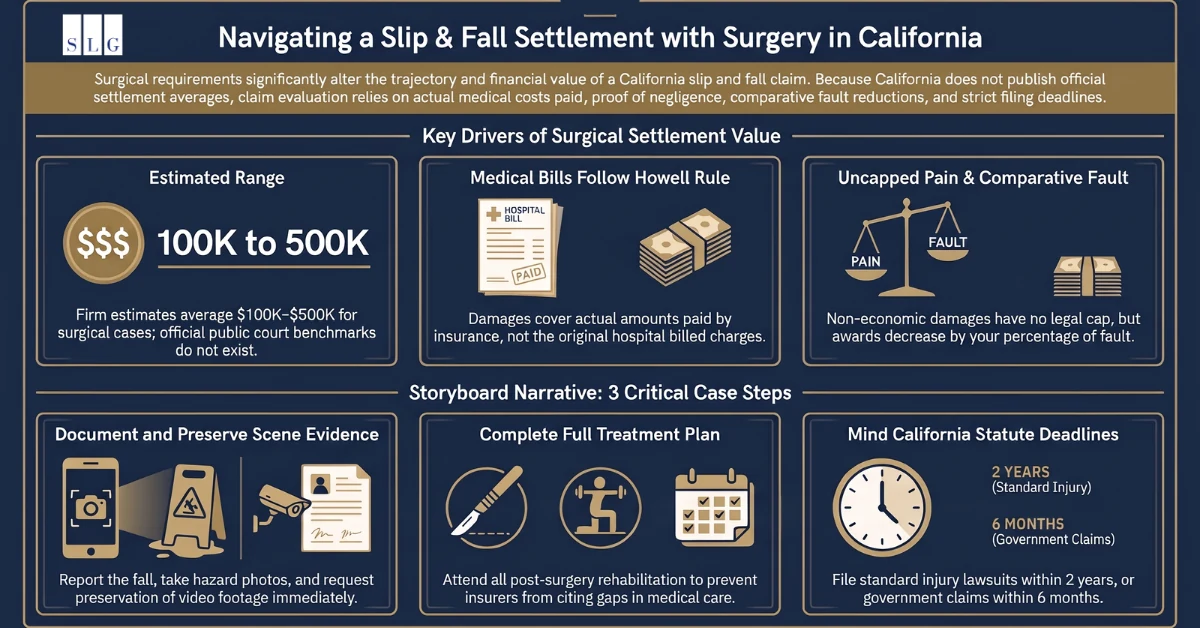
Law firms that handle several California injuries report that settlements for cases where surgery has been involved typically range from around $100,000 to $500,000. Those numbers come from firm estimates rather than published data, and past results do not guarantee future outcomes.
The broader average personal injury settlement blends many personal injury claims, so it says little about surgical fall settlement amounts. A sidewalk fall on public property follows government claim rules, unlike falls inside stores, restaurants, apartments, and hotels.
How Surgery Changes the Value of a Slip and Fall Case
California law has no surgery multiplier, and no statute adds a set amount because an operation took place. Surgery raises settlement value through the inputs that follow it, such as hospital bills, months of rehab, future care, and missed work. Insurers and juries weigh those inputs when they put a price on a slip and fall injury.
Minor injuries such as bruises or minor soft tissue injuries may produce medical bills of a few thousand dollars. Moderate injuries, like a fracture set in a cast, usually involve shorter care and fewer future costs. Serious injuries that need plates or a joint replacement cost far more, and severe injuries can end someone’s working life.
The scale shows up in data from the Centers for Disease Control, which tracks falls among adults 65 and older. Hospitalization rates due to falls result in roughly 1.4 million hospital admissions each year, and nearly 319,000 older adults are hospitalized for hip fractures. The same data name falls as the most common cause of traumatic brain injury in older adults.
Injury type and injury severity are two key factors, because a wrist repair and a spinal fusion carry different costs.
Hip Fracture Surgery and Hip Replacement
Surgeons repair many hip fractures with screws, plates, or rods, and other breaks call for a partial or full hip replacement. According to the CDC, falls account for 88% of emergency room visits and hospitalizations due to hip fractures. Older adults face a longer recovery, often with a rehab stay, home help, and ongoing treatment for mobility.
Spinal Fusion and Disc Surgery
A hard fall onto the back can herniate a disc, and surgeons may respond with a discectomy, laminectomy, or spinal fusion. People with back and neck injuries usually try getting shots and therapy before considering surgery. A spinal cord injury is different and usually very serious because damage to the cord affects movement below where the damage happens.
In spinal injuries, insurers often argue that degenerative disc disease existed long before the fall. CACI 3927 tells jurors to compensate for the worsening of a prior condition, so the records must show what changed.
Knee Surgery After a Fall
Slipping on wet tiles can result in tearing of the meniscus or ACL ligaments or breaking a kneecap. Repair work can vary from arthroscopic surgery to the reconstruction of damaged ligaments and joints, which may require replacement, followed by months of physical therapy for recovery. A serious knee injury can end careers that involve standing, kneeling, or ladder climbing. That loss becomes part of a claim for reduced earning capacity, valued separately from the surgery bill.
Wrist, Ankle, and Shoulder Surgery
Throwing hands out to break a fall can result in broken wrists or torn rotator cuffs. Surgeons fix these physical injuries with plates, screws, or a rotator cuff repair, and recovery can limit work for months. Fractures that enter a joint can lead to arthritis, and ankle surgery can involve a second operation to remove screws. Each subsequent step adds future medical costs that should be part of the claim.
How California Counts Your Medical Bills in a Settlement
In Howell v. Hamilton Meats, the Supreme Court of California limited recovery to the reasonable value of medical services. For a privately insured person, that usually means the amounts the insurer actually paid, not the amounts billed. Damages for past medical costs are based more on how much money was spent rather than on how much the hospital billed.
Pebley v. Santa Clara Organics, a 2018 appellate decision, addressed patients who choose care outside their health plan. A plaintiff on a lien may be viewed as uninsured, so the reasonable value of the billed amounts can be argued. Surgeons who perform medical treatment for patients on a medical lien or a letter of protection receive payment from the settlement.
Future Medical Expenses and Lost Earning Capacity

The California Civil Jury Instructions allows jurors to award future medical costs that belong to the plaintiff is “reasonably certain to be needed.” That standard is why lawyers usually wait for maximum medical improvement before valuing a surgical claim. Future healthcare needs may involve more physical therapy, managing pain better, removing hardware that has been implanted, or revising a joint replacement. Surgeons and people who plan care for patients often write down future medical costs in writing, and that document sets the demand.
According to Civil Code section 1431.2, economic damages consist of things like medical costs as well as lost wages and missed business opportunities. Lost wages are for pay that you miss out on because of time off work for surgery and convalescence. Meanwhile, earning capacity refers to income losses resulting from a permanent disability. Catastrophic injuries such as paralysis can stretch these future claims across decades of care and lost work.
Pain and Suffering Damages Have No Cap in Premises Cases
Civil Code section 1431.2 defines non-economic damages to include pain, suffering, inconvenience, mental suffering, and emotional distress. These pain and suffering damages cover physical pain and the way an injury changes daily life. In some cases, they can exceed the medical bills, especially when surgery leaves lasting pain.
Civil Code section 3333.2, part of the law known as MICRA, applies only to professional negligence claims against health care providers. Ordinary slip and fall claims against stores, landlords, and restaurants face no statutory cap on non-economic damages.
Proposition 51 is not a ceiling; it reduces payments but also limits them. Each defendant pays only part of non-economic damages proportional to their responsibility. If a jury assigns 40% of the fault to a settled contractor, the store pays only 60% of that award. Economic damages remain joint and several, so the limit does not reach medical bills or lost wages. Punitive damages are rare in premises cases because they require proof of conduct far worse than carelessness.
How Comparative Fault Reduces a Surgical Settlement
California slip and fall claims follow pure comparative fault, which the state Supreme Court adopted in Li v. Yellow Cab in 1975. Under that rule and CACI 405, an injured person can still recover compensation even when mostly at fault. Someone who is found to be responsible for 90% gets to recover 10% of the damages.
In a study conducted in 2005, the Bureau of Justice Statistics found that plaintiffs won 38.4% of trials related to premises liability cases. Awards were reduced for the plaintiff’s own negligence in 41.1% of those wins, by about 51% on average. Common fault arguments include phone use, slick shoes, and ignored warning signs. Insurers also cite pre-existing conditions and gaps in care as reasons for arguing that the fall was not what led to the surgery.
Proving the Property Owner Was Negligent
Civil Code section 1714 holds people responsible for injuries resulting from negligence regarding their own property. Under CACI 1001, a property owner is to use reasonable care to keep the property reasonably safe, not perfectly safe. California premises liability law, through CACI 1000, requires proof of control, negligence, harm, and causation. Notice is often the contested element, because the owner must either have known or reasonably should have known about the hazard.
Hazards of spills in a grocery store or restaurant are short-term, so what matters is for how long that liquid has been sitting there. Under CACI 1011, reasonable inspection would have uncovered the hazard promptly; constructive notice is given if this happens. A premises liability claim does not require proof that the owner created the spill, only that it failed to clean or warn. Strong evidence of negligence on the part of the property owner is found in video surveillance, log sheets for sweeps, written reports of incidents, witness names, and medical records.
Insurance Policy Limits and Who Pays the Settlement

The amount you can collect often depends on the property owner’s liability coverage, including any umbrella or excess policies. More than one party may share responsibility, such as the owner, a tenant, a business, and a maintenance contractor. A policy limit is a practical ceiling rather than a legal cap, but collecting beyond policy limits is often difficult.
Most settlement negotiations start with a demand package and an early offer that leaves room to move. Sometimes the insurance company refuses a fair demand within the limits, and the insurer can then face exposure above them.
How to Protect Your Claim After a Fall That Leads to Surgery
What you do in the first weeks after a slip and fall accident shapes the evidence for the whole claim. Witnesses forget what they saw, and stores may lose footage, so start on these steps as soon as you are able.
Get Immediate Medical Treatment
First, get immediate medical treatment, even if the pain seems manageable at the scene. Visiting on the same day links the fall incident directly to the resulting injury. Less than half of older adults who fall tell their doctor, the CDC reports, which leaves gaps in the record.
Report the Fall and Ask for a Written Incident Report
Before you leave, please also report the fall to a manager or landlord, if you are able. Request a copy of the written report of the incident and write down the names of people who witnessed that fall.
Preserve Photos, Video, and Witness Names
Snap photos of the hazard, the lighting, any warning signs, and the shoes you were wearing. Ask the business in writing to preserve their surveillance videos since most systems overwrite older footage.
Follow Your Treatment Plan Through Recovery
After surgery, attend every follow-up visit and physical therapy session your surgeon orders. Gaps in ongoing treatment give insurers an argument that something other than the fall explains your condition.
Track Lost Wages and Daily Limits
Keep pay stubs, an employer letter confirming missed time, and records of any sick leave you used. Keeping a brief journal of tasks that you can no longer perform serves as evidence for both lost wages and intangible damages suffered.
Talk With a Lawyer Before Giving a Recorded Statement
The property owner’s insurer may call within days and ask for a recorded statement about the fall. Personal injury lawyers handle that communication and decide exactly what information the insurer needs. Afterwards, a slip and fall lawyer will collect records and draft a settlement demand after recovery is clear.
Filing Deadlines and How Long Surgical Cases Take to Settle
Code of Civil Procedure 335.1 gives most injured people two years from the fall to file a slip and fall lawsuit. The same section covers death caused by another’s wrongful act, so wrongful death claims usually face the same two-year statute of limitations. Accidents on public property will follow a quicker path under Government Code section 911.2, where a government claim is due within six months.
Many fall cases settle after maximum medical improvement, but the filing clock keeps running during a long surgical recovery. Many lawyers file the lawsuit to protect the deadline and continue negotiating as the case proceeds. There is no standard answer for how long a lawsuit takes, and wrongful death cases or contested claims often run longer.
Are Slip and Fall Settlements Taxable in California?
Under Internal Revenue Code section 104(a)(2), damages received on account of personal physical injuries are excluded from gross income. IRS Publication 4345 says that a settlement for a physical injury is not taxable if you have not yet deducted related medical expenses. That rule covers most personal injury settlements that pay for surgery, lost wages, and pain.
Interest on a settlement and punitive damages are considered taxable income, and so are any deductions you took for medical expenses. The emotional distress related to physical injuries is managed in the same way as those injuries heal. Settlement wording can affect reporting, so confirm the details with a tax professional before you sign.
Ready to Talk About Your Slip and Fall Surgery Claim?
Your medical records show that you had surgery after a fall. Proof that you received notification of this and that there is insurance backing up the property is important too. Insurance companies often begin investigating within days of a fall, so early medical care and saved video can shape the outcome. Deadlines start ticking during your recovery process, and a claim against an agency of the public can expire in just six months.
Since 2009, our personal injury lawyers have handled injury claims from offices in Beverly Hills, Rancho Cucamonga, and Encino. With over 16 years of experience, the team led by Michael Saeedian handles claims for falls from stores, restaurants, and apartments. Contact Us Today to talk through your surgery and also discuss the deadline for filing your claim.
Frequently Asked Questions
Saeedian Law Group has handled California personal injury claims since 2009, including premises cases from falls in stores, restaurants, and apartments. That work shows us which questions people ask most after a fall leads to surgery.
How Much Is a Slip and Fall Case With Surgery Worth in California?
California has no official average, so value depends on medical costs, future care, lost earnings, pain and suffering, fault, and coverage.
Does Surgery Always Increase a Slip and Fall Settlement?
Surgery usually raises the medical bills and future care that drive value. Weak liability or causation evidence can still lead to a low offer.
Can I Still Recover Compensation if I Was Partly at Fault?
Yes, California follows pure comparative fault, so your recovery is reduced by your percentage of fault but is not barred.
Are Slip and Fall Settlements Taxable?
Compensation for physical injuries is generally not taxable under federal law, while punitive damages and interest on a settlement are taxable.
How Long Does a Slip and Fall Case Take to Settle After Surgery?
Lots of cases wait until they are maximally improved before future care becomes valuable. The deadline to file a lawsuit is generally two years from the date of the fall.
How Do Slip and Fall Lawyers Charge for a Case?
Saeedian Law Group takes on slip and fall cases on a contingency fee basis. Under that arrangement, there is no attorney fee unless we recover on your claim.
Do I Need a Lawyer for a Slip and Fall Case With Surgery?
People in California don’t need to hire lawyers, and some folks handle small claims matters on their own as well. Surgery cases bring liens, future care estimates, and causation disputes, so a lawyer’s review before you accept an offer often helps.
What If the Property Owner Says the Hazard Was Obvious?
An obvious hazard can weaken a claim that the owner failed to warn you, since people are expected to notice plain dangers. The owner may still be responsible for failing to fix it when visitors had no practical way around it. Any share of blame for not watching your step lowers the award under comparative fault.
Can I Claim Future Surgery I Have Not Had Yet?
Yes, California jurors can award future medical expenses you are “reasonably certain to need,” which can include a revision or second operation. Your surgeon’s written opinion and a cost estimate usually carry that part of the claim.
What Happens if the Fall Happened on City Property?
Falls on city or county property require a written government claim, generally within six months under Government Code section 911.2. A lawsuit will happen only if the agency denies the claim or fails to respond promptly. If you miss that window, you may lose your case before your recovery even ends.
Will My Health Insurance Get Paid Back From the Settlement?
Often, yes, because many health plans and government programs such as Medicare have reimbursement rights when a settlement covers bills they paid. Usually, liens come off the settlement check before you get your share, and some of those liens can also be negotiated down.
What Should I Avoid Saying to the Insurance Company?
Avoid guessing about the fall or saying you feel fine, because adjusters use those words to dispute the surgery. Politely decline any recorded statement until a lawyer has reviewed the claim and your records.
Legal Disclaimer
This article gives general information on California premises liability law and isn’t meant as legal advice. Reading this article or contacting Saeedian Law Group does not establish any attorney-client relationship. Every case depends on its own facts, and past results do not guarantee future outcomes.

Michael Saeedian founded Saeedian Law Group in 2009 with the goal of providing injured individuals and their loved ones with caring, personalized, and attentive legal representation.