
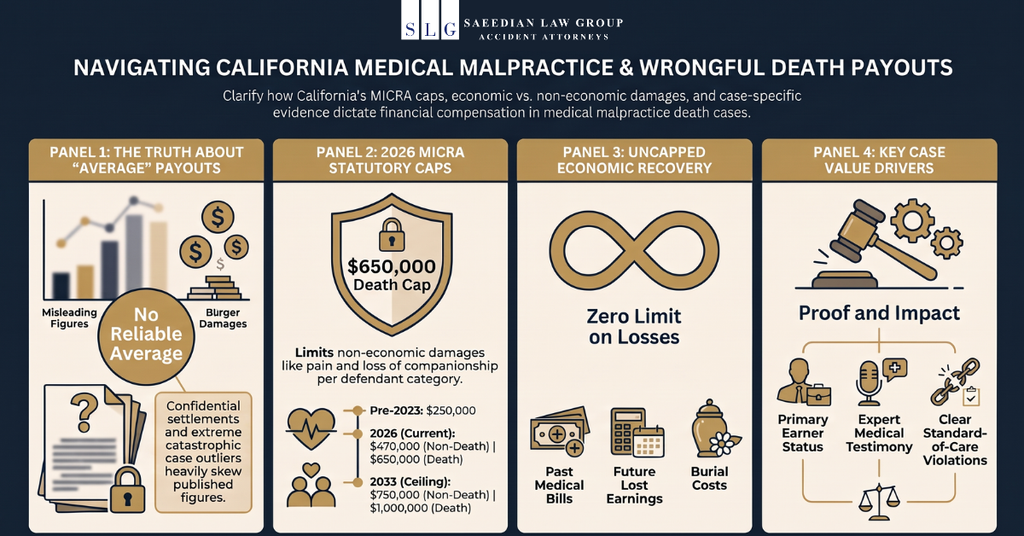
There is no clear, reliable average payout for cases involving deaths related to medical negligence because most settlements are private, and when there is public data, they vary widely depending on the methodology used, the year, and whether reported numbers are means or medians. California law provides an exact figure for part of that recovery. The state’s Medical Injury Compensation Reform Act, known as MICRA, caps non-economic damages at $470,000 in a medical malpractice case and at $650,000 when that malpractice causes a death, while economic damages in the same case, such as future medical expenses and lost income, remain completely uncapped.
For over 16 years, Saeedian Law Group has been advocating on behalf of families in California who have suffered losses due to sudden death, including cases involving wrongful diagnosis, surgical errors, and other types of medical negligence, along with a range of personal injuries. Our wrongful death attorneys investigate the standard of care a healthcare provider owed the patient, gather the medical records and expert opinions needed to prove fault, and negotiate directly with hospitals, physicians, and insurance companies on a family’s behalf. If your family is in this situation right now, you can contact our office today for a free consultation.
This article explains the average compensation paid out in these cases. It also clarifies exactly what California’s MICRA caps limit and what ultimately controls how much a family receives when someone dies due to medical negligence.
Why There Is No Reliable Average Payout for a Medical Malpractice Death Case

People who sue for compensation after a death from medical malpractice need a straight answer, not an inflated marketing number. Wrongful death settlements in general and medical malpractice settlements get discussed online as if they were interchangeable, but a death caused by malpractice is a narrower, specific category. Search for an average medical malpractice settlement, and you will find wildly different numbers, sometimes a few hundred thousand dollars, sometimes well over a million.
Most medical malpractice settlements are never made public, and defendants in malpractice cases typically require confidentiality to resolve a medical malpractice lawsuit, so no agency tracks every finalized case and publishes a verified average settlement. Published figures usually reflect a mean, not a median, and malpractice payouts are heavily skewed by a small number of catastrophic cases, so a handful of severe-injury or wrongful-death verdicts can pull a reported average far above what a typical family receives, while the median stays much lower.
That is why one legal-marketing page can cite a figure for medical malpractice payouts, and another can cite a number twice as large without either source being wrong; they are simply measuring different things. It is also why Saeedian Law Group does not publish a specific average payout for medical negligence resulting in death as a marketing claim, since California’s Rules of Professional Conduct prohibit a law firm from advertising unsubstantiated case results. Wrongful death settlements in general vary from case to case for the same reason, and many numbers remain confidential. The one number in this topic that is actually written into a statute, rather than estimated from scattered reports, is the MICRA cap below.
What Is California’s MICRA Cap on Medical Malpractice Damages in 2026
California limits one specific part of a verdict or settlement in a medical malpractice case: the non-economic damages, meaning compensation for pain and suffering, loss of companionship, and other intangible harm. This limit comes from California Civil Code Section 3333.2, the state’s Medical Injury Compensation Reform Act, better known as MICRA, and the figures under this medical malpractice law changed significantly when Assembly Bill 35 took effect for cases filed on or after January 1, 2023.
Before that reform, MICRA had capped non-economic damages at a flat $250,000 since 1975, with no inflation adjustment and no distinction between a malpractice case that caused a death and one that did not. AB 35 replaced that single number with two schedules, which increase every year. Non-death medical malpractice cases began at $350,000 in 2023 and will increase by $40,000 each January 1 for the next ten years. In contrast, malpractice wrongful death cases started at $500,000 and will rise by $50,000 each January 1, with both schedules reaching a permanent ceiling in 2033 before transitioning to a smaller annual inflation adjustment.
Working that schedule forward, the 2026 non-economic damages cap is $470,000 for a non-death medical malpractice case and $650,000 for a medical malpractice case resulting in death. These figures apply per category of defendant rather than once per case, since healthcare professionals named as defendants share one combined cap, healthcare institutions such as hospitals share a separate combined cap at the same figure, and unaffiliated defendants have their own cap too. A case naming both a hospital and independent physicians could see non-economic damages capped at up to two of these figures, not one number for the entire case.
There is an easy oversight of a ceiling on damages at $470,000 or $650,000. This ceiling applies only to the non-economic damages. Economic damages in the same case, such as medical bills, lost wages, and future medical costs, are not subject to this cap at all.
Does the MICRA Cap Apply to Every Wrongful Death Case in California?

No, and this is a critical distinction for this whole topic. The MICRA cap applies only if the underlying wrongful death claim is based on medical malpractice, meaning the cause of death is due to negligence by a healthcare provider or institution acting as professionals. An ordinary California wrongful death case arising from a car accident, a slip and fall, a defective product, or almost any other type of negligence has no statutory cap on non-economic damages whatsoever.
That distinction is constantly getting blurry online, and that has huge significance for what families can hope to get back. Medical malpractice is one of several types of wrongful death cases, alongside causes like car accidents or workplace incidents. It is itself a case of professional negligence, requiring proof that a healthcare provider has deviated from the accepted medical standards that are expected of their profession. Because medical negligence cases carry California’s unique MICRA cap and ordinary negligence claims do not, two wrongful death cases with similarly tragic facts can have unique ceilings depending on whether a hospital or physician was named as a defendant.
Families should not assume a cap applies just because their case involves a death, and they should also not assume that without a cap, every malpractice wrongful death case recovers the same amount. Each case is judged based on its specific circumstances, and determining when MICRA applies usually requires an attorney who has experience with litigation related to medical malpractice. Families also need to act before California’s statute of limitations runs out, since missing that filing window can end a claim regardless of its merits, and hiring an experienced wrongful death lawyer starts with knowing what to look for.
What Economic Damages Can a Family Recover After a Death Caused by Medical Negligence?
California Code of Civil Procedure Section 377.60 and Section 377.61 set out who may bring wrongful death claims and how damages are measured, and neither statute places a dollar limit on economic damages. Section 377.60 lists who can file a wrongful death lawsuit in California, generally a surviving spouse or domestic partner, children, and certain other dependents, though the full eligibility rules vary by family situation. Section 377.61 simply says damages may be awarded that are just under the circumstances, leaving the categories to case law and jury instructions.
Economic damages are the uncapped half of a medical malpractice wrongful death case and often the larger half in dollar terms. These economic damages encompass the decedent’s lost income and past wages, as well as future financial support that the decedent would have provided. They also include future medical expenses already paid by the family, lost household services, health insurance and other lost benefits, funeral and burial costs, and any medical expenses incurred before death, such as hospital bills directly related to the malpractice. None of these categories are limited by MICRA regardless of how big the total is.
Non-economic damages, sometimes written as noneconomic damages, non-economic damages, or non-economic damages depending on the source, cover the surviving family members’ loss of love, companionship, comfort, care, and moral support. This is the category MICRA caps at $470,000 or $650,000 in 2026, as explained above.
Birth injuries show why total settlements can still reach very high numbers even with the non-economic cap in place. When a birth injury such as brain damage or spinal cord injuries occurs due to a healthcare provider’s failure to meet accepted medical standards during delivery, the family’s largest recoverable losses are usually future medical bills, future medical costs, and future medical needs such as attendant care, plus lost future earning capacity, not the capped non-economic award. Comprehensive medical records and life-care planning testimony, not the MICRA cap, drive these high-value economic damages.
What Factors Make a Medical Malpractice Death Case Worth More?

Settlement amounts in medical malpractice wrongful death cases move up or down based on a consistent set of factors, even without a fixed average to compare against. The decedent’s age and earning capacity matter, since a family depending on a younger primary earner’s income typically has a larger economic damages claim than a family whose loved one was retired. Severe injuries leading up to death, prolonged pain and suffering, and significant emotional distress or mental anguish before passing can also increase the value of a malpractice claim, since some of that suffering is itself compensable.
The occurrence of medical malpractice also matters. Medical errors generally fall into a few categories, including diagnosis errors, medication errors, and surgery malpractice, and proving medical malpractice almost always requires expert testimony establishing that a medical professional departed from what the medical community recognizes as an acceptable standard of care. Cases with clear documentation, including detailed medical records and credible expert opinions, tend to produce a fair settlement faster than cases where liability is disputed.
Clients frequently ask about medical malpractice claim worth, and the honest answer is that no two cases are evaluated the same way. “The strength of the evidence, the severity of what the family lost, and which of California’s MICRA categories apply to the defendants usually decide the outcome far more than any published average,” says Attorney Michael Saeedian, founding attorney of Saeedian Law Group.
Insurance coverage also impacts results. Insurance companies defending a healthcare provider will rarely offer substantial compensation beyond their policy limits, regardless of how strong the underlying medical malpractice claims are, one more reason settlement amounts vary so widely.
Finally, state-by-state variation in malpractice payouts is real, driven primarily by differing damage-cap laws rather than differences in the severity of malpractice itself, and California’s own MICRA structure is the clearest example of that. The federal National Practitioner Data Bank tracks medical malpractice payment reports nationwide and categorizes the severity of outcomes, including death. This serves as a reminder that malpractice litigation is systematically monitored, even though no public source publishes a definitive average payout.
Most medical malpractice cases settle rather than go to a jury trial, since both sides generally want to avoid the cost of trial once liability is reasonably clear. A U.S. Bureau of Justice Statistics study of civil trials in state courts found that trials account for only about 3% of tort case dispositions nationwide, the same pattern Saeedian Law Group sees in medical malpractice and wrongful death cases specifically.
California’s non-economic damages cap has changed dramatically since AB 35 took effect, and the table below contrasts the old flat limit with the current 2026 figures and the ceiling the schedule reaches in 2033.
| Period | Non-Death Malpractice Cases | Malpractice Wrongful Death Cases |
| Pre-2023 (flat cap since 1975) | $250,000 | $250,000 |
| 2026 (current) | $470,000 | $650,000 |
| 2033 (ceiling) | $750,000 | $1,000,000 |
Talk to a California Wrongful Death Attorney Today
No single average payout can tell a family what a medical malpractice death case is truly worth, since the real numbers that matter are California’s rising MICRA cap on non-economic damages and the uncapped economic damages a family can recover. In 2026, that cap stands at $470,000 for non-death malpractice cases and $650,000 for malpractice wrongful death cases, and it applies only when the underlying claim is medical malpractice, never to an ordinary wrongful death case. In every case, economic losses like lost wages and medical costs, as well as future medical expenses, go uncapped; this usually decides if victims get proper compensation that they deserve.
Saeedian Law Group has represented California families in medical negligence and wrongful death cases for more than 16 years, and our experienced medical malpractice attorney team, part of a broader experienced legal team of medical malpractice lawyers, handles medical records, expert witnesses, and insurance company negotiations so families do not have to do it alone. We work on a contingency basis, meaning there are no attorney fees unless we win, and every family can start with a free case evaluation. Reach out to us today to begin working toward the financial compensation and legal help for your family.
Frequently Asked Questions
We have over 16 years of experience helping victims of medical negligence along with their families, and we’ve addressed some of the most frequently asked questions about death cases involving negligence in medicine.
What Is the MICRA Cap on Compensation in a California Medical Malpractice Wrongful Death Case in 2026?
In 2026, California’s MICRA cap limits non-economic damages to $650,000 in a medical malpractice case that results in death and $470,000 in a medical malpractice case that does not. These numbers go up automatically every year starting from January 1, according to the schedule set by AB 35, until they hit a permanent ceiling in 2033.
Does California Limit How Much a Family Can Recover for a Death Caused by Medical Malpractice
California limits only damages that don’t have an economic component rather than total recovery amount. Damages like lost wages, funeral costs, and future medical bills still go unbounded. That’s why total compensation in a death case due to medical negligence can still be substantial.
Is There a Cap on Damages in All California Wrongful Death Cases or Only Ones Caused by Medical Malpractice?
This cap applies only if the death results from medical negligence. An ordinary California wrongful death case, such as one arising from a car accident or a defective product, has no statutory cap on non-economic damages at all.
What Is the Difference Between Economic and Non-Economic Damages in a California Wrongful Death Claim?
Economic damages cover measurable financial losses such as lost paychecks, medical costs, and funeral expenses. Non-economic damages cover intangible losses such as pain and suffering and loss of companionship, and only the non-economic category is subject to California’s MICRA cap in a medical malpractice case.
How Much Has California’s Medical Malpractice Damages Cap Increased Since AB 35 Passed in 2022?
The cap has risen every year since AB 35 took effect in 2023, starting at $350,000 for non-death cases and $500,000 for wrongful death cases, and reaching $470,000 and $650,000, respectively, by 2026.
What Was the MICRA Cap Before the 2023 Reform and Why Did It Change?
Before 2023, MICRA had capped non-economic damages at a flat $250,000 since 1975, with no distinction between death and non-death cases and no adjustment for inflation. Lawmakers, along with medical and legal groups, worked on negotiating AB 35. They changed an old number and replaced it with a plan that goes up in value gradually.
Can a Family Recover More Than the MICRA Cap if Medical Bills and Lost Income Are Very High?
Yes. The MICRA cap applies only to non-economic damages, so economic losses such as medical expenses incurred before death, future medical needs, and lost income are recoverable in full above and beyond the cap.
Who Is Legally Allowed to File a Wrongful Death Claim in California After a Death Caused by Medical Negligence?
Under normal California law, spouses or domestic partners, along with children and other dependents, are generally allowed to file together. Priority and eligibility rules vary depending on specific circumstances of each family, and a lawyer can verify qualification before a claim is submitted.
Is There a Reliable Average Settlement Amount for Medical Malpractice Death Cases?
There is no reliable average because most settlements are kept secret. The numbers that are released for publication also vary in methodology, and they often mix together means and medians. What is reliable is California’s MICRA cap on non-economic damages and the uncapped economic damages categories described above.
Why Do Medical Malpractice Settlement Statistics Vary So Widely From Source to Source?
Different sources use different years and report different sample sizes and sometimes mix up means with medians; this results in averages that appear inconsistent even when each is calculated properly. Payouts for malpractice insurance also get skewed because there are some big cases that pull averages up.
This article provides general information about California’s medical malpractice and wrongful death laws and is not legal advice. Reading it does not create an attorney-client relationship with Saeedian Law Group. Statutes, damages caps, and case law can change over time, and the outcome of any case depends entirely on its facts, so consult a licensed attorney before relying on anything here for an active legal matter. Past case results do not guarantee a similar outcome in any future case.

Michael Saeedian founded Saeedian Law Group in 2009 with the goal of providing injured individuals and their loved ones with caring, personalized, and attentive legal representation.