

An ankle injury can lead to surgery, months of treatment, and time away from work. If the injury happened because of someone else’s negligence, you may want to know how much compensation you could receive. Searching for the average payout for an ankle injury with surgery can give you numbers that do not reflect your case. The amount you may receive depends on your injury, medical costs, lost income, and other losses.
Saeedian Law Group has over 16 years in handling premises liability falls and vehicle collisions with catastrophic injuries. We have recovered $12 million in compensation for injured victims across California. Contact us today for a free case evaluation.
Below you will find why a single average is close to useless, what drives ankle injury settlement amounts, and a real California case.
Understanding Ankle Injuries and Their Implications

The ankle joint carries your whole body weight over a small surface. When it is damaged, ordinary life changes in ways that are difficult to explain on a claim form. Stairs may become difficult, standing for work may be impossible, and the injury can affect your sleep even after the cast comes off.
That is why grouping all ankle injuries under one average makes so little sense. A left ankle sprain that resolves in three weeks and a trimalleolar ankle fracture requiring plates and screws are not the same event. Any honest answer has to start with which injury you actually have.
Types of Ankle Injuries
Sprains involve stretched or torn ligaments. Most resolve with rest and physical therapy, though severe sprains can leave lasting instability that needs surgical repair. A sprained ankle is often dismissed early, and that early dismissal is what hurts the claim later.
Fractures is another type of ankle injury and can vary a lot; what matters most is the damage they cause. A single clean break in the fibula is one thing, and moderate injuries of that kind often heal well. A trimalleolar ankle fracture, which breaks the ankle in three places, is another, and it almost always requires surgery. A fractured ankle involving multiple broken bones increases both recovery time and settlement value. Crush injuries and a dislocated ankle sit at the serious end, and so does any fracture that destroys the joint surface itself.
A broken ankle injury that involves the weight-bearing surface is a more severe injury than the same break above the joint line. Fractures that require surgery to realign the joint are more severe than those that do not.
Torn ligaments and tendon injuries often accompany fractures. Where cartilage is destroyed, surgeons may eventually recommend ankle fusion, which relieves pain by permanently removing motion at the joint. Some patients develop complex regional pain syndrome. That chronic pain condition can require a spinal cord stimulator, and it changes what a claim is worth.
Common Causes
Workplace accidents produce many foot and ankle injuries. Falls from height, dropped loads, and forklift incidents account for most work-related ankle injuries. Construction, warehousing, and delivery work carry the highest exposure.
Slip-and-fall cases are another major group. A wet floor, an unmarked step, or a broken stair tread can produce an ankle fracture case in a second. A serious foot injury often comes from the same fall. Sports injuries account for many severe sprains, though those rarely involve anyone’s legal liability.
Car crashes and motorcycle collisions cause the most complex ankle and foot injuries, because the force involved is far greater. Those cases frequently involve multiple injuries, such as rib fractures alongside the ankle damage, and each one has to be documented separately.
Average Workers’ Comp Settlement for Ankle Injury with Surgery
If your injury happened at work, workers’ compensation is usually the first option. It is a no-fault system, so you do not need to prove anyone was careless. What you give up in exchange matters more than most people realize.
California’s Division of Workers’ Compensation explains that temporary disability pays two-thirds of the gross wages you lose while you recover. A maximum weekly amount set by law caps that figure. For injuries on or after January 1, 2008, those wage replacement benefits last no more than 104 weeks. That window runs five years from the date of injury. The system provides five benefits in total, covering medical care, temporary disability, permanent disability, supplemental job displacement, and death benefits.
If lasting impairment remains, a doctor assigns an impairment rating. That rating converts into a permanent disability percentage under California’s schedule for rating permanent disabilities. That percentage, your age, and your occupation then produce a fixed dollar figure. The process is mechanical by design, which makes it predictable and also rather blunt.
Notice what is missing. Workers’ compensation pays nothing for pain and suffering. A permanent disability rating may compensate you for lasting impairment, but the human cost of chronic pain carries no line item at all.
This is why average workers’ compensation settlements can give you a very general number. Comp settlements are built from medical costs and a disability rating, not from what the injury did to your life. A workers’ compensation attorney handles that side, and it is not the work our firm does.
Where our work begins is the second claim. Suppose someone other than your employer caused your injury. A defective ladder manufacturer, a negligent driver, or a property owner may all qualify. You may then have a personal injury claim running alongside your workers’ compensation claims. That third-party case can recover pain and suffering, and it is often worth considerably more than the comp file.
Case Studies

The clearest illustration of how badly an insurer can misjudge an ankle injury comes from a published California decision. In Mazik v. GEICO General Insurance Company, the plaintiff suffered unusually severe ankle and heel damage. A shattered heel destroyed the joint between his ankle bone and heel bone. His medical expert called the injury devastating and said the bone had literally exploded into too many pieces. Surgery was not a viable option, so he was splinted and left facing a possible fusion and a lifetime of chronic pain.
He collected $50,000 from the at-fault driver’s insurer, which was that policy’s full limit. He then claimed the remaining $50,000 under his own underinsured motorist coverage with GEICO, which carried a $100,000 limit.
This is the lower estimate. GEICO’s internal written evaluation put the entire claim between $47,047.86 and $52,597.86. The company then offered him $1,000. Over the following two years, the offers rose to $13,800, then $18,000, then a formal offer of $18,887. A GEICO adjuster later testified that the company’s own evaluation had omitted important information from the medical records supplied.
Here is the high outcome. An arbitrator awarded the full policy limits. Mazik then sued for bad faith. A jury awarded $313,508 in compensatory damages, being $300,000 for mental suffering and anxiety and $13,508 in fees. The jury added $4 million in punitive damages, which the trial court reduced to $1 million.
Read those figures carefully, because the distinction matters. The ankle injury claim itself was worth the policy limits, which totaled $100,000 across two policies. The larger sums punished how the insurer handled it. What the case proves is that a carrier’s opening number can be a small fraction of what a claim is genuinely worth.
Factors Influencing Ankle Injury Settlement Amounts
Medical costs are the starting point. Surgical repair, hardware, anesthesia, follow-up imaging, and months of physical therapy accumulate quickly. Ankle surgery alone can run well into five figures before rehabilitation begins. Future medical expenses matter just as much, because hardware removal, a later fusion, or treatment for post-traumatic arthritis may all arrive years afterward.
Lost wages come next. A roofer with a fractured right ankle loses far more income than an office worker with a left ankle fracture. One can work seated and the other cannot. Where the injury ends a physical career, lost earning capacity becomes the largest single element of the claim.
Pain and suffering is the least predictable part and often the largest. There is no formula, and it is argued rather than calculated. Evidence of how the injury affects daily life carries more weight here than medical bills do. That is why treating physician testimony and expert testimony about permanent limitations matter so much.
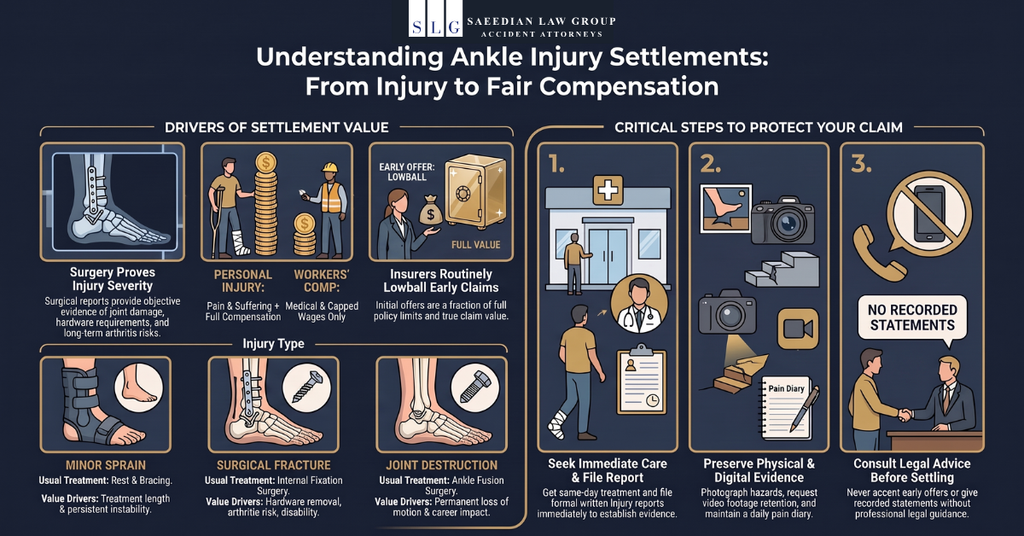
| Injury type | Usual treatment | What drives value |
| Ankle sprain, minor injuries | Rest, bracing, physical therapy | Length of treatment, whether instability persists |
| Severe sprain or ligament tear | Possible ligament repair | Need for surgery, residual weakness |
| Single ankle fracture | Casting or internal fixation | Whether the joint surface is involved |
| Trimalleolar fracture, crush injuries | Surgery, often multiple surgeries | Hardware, arthritis risk, permanent disability |
| Joint destruction, failed repair | Ankle fusion | Permanent loss of motion, career impact |
Two things can then limit the amount you receive. California reduces your recovery by your own share of fault. An argument that you were not watching where you stepped costs you a percentage of everything. The available insurance sets the harder ceiling, because a claim is only worth what can actually be collected. A serious injury against a small business with a modest policy can be worth less than a moderate one against a well-insured company.
Does Surgery Increase Ankle Injury Settlement Value?

Generally yes, though not for the reason people assume. Surgery raises value partly because it costs money, but mainly because it proves severity. An operative report is objective evidence that a doctor considered the damage serious enough to open the joint.
An ankle injury with surgery also carries consequences that a sprain does not. Hardware can loosen, infection is a real risk, and post-traumatic arthritis is common where the joint surface was involved. Those long-term effects legitimately raise the settlement value of ankle injury cases.
Having multiple surgeries can increase the value of a claim. Hardware removal is common once a fracture has healed, and that second operation carries its own recovery period. Where a repair fails and a fusion follows, you are valuing two distinct injuries in sequence rather than one.
Surgery is not the only marker of a serious injury, and Mazik shows why. His injury was severe precisely because surgery could not help. Sometimes a surgeon declines to operate because the damage is beyond repair. That is not a weak case, and you should not let an adjuster treat it as one.
Legal Rights and Steps to Take after an Ankle Injury
What you do in the first weeks shapes what different ankle injuries are eventually worth. Below are important steps to take immediately after an ankle injury that can support your claim.
1. Seek Medical Care Immediately
Go the same day, even if you can bear weight. A broken ankle is missed on initial examination more often than people expect. A gap between the accident and your first medical treatment is the first argument an adjuster will make.
2. Report the Injury Properly
Tell the property owner, your employer, or the police, depending on where it happened. Ask for a written report and keep a copy. A workplace injury has its own reporting deadlines. Missing them can jeopardize your benefits entirely.
3. Preserve the Evidence
Photograph the hazard, the scene, and the affected ankle while the bruising is visible. Collect witness details. Ask that any surveillance footage be preserved in writing, because most systems overwrite within days.
4. Follow Your Treatment Plan
Attend every appointment and complete the physical therapy. Missed appointments become evidence that you recovered. Keep your medical records, receipts, and a simple diary of physical pain and what you can no longer do.
5. Get Advice Before You Accept Anything
An early offer usually arrives before anyone knows whether you will need further surgery. Speak with a personal injury lawyer first, since accepting a low settlement closes the claim permanently.
What Is Your Ankle Injury Actually Worth?
The number you are searching for does not exist as an average, and treating one as such is how people accept too little. What exists is your injury, your evidence, your insurance picture, and the way the other side chooses to handle it. Those four things are knowable, and the sooner you know them, the stronger your position becomes. One conversation is usually enough to tell you which of them is working against you.
At Saeedian Law Group, we help injured clients understand their options and pursue the compensation they may be entitled to. Our attorneys review the details of each case, gather the necessary evidence, and work with insurance companies to seek a fair settlement. Call us today to learn the next possible steps to take.
Frequently Asked Questions
This section provides answers to common questions about the average payout for ankle injury with surgery.
What Is the Average Payout for an Ankle Injury with Surgery?
There is no reliable average, and any single figure you see quoted online should be treated with suspicion. Ankle injury settlements span from a few thousand dollars for a minor sprain to seven figures where a crush injury ends a career. Published ankle injury lawsuit settlements vary just as widely, which is exactly why averaging them tells you nothing. The honest answer is that severity, liability, available insurance, and documentation decide it.
How Much Compensation Can I Expect for an Ankle Injury Requiring Surgery?
Your realistic range depends on your medical expenses, your lost income, the permanence of the damage, and the insurance available. A surgical ankle fracture case with clear liability and lasting limitation sits far above a sprain. A free case evaluation will give you a grounded range rather than a guess.
What Factors Influence the Settlement Amount for Ankle Injuries?
Injury severity comes first, followed by whether surgery was required and whether permanent disability remains. Medical bills, lost wages, and future medical expenses form the measurable part. Fault, policy limits, and the quality of your medical records then decide how much of that value you actually collect.
Are There Standard Guidelines for Calculating an Ankle Injury Payout?
No. No California statute or jury instruction sets a formula for these claims. Adjusters use internal software and multipliers as shorthand. Those are negotiating conventions rather than law, and Mazik shows how far such an estimate can drift.
What Legal Options Are Available after an Ankle Injury?
You may file a personal injury case against whoever caused the injury, or negotiate directly with their insurer. A personal injury lawsuit follows if talks fail. Work injuries add a parallel workers’ compensation route. Where a third party is responsible, both can proceed at once.
How Does Legal Representation Affect the Outcome of My Case?
A represented claim is priced differently because the insurer now faces the prospect of a court award rather than a closed file. Injury lawyers also know which ankle claims are routinely undervalued. Most importantly, they stop you from settling before the full extent of the damage is known.
How Can I Make Sure I Receive a Fair Settlement?
Finish your treatment before you negotiate, document everything, and never give a recorded statement without advice. Ask what your claim is worth with and without the future care your doctor has predicted. A fair settlement is one that still looks reasonable in five years.
Disclaimer: This article provides general information about California ankle injury claims and does not constitute legal advice. Reading it creates no attorney-client relationship with Saeedian Law Group. The figures described come from published court records and do not predict the outcome of any other claim. Speak with a licensed attorney about your own situation.

Michael Saeedian founded Saeedian Law Group in 2009 with the goal of providing injured individuals and their loved ones with caring, personalized, and attentive legal representation.