

Accidents happen, and while no one desires that outcome, people still need to be responsible for the unfortunate incident. Among the tools at the legal system’s disposal for disciplining negligent parties are punitive damages.
Punitive damages are unique in terms of their intended purpose. You must know how to manage them, or else you could be the one who runs into trouble with the law.
Since 2009, Saeedian Law Group has assisted clients in handling injury claims ranging from bicycle accidents, car accidents, wrongful death, dog bite injuries, and so much more. With in-depth legal knowledge and exceptional trial skills, our team has recovered over $12 million for injured victims. Reach out today to get the compensation you deserve.
In this article, we’ll go into the topic of punitive damages and how to handle them from a tax standpoint.
What Are Punitive Damages?

Once it’s proven in court that you were involved in a car accident or some other incident you did not cause, they will likely award you some form of compensation. In court cases, they call that compensation damages. You can break damages down into two major categories.
First off, you have the compensatory damages. The name should tip you off to what compensatory damages are. They are supposed to offer financial compensation for the losses you incurred due to the accident. The courts classify compensatory damages as either actual or general damages.
Actual compensatory damages refer to your quantifiable losses such as your medical expenses, damage done to your property, or paychecks you missed out on due to your injuries. Actual damages are supposed to provide direct and equivalent compensation for those losses.
General damages are the opposite, meaning they compensate you for losses that you cannot quantify. Examples of general damages include emotional distress, a decrease in quality of life, and potential job opportunity losses.
The different kinds of compensatory damages are with your losses in mind. They are supposed to cover your needs. Punitive damages are different because they are more focused on the guilty party. Courts set punitive damages to punish the guilty party. They are additional penalties handed down to defendants with possible incarceration and other forms of punishment.
The courts also set punitive damages because they want to teach the guilty party a lesson. They want to discourage the party in question from engaging in that behavior again. The hope is that the financial blow will get that lesson to stick a bit better.
When Are Punitive Damages Awarded?
An important thing to note about punitive damages is that they are far from common. Judges will not order them to be included in compensation simply because another party was negligent.
For courts to include punitive damages in the financial award handed down to a plaintiff, they must prove that the defendant acted recklessly with malice or deceit. They must also show that the guilty party willingly engaged in the activity that led to the incident in the first place.
Judges may also decide to include punitive damages in their ruling if they believe doing so will be an effective deterrent to others in the future. As you can probably guess, there’s a high threshold for setting punitive damages and it isn’t often reached. Even so, you must know how to manage them if they include them in your case.
Do You Have to Pay Taxes on Punitive Damages You Receive?

Now for the main question, and the short answer is yes. Punitive damages are almost always taxable, and the IRS treats them as ordinary income. As a general rule, federal tax law includes them in your gross income under Internal Revenue Code section 61. These punitive awards are considered taxable income no matter how your case began.
There is a clear reason for this. The exclusion that makes injury money tax-free, IRC section 104(a)(2), covers compensatory damages but expressly leaves out punitive damages. The Supreme Court confirmed this in O’Gilvie v. United States, holding that punitive damages are not paid “on account of” your injury. The Internal Revenue Service sees them as a windfall for the injured party, closer to a prize than to repayment. You report them as other income on Form 1040, Schedule 1, line 8z.
Are There Cases Where Punitive Damages Are Not Taxable?
Most of the time, if you received punitive damages, you would pay taxes on them. That’s the law, and you must abide unless you want to experience some legal troubles yourself.
However, there are exceptions to that law, and they mainly come from IRC section 104(c) and applies only to certain wrongful death cases. If your state’s wrongful death statute, as it stood on September 13, 1995, allowed only punitive damages, those awards can be tax free.
Alabama is the classic example, since its wrongful death law is punitive by design. Outside that narrow situation, punitive damages in a wrongful death case are still taxable. Financial compensation in wrongful death cases is sometimes harder to parse through because there are so many elements included.
But what about the punitive damages? Are they still taxable in this scenario? To find out the answers to those questions, you will need to consult with your state’s laws.
In wrongful death cases, the courts usually refer to the state statutes to come up with a ruling. If the state laws indicate that the financial awards provided in wrongful death cases are all punitive damages, they will be exempt from taxation.
Seeking a lawyer familiar with the laws in your area should help you understand the status of the compensation you received. Don’t hesitate to seek out their help if you need more guidance regarding your taxes.
Are Lawsuit Settlements Taxable? Understanding Different Types
Punitive damages are only one piece of a bigger picture. Whether a settlement is taxable depends on what the money is meant to replace. The same logic runs through all legal settlements, from a single claim to a class action lawsuit. What matters is what your settlement proceeds actually stand in for. Under federal law, IRC section 61 treats all income as taxable unless a specific rule excludes it. The table below sorts the common damage types.
| Damage type | Is it Taxable? | Authority | How to report |
| Compensatory damages for physical injury or sickness | Generally no | IRC 104(a)(2) | Not reported as income |
| Punitive damages | Yes | IRC 61, O’Gilvie | Schedule 1, line 8z |
| Emotional distress from a physical injury | Generally no | IRC 104(a)(2) | Not reported as income |
| Emotional distress with no physical injury | Yes | IRC 104(a) | Schedule 1, line 8z |
| Lost wages in an employment case | Yes | IRC 61 | Wages, Form W-2 |
| Interest on any award | Yes | IRC 61 | Schedule B |
Taxable vs. Non-Taxable Damages
The dividing line is simple to state. Money that replaces a personal physical injury or physical sickness is usually non taxable. Damages paid for personal injuries that are physical usually escape tax. Money that punishes, replaces lost profits or wages, or adds interest is usually taxable. Non physical injuries, such as defamation or discrimination claims, are taxable too. Sorting your award into these two categories is the first step.
IRS Guidelines on Settlement Taxation
The IRS lays out these rules for legal settlements in Publication 4345, Settlements Taxability. It explains that the origin of your claim decides the tax treatment. If you deducted medical costs in an earlier year and later recover them, that previously deducted portion becomes taxable under the tax benefit rule. When in doubt, the settlement agreement should spell out each category clearly.
How to Avoid Paying Taxes on Settlement Money Legally
You cannot turn taxable money into tax free money by wishing it so. You can, however, plan ahead to lower the sting. The goal is compliance, not evasion, since hiding taxable income invites penalties.
Structured Settlements Explained
A structured settlement pays your award in periodic payments over time instead of one payout. Each settlement payment is smaller, so large lump sums do not spike one year’s tax bracket. For tax free physical injury damages, this spreads the money out without changing the tax result. For taxable damages, structuring can smooth income across years and may soften your top tax rate. Ask whether periodic payments fit your case before you sign.
Tax Planning Tips for Settlement Recipients
A few steps help you avoid surprises. Keep your settlement agreement detailed, so each dollar is clearly compensatory or punitive. Do not deduct medical expenses you expect to recover later. Above all, involve a tax attorney or CPA before you settle, not after the tax bill arrives.
Are Personal Injury Settlements Taxable? What You Need to Know
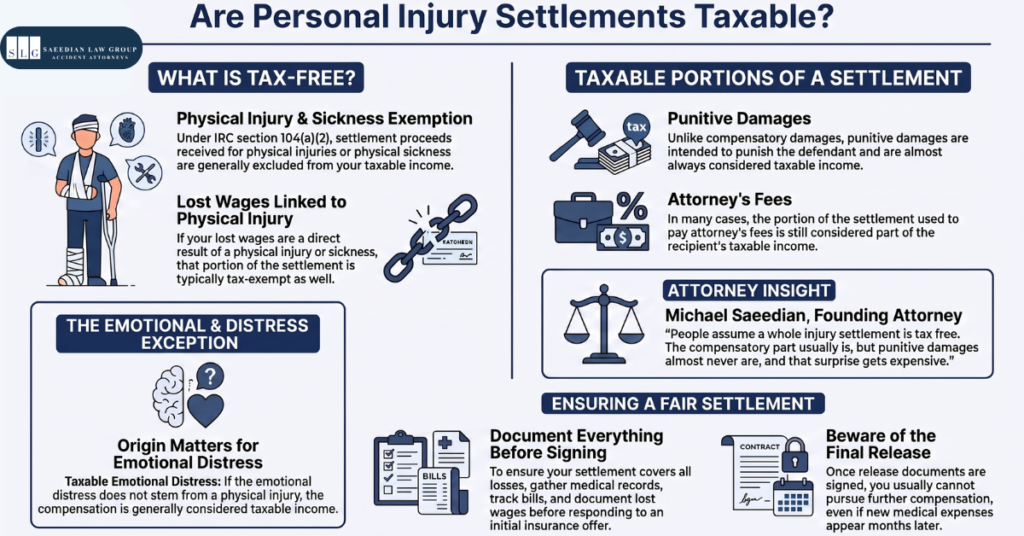
Here is the good news for injury victims. Compensation for personal physical injuries or physical sickness is generally excluded from taxable income under IRC section 104(a)(2). In a personal injury claim, the exclusion requires an actual physical injury or sickness. Amounts paid for that harm, including your medical bills and the physical harm itself, are generally tax free. Lost wages are also tax free when they flow from a physical injury.
Things play out different with emotional distress. Emotional distress damages are tax free only when they arise from a physical injury. Emotional distress damages arising from no physical cause are taxable, minus any medical costs you paid to treat them. Attorney’s fees can be taxed too, since the Supreme Court in Commissioner v. Banks treated the full recovery as your income.
Michael Saeedian, our Founding Attorney, puts it plainly: “People assume a whole injury settlement is tax free. The compensatory part usually is, but punitive damages almost never are, and that surprise gets expensive.”
What Happens if You Reach a Settlement?
Not all cases reach a verdict in court. These matters often double as negotiations, and both sides may decide that settling now is more palatable than potentially spending months or even years tied up in a long legal battle.
Settling offers a way for both sides to compromise and put the issue behind them. So, how will opting for a settlement affect your tax situation? Determining whether a certain amount is taxable is easy enough if the court decides because the rulings usually indicate which damages are considered compensatory or punitive. The opposing sides don’t need to do that if they are negotiating a settlement.
The two sides have more control over how the documents will be written out. That is a situation where the IRS may get involved to determine if a portion of the damages awarded should indeed be taxable.
What Is Reallocation?
The next topic we need to discuss is reallocation. Using an example will make it easier to comprehend.
Let’s say that the camps of the plaintiff and the defendant decide that they don’t want to go to trial. They want to get the matter over with as soon as possible, so they negotiate a settlement.
During those negotiations, the plaintiff may want to classify most of the settlement amount as compensation for their injuries and losses. The plaintiff may do that in the hopes of avoiding a bigger tax bill. Is that tactic going to work? There’s a good chance that it won’t.
The IRS has a trump card that it can use in that situation. It’s known as reallocation. The agency may take a closer look at the court documents and see if the amount the plaintiff claims to be solely for compensatory damages is valid. You could count on the IRS going through those documents with a fine-tooth comb to see if everything listed is correct.
Now, if the agency finds that the plaintiff’s claims are wrong, they will let the court know about that. Though the plaintiff indicated that all the money they received is compensatory, the IRS may argue that they should earmark at least a percentage of it for punitive purposes.
The IRS can then reallocate the funds the plaintiff received and argue in court that their arrangement is the right one. Because of all that, the plaintiff may end up paying more taxes.
The bottom line here is that settling will not allow you to avoid taxes. There are cases where negotiating a settlement makes sense, but don’t use taxes as your primary incentive for going down that route.
When to Recognize Settlement Income for Tax Purposes on Accrual
Timing matters for taxes, especially for businesses. Most individuals use the cash method, so you report settlement income in the year you actually receive it. A business on the accrual method reports income when the right to it is fixed and the amount is known.
This split affects delayed payment deals. If your award is paid directly in a later year, a cash method taxpayer is taxed then, not now. A business reporting business income or business profits from lost profits may have to recognize it sooner. In employment cases like wrongful termination or wrongful discharge, back pay is taxable and can trigger employment taxes. Ask your accountant which method applies to you.
Settlement Tax Calculator: Estimating Your Tax Liability on Punitive Damages
No formula replaces a professional, but a simple example shows how the numbers work. Imagine a $500,000 award for physical injuries plus $1,000,000 in punitive damages. The compensatory portion is generally tax-free, while the entire amount of the punitive award is taxable. The table below sketches the result.
| Part of the award | Amount | Taxable portion |
| Compensatory, physical injury | $500,000 | $0 |
| Punitive damages | $1,000,000 | $1,000,000 |
| Total received | $1,500,000 | $1,000,000 |
Your actual tax depends on your bracket, your state, and your legal fees. Because attorney’s fees on the taxable part can still count as your income, the real bill can climb. Run your own numbers with a tax attorney before you plan around them.
Handling the Interview
If the IRS believes there’s something suspicious about the tax filings related to your settlement, they may request to interview you. The goal of the interview is to determine why your filing looks that way. They’re also trying to figure out if the settlement amount you reported is taxable.
Expect the IRS agent to ask a variety of questions regarding the settlement. They may ask why you opted to settle out of court in the first place. They will also likely ask why the other party agreed to the settlement.
Getting more to the heart of the matter, the IRS agent conducting the interview may also ask if they discussed punitive damages during the settlement negotiations. They may wonder if you were aiming for punitive damages before settling.
It’s also possible that the IRS agent will ask about the conversations with your lawyer. They may wonder if your lawyer mentioned pursuing punitive damages at some point. What should you do if an IRS agent drops by unannounced and asks you those questions? The first thing you should do is contact your lawyer.
Some IRS agents may not tip you off to the fact that they are investigating your filings to obtain important information from you. By catching you off guard and maintaining a friendly tone, they hope you would talk without consulting with your lawyer first.
In that situation, it’s important to remember that you don’t need to say anything. Let the agent know that you have nothing to say without your lawyer present, and they should leave not long after that.
Handling Document Requests
If their attempt to obtain information from you via an interview fails, the IRS may turn to document requests to get what they need. The agency may file a formal request to obtain documents from you, including copies of your court petitions, the settlement agreement, and certain checks.
The IRS may also ask you to detail your legal fees as well as your communications with your lawyer. A request such as that can be intimidating, and you may be spooked by it greatly. Don’t panic, though.
Once again, the right move in that situation is to get in touch with your lawyer and ask them what you should do next. Dealing with the IRS on your own can be scary, but you don’t need to do that. Partner with a lawyer if you haven’t done so already and make this ordeal easier to manage.
What Happens if You Make a Mistake while Reporting the Punitive Damages You Received?

Chances are you don’t have a ton of experience reporting income from awarded damages. Because of that, mistakes can happen from time to time. What happens if you make a mistake while reporting the financial compensation you received? How much trouble could you potentially be in?
Likely, the penalties you’ll face will come in the form of additional payments. The IRS may hit you with penalties regarding failure to file or failure to pay. At that point, you can probably still pay the penalties and take care of this stressful issue.
Now, if the IRS claims that you intentionally filed fraudulent documents, you could be staring at stiffer penalties. It’s best to avoid that by being honest with your filings right from the get-go.
The importance of cooperating with a lawyer cannot be stressed enough if you’re dealing with the IRS. Your lawyer can solve a lot of your problems and get the matter settled as soon as possible.
Need Help With Your Settlement?
Receiving punitive damages can lead to headaches if you aren’t careful about reporting them. Make sure you handle the process correctly by working an experienced lawyer. Contact us at the Saeedian Law Group and let us help with any issues related to the punitive damages you received.
Frequently Asked Questions
Below are common questions on punitive damages and whether they are taxable.
How Much Are Punitive Damages Taxed?
Punitive damages are taxed as ordinary income at your regular federal rate. There is no special punitive tax rate, so the amount depends on your bracket and your state. A large award can push you into a higher bracket for that year. A tax professional can estimate the real number.
What Types of Damages Are Not Taxable?
Damages that replace a personal physical injury or physical sickness are generally not taxable. That includes related medical bills and lost wages caused by the injury. Emotional distress is tax-free only when it stems from that physical injury. Punitive damages do not qualify.
Do I Have to Report Settlement Money to the IRS?
You report the taxable parts. Punitive damages, taxable interest, and most employment awards go on your tax return, usually as other income on Schedule 1. Tax-free physical injury compensation is generally not reported. When unsure, report the amount and ask a professional.
Are Emotional Distress Damages Taxable?
It depends on the source. Emotional distress damages arising from a physical injury are tax-free. Emotional distress with no physical cause is taxable, though you can subtract unreimbursed medical costs you paid to treat it. The origin of the claim decides the outcome.
Are Punitive Damages Always Taxable?
Almost always. The one exception is a wrongful death case in a state whose law allows only punitive damages, under IRC section 104(c). Alabama is the usual example. In every other situation, expect punitive damages to be fully taxable.
Legal disclaimer: This article is general information, not legal or tax advice. Saeedian Law Group is a personal injury firm, not a tax advisor. Tax rules change, so consult a CPA or tax attorney about your specific situation.

Michael Saeedian founded Saeedian Law Group in 2009 with the goal of providing injured individuals and their loved ones with caring, personalized, and attentive legal representation.