

Most personal injury lawyers charge a contingency fee of about 33% to 40% of your recovery. The lower end usually applies when a claim settles before a lawsuit is filed, and the percentage climbs once litigation begins. If your case does not result in a recovery, you generally owe no attorney fees, although case costs can still apply.
In 2009, Michael Saeedian founded Saeedian Law Group and has been practicing with California State Bar number 265470 for over 16 years now. Our personal injury attorneys handle car, truck, pedestrian, and dog bite claims, plus wrongful death and premises liability cases, on contingency. You pay no attorney fees unless your case ends in a recovery, so schedule a free consultation to review your fee.
This article explains how contingency fees work, what percentage lawyers take at each stage, which costs reduce a settlement, and how to negotiate.
How Personal Injury Lawyer Fees Are Structured

Personal injury lawyer fees are almost always structured on a contingency fee basis. Under a contingency fee agreement, the attorney is paid only if your case produces a settlement or court award. Rather than charging by the hour, the lawyer takes a fixed percentage based on any recovery made.
Because the firm takes on both the risk and the work, you can hire a lawyer without paying legal fees upfront. That setup helps accident victims who are facing medical bills bring a personal injury claim after someone else's negligence caused their injuries. If the case does not result in a recovery, you generally owe the lawyer no fee.
A contingency fee system works nicely when both lawyer and client want the same end result. A strong settlement should cover medical bills, lost wages, pain and suffering, and other damages. The lawyer earns a fair percentage for the legal work that produced the recovery.
What Does a Written Fee Agreement Have to Include?
In California, a contingency fee agreement needs to be in writing. Under Business and Professions Code section 6147, the lawyer must give you a signed copy and state the contingency rate. The agreement must specify how cost considerations impact both the fee and your final recovery amount. It must also say whether you could owe the lawyer for related matters outside the contract.
For most injury claims, the agreement must also say that the fee is not set by law and can be negotiated. A contract missing these terms can be voided at the client's option, and the lawyer is then limited to a reasonable fee. Starting with a clear written contract helps protect the attorney-client relationship.
Typical Personal Injury Lawyer Fee Percentages
So roughly what percentage of a personal injury settlement do most lawyers end up taking? They typically charge between 33% and 40% of the settlement. The percentage varies depending on how far your case goes. No statute sets one rate for every injury claim, so your contingency fee percentage reflects the firm's policy and the work ahead.
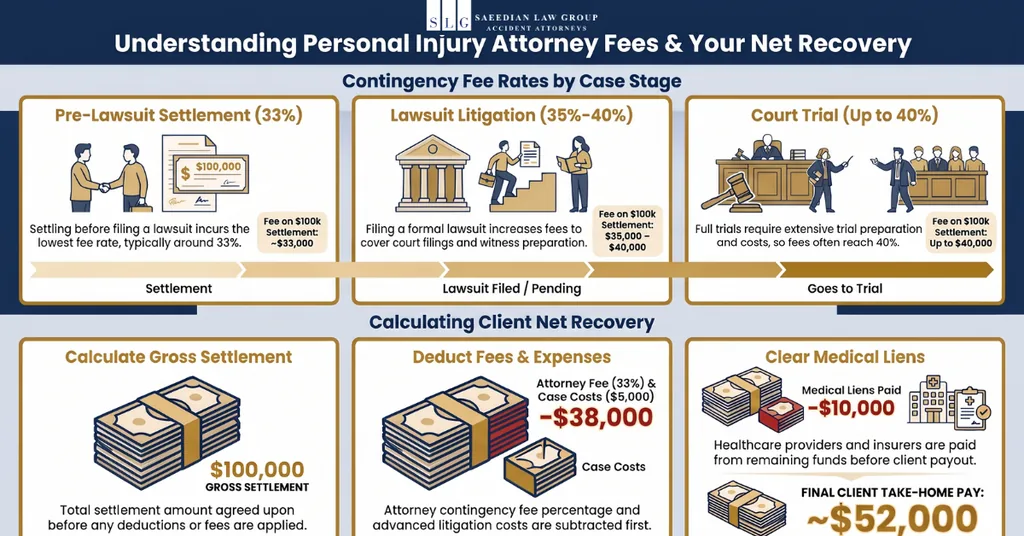
The table below shows how the fee usually changes as a case moves toward a courtroom, using a $100,000 settlement.
| Case Stage | Typical Fee | Fee on a $100,000 Settlement |
| Settles before a lawsuit is filed | About 33% | $33,000 |
| Lawsuit filed, case still pending | 35% to 40% | $35,000 to $40,000 |
| Case goes to trial | Up to 40% | $40,000 |
The dollar amounts above are illustrations and not results from any client. Past results do not guarantee future outcomes.
Most personal injury firms, including those that handle car accidents, charge about 33% when a claim settles out of court before a lawsuit is filed. Once formal litigation begins, the percentage typically rises to 35% to 40%, and trial cases often sit near 40%. Trials require much more preparation, gathering of witnesses, and higher costs, so firms charge more for them.
The costs are distinct from the fee. Along with the percentage charged by lawyers, other expenses such as court filing fees and fees for expert witnesses also come out of the settlement money. Most firms advance them and recover them when the case ends.
Flat Fees vs Hourly Fees
While contingency fees are the most common in personal injury cases, many personal injury attorneys may use flat fees or hourly rates in specific situations. A flat fee is a set amount of money paid for a particular service, regardless of the time it takes. This is rare in personal injury cases but might apply for very simple tasks, such as drafting a demand letter or reviewing settlement documents. For example, a lawyer might charge one set price to draft a demand letter for a straightforward claim that doesn't require court action.
An hourly rate means the lawyer bills you for every hour they work on your case. Hourly fees can range widely depending on the lawyer's experience and location. An hourly fee arrangement is more common in business disputes, contract reviews, or family law. But some personal injury attorneys may use it if the case seems uncertain or too small to justify contingency legal representation.
Compared with these options, contingency fee arrangements are usually more client-friendly in a personal injury claim. They remove the need for upfront payments and shift the financial risk to the lawyer, since they only get paid if you win. Flat or hourly fees, on the other hand, require clients to pay out of pocket, no matter the outcome, which can be costly in long or complex cases.
How Contingency Fees Are Calculated in Personal Injury Cases

Knowing how the math works lets you see how much of the final settlement you keep. It also lets you compare agreements before you sign. This calculation involves five steps and an example here uses a settlement of $100,000.
Start With the Total Compensation
First, identify the gross amount, which is the total settlement or award before anything is deducted. In our example, the gross recovery is $100,000.
Apply the Agreed Percentage
Then apply the percentage written in your fee agreement. A 33% fee on a $100,000 settlement is $33,000, and if you pay a fee of 40% after going through trial, that fee will be $40,000. The firm typically deducts its fee before it subtracts other expenses.
Deduct Case Expenses
Then the firm deducts costs for things like court filing fees, retrieval of medical records, and expert witness fees. Some firms calculate their percentage after costs come off the top, which favors you, and others use the gross amount. On $10,000 in costs, that choice changes a 33% fee by about $3,300, so ask which method your agreement uses.
Pay Medical Liens and Reimbursements
After that, any medical liens or reimbursement claims are paid from the settlement before the remaining money goes to you. This can come from healthcare providers, insurance companies, or governmental programs like Medicare and Medicaid that paid for your treatment.
Calculate Your Net Recovery
Finally, subtract the fee, the costs, and the liens from the gross amount to find your net recovery. This table works through an example using a fee rate of 33%, for $5,000 in case expenses and a lien worth $10,000.
| Item | Amount |
| Total settlement | $100,000 |
| Attorney fee at 33% | $33,000 |
| Case costs | $5,000 |
| Medical lien | $10,000 |
| Net to the client | $52,000 |
This example is an illustration and not a result from any client. Past results do not guarantee future outcomes.
What Factors Affect Personal Injury Attorney Fees?
Several factors move the percentage up or down, and knowing them before you sign helps you judge whether an offer is fair.
The Stage of Your Case
When a case settles before a lawsuit is filed, the fee is usually the lowest, often around 33%. Once the lawyer files a personal injury lawsuit, takes depositions and prepares witnesses, the typical percentage tends to move up into the range of 35% to 40%. The more complex the case, the higher the fee tends to be.
Case Complexity
A minor car accident with clear fault usually gets resolved more quickly and has a higher chance of success; this allows for a lower percentage. Legal complexities such as several defendants, disputed fault, or expert testimony take more research and money, so fees can climb toward 40%. Costs also accumulate quickly in complex cases, which affects what you keep. Medical malpractice cases are a common example because they usually require expert review.
State Laws and Fee Caps
Some states regulate contingency fees and cap them for specific claims. California has restrictions on fees in claims against healthcare providers under Business and Professions Code section 6146. That law allows 25% of a recovery reached before a complaint or arbitration demand is filed, and 33% after one is filed. A court can approve a higher fee for good cause.
Different states take different approaches. Florida's constitution lets claimants in medical liability cases keep at least 70% of the first $250,000 in damages and 90% of any amount above that. New York's Judiciary Law sets a sliding scale for medical malpractice: 30% of the first $250,000, 25% of the next $250,000, 20% of the next $500,000, 15% of the next $250,000, and 10% of any amount over $1,250,000. For most other injury claims, no statute fixes the rate, which is why the percentage in your agreement is negotiable.
Law Firm Policies
Every personal injury law firm has its own fee schedule. Some larger firms charge more, and smaller firms may offer more flexibility on the percentage or on how costs are handled. Get the policy in writing before you commit.
Negotiation and Your Fee Agreement
Because no statute fixes the rate for most injury claims, the fee is often negotiable before you sign. A lawyer may adjust the percentage depending on the strength of the case, the likely size of the recovery, and your financial responsibilities. The expected timeline matters too, since an attorney who expects a quick resolution may accept a lower rate.
What Are the Hidden Costs in Personal Injury Cases?

Case costs are the part of a settlement many clients overlook. They include fees for filing court papers, medical records fees, witness fees for experts, costs of depositions and investigator expenses, as well as mediation fees. Other costs, such as service fees for delivering legal papers, can also appear. Most firms advance these expenses and reimburse themselves from your settlement.
Even if there is no recovery, depending on the terms of your agreement, you may still owe money for things like getting medical records. Ask whether you will be responsible for costs only if there is a recovery, or if you're on the hook for those costs regardless of results. These additional costs reduce your take-home amount just as the fee does, so ask for a cost estimate at the start.
For example, if your gross recovery is $100,000, your lawyer takes 33% ($33,000), and case expenses are $10,000, you receive $57,000 before paying any liens. So, understanding these hidden costs helps you set realistic expectations and ask the right questions before signing a fee agreement.
How to Negotiate the Percentage With a Personal Injury Lawyer
Fee negotiation is normal, and many personal injury lawyers will openly discuss terms if they are confident in the case. Bring up the topic during the initial consultation, before you sign anything.
Highlight the Strength of Your Case
A case with clear liability and well-documented injuries carries less risk for the firm. Highlighting that point can help support asking for a slightly smaller percentage. The more likely a recovery looks, the more comfortable a lawyer may be with an adjustment.
Compare Multiple Attorneys
Talking to more than one lawyer shows what local rates look like. If one attorney quotes 40% and another quotes 33%, you can use that difference in the conversation. Bring a list of questions to ask each lawyer; this way you can compare fees, costs, and communication terms fairly.
Balance the Fee Percentage With Experience
A lower percentage is not automatically the better deal. An experienced attorney charging 40% may recover more than a less experienced lawyer charging 30%, leaving you a larger net amount. Weigh the percentage along with the lawyer's track record for cases similar to yours.
Clarify Which Costs Are Included
Find out if costs are deducted before or after the lawyer calculates the percentage. A fee based on the net recovery after costs is usually better for you than one based on the gross amount. Also ask about any costs that will be owed if the case doesn't result in a recovery.
Ask for a Fee Cap
Ask the lawyer to specify a maximum percentage regardless of how long the case goes on. For instance, if something is capped at 35%, that means it will stay capped regardless of whether the case goes to trial or on appeal. That protects you from a fee that creeps upward as the case drags on.
Ask How Costs Are Handled
Even when a lawyer will not lower the percentage, you may be able to negotiate how expenses are handled. Some firms will absorb small administrative charges instead of billing them to you. It costs nothing to ask.
Put Everything in Writing
Any change you agree on belongs in the signed retainer, since California law already requires a written contingency fee agreement. A written term prevents misunderstandings about how the fee will be calculated later. Read the final version carefully before you sign.
How to Find an Experienced Personal Injury Lawyer

The lawyer you hire shapes your case, so the percentage should not be your only consideration. Skill, dedication, and experience in dealing with insurance companies matter just as much.
Start with an attorney who focuses on personal injury law, since family or business lawyers may not know the tactics insurers use. Check that the attorney regularly handles your type of claim, whether a car crash, a slip-and-fall, or a premises liability case.
Next, take a look at their experience and track record. Ask how long the attorney has been practicing and what results they have had in cases similar to yours. Ask also about their trial experience. Most personal injury cases end up being settled before going to trial, but insurance companies usually negotiate much more seriously when they know there is an attorney who is prepared to go to court.
Client reviews and testimonials offer another perspective. Look for comments on responsiveness and communication rather than outcomes alone. Referrals from friends, family, and the local or state bar association referral service can also lead you to good attorneys.
Schedule some free initial meetings with more than one lawyer. You are not obligated to hire the first attorney you meet, so take time to meet with several and get a sense of their experience levels and fee structures. California's statute of limitations limits how long you have to file, so book these meetings soon.
Ready to Work With a Skilled Personal Injury Lawyer?
Knowing how fees for personal injury lawyers work gives you an advantage before you agree to anything. Compare more than one attorney, read the fee agreement closely, and ask what your net recovery could be after fees and liens. The right lawyer will answer those questions plainly and put the answers in writing.
Michael Saeedian has been the founding lawyer of Saeedian Law Group since he was admitted to the California Bar in 2009. Our personal injury team works on contingency across car, truck, Uber and Lyft, pedestrian, dog bite, wrongful death, and premises liability claims. Contact us today for a free consultation, and we can review the fee terms with you before you commit.
Frequently Asked Questions
Our attorneys have handled injury claims on contingency since 2009, so these fee questions come up often in first consultations. The answers below reflect how fee agreements typically work in California. Read your own agreement carefully, because it controls the details.
Do I Owe My Lawyer if I Lose My Personal Injury Case?
Under a contingency fee agreement, you generally owe no attorney fees if the case does not result in a recovery. You may still owe things like filing fees or costs for retrieving records according to your agreement.
Do I Have to Pay Anything Upfront to Hire a Personal Injury Lawyer?
You generally do not pay anything upfront. Contingency fee firms advance the work and costs incurred and then recoup these expenses from any settlement reached. That means there are no fees and no costs up front.
Does a Lawyer's Percentage Increase if the Case Goes to Trial?
It frequently happens that way, usually around 40% because trials require much more preparation and cost. The increase will depend on the terms of your signed agreement.
What Extra Costs Are Deducted From a Personal Injury Settlement?
Court costs like filing fees, fees for experts, medical records, deposition costs and expenses for investigations are typical things. Liens for medical bills are paid out of the settlement money before anything else goes to you. Most firms advance these expenses and recover them at the end.
Are There State Limits on Personal Injury Lawyer Fees?
Some states impose limits on contingency fees for certain types of claims like medical malpractice. California limits those fees to 25% before a complaint is filed and 33% after, although a court can approve a higher fee for good cause, and New York uses a sliding scale.
How Can I Tell if a Lawyer's Fee Is Reasonable?
Most contingency fees fall between 33% and 40%, depending on the stage and complexity of the case. Compare quotes from several attorneys, and review what the fee covers, which costs come out of the settlement, and whether the agreement is in writing.
Attorney Advertising. This article is for general information only and does not constitute legal advice. Reading this doesn't establish any attorney-client relationship with Saeedian Law Group. Fee percentages, costs, and legal limits vary by case and change over time, so speak with a licensed attorney about your situation. Past results do not guarantee future outcomes.
This advertisement is the responsibility of Saeedian Law Group and Michael Saeedian, Esq., California State Bar #265470, 9100 Wilshire Blvd, Suite 500W, Beverly Hills, CA 90212.

Michael Saeedian founded Saeedian Law Group in 2009 with the goal of providing injured individuals and their loved ones with caring, personalized, and attentive legal representation.