
A dog bite can leave you with medical bills, missed work, and an injury that takes time to heal. The insurance company may offer you money before you know how much the injury will really cost; do not rush to accept the first offer. You should also have records of your medical treatment, lost income, and other costs before you negotiate. You need to know what your claim is worth before you agree to a settlement.
Saeedian Law Group has more than 16 years of experience representing injured Californians. We have secured settlements and verdicts of more than $12 million and handle dog bite claims throughout California, working on a contingency fee basis, so you pay no upfront legal fees and only pay if we recover compensation for you. Call us today for a free consultation.
This article explores dog bite settlements, steps to take after a dog bite, and ways to determine liability.
Understanding Dog Bite Laws in Different States

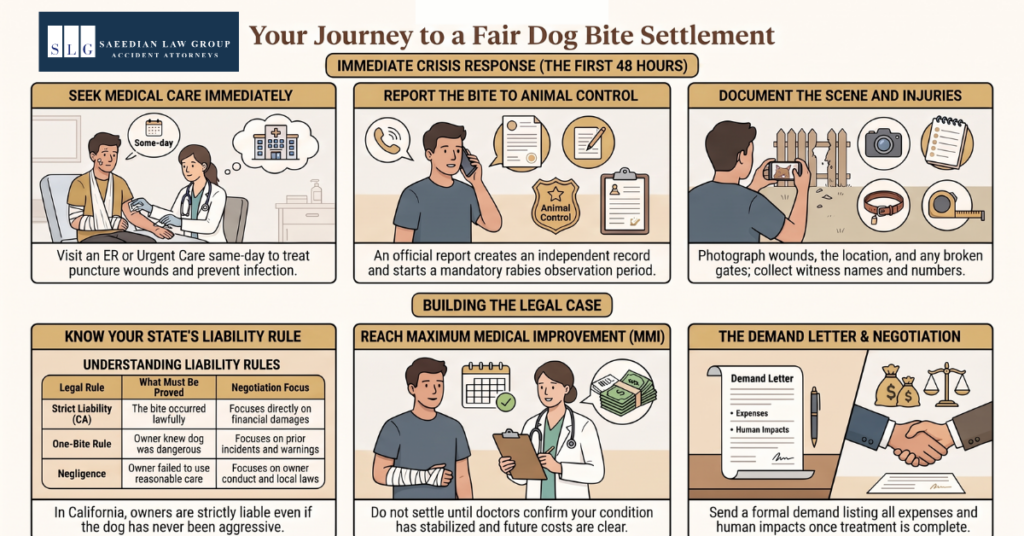
Everything about your negotiation starts with which rule your state follows. Roughly two-thirds of states apply a strict liability rule. Dog owners are responsible for the bite whether or not the animal ever showed aggression. The rest follow some version of the one-bite rule, where you must prove the owner knew the dog was dangerous.
California is a strict liability state, and the statute is unusually direct. Civil Code section 3342 makes an owner liable when a dog bites someone in a public place, or lawfully on private property. Liability attaches “regardless of the former viciousness of the dog or the owner’s knowledge of such viciousness.”
The statute also covers people on the property doing a job imposed by law, which is why mail carriers are protected. That protection gets used. The Postal Service reported more than 5,200 dog attacks on its employees nationwide in 2025, with California leading every state at over 770. Los Angeles ranked first among all cities, with 70 attacks.
That difference affects how the negotiation plays out. The table below compares what you can expect from each approach.
| Legal approach | What you must prove | Where the negotiation actually goes |
| Strict liability, including California | That the dog bit you and you were lawfully there | Straight to damages, since liability is rarely winnable for the insurer |
| One bite rule | That the owner knew or should have known the dog was dangerous | Prior incidents, complaints, and warning signs come first |
| Negligence based | That the owner failed to use reasonable care, such as breaking a leash law | Owner conduct, local ordinances, and your own behavior |
Knowing your local rule changes your strategy rather than just your paperwork. In a strict liability state, an adjuster may argue the dog had never bitten anyone. The statute already answered that. In a one-bite state, that same argument is the case. Comparative fault still matters everywhere, because provoking the dog or trespassing reduces what you recover.
Steps to Take Immediately after a Dog Bite
What happens in the first 48 hours after a dog attack sets the ceiling on your claim. Dog bites carry infection risk that visible severity hides, and the record you create now is the record an adjuster reads months later.
1. Get Medical Care the Same Day
Go to an urgent care or emergency room even for minor injuries. Puncture wounds close over bacteria, and infection is the complication that turns a small claim into a serious one. Same-day medical attention also removes the argument that something else caused your injuries.
2. Report the Bite to Animal Control
Call animal control or your local authorities, not just the police. This creates an official record, starts the rabies observation period, and puts the dog into a system that tracks prior incidents. Get the report number. Claims without an animal control report are worth measurably less because nothing independent corroborates the dog bite incident.
3. Photograph Everything Before It Heals
Photograph the wounds the same day, then again every few days as they change. Photograph the location where the bite occurs, any broken fencing or open gate, and the dog if you can do it safely. Bite wounds look worst around day three, and scarring photographs badly once it fades.
4. Collect Witness Statements While Memories Are Fresh
Get names and phone numbers from anyone who saw it. Neighbors know the dog’s history better than anyone, and one of them will tell you about an earlier incident nobody reported.
How to Gather Evidence for a Dog Bite Claim
The strongest evidence in a dog bite claim usually comes from your records. Medical records, bills, animal control reports, and photos can all help show what happened and how the injury affected you. Request your medical records early instead of waiting for the insurer to ask for them. This gives you time to correct missing information or billing errors before sending your demand.
Witness statements are more useful when they come from people who have no connection to either side. An adjuster may give more weight to what a neighbor saw than to a statement from a family member. Ask the witness what they saw, whether they had seen the dog loose before, and whether they knew of any earlier complaints. Write down their answers, add the date, and have the witness sign the statement if possible.
Public records are the part most people skip. Animal control keeps a history on individual dogs, and prior complaints about the same animal are usually obtainable. That history does not change liability under the strict liability rule. It changes the value, because it undercuts any claim that the attack was a freak event.
Expert opinions come later and only in some cases. A plastic surgeon’s report on scar revision converts a description of your dog bite injuries into a number. A life care planner does the same for future medical care. An animal behaviorist matters more where the owner disputes provocation.
Determining Liability for the Dog Bite
Start by identifying every responsible party, because it is not always the person holding the leash. The owner is the obvious defendant. A keeper, such as a dog sitter or kennel, can also be liable. Landlords occasionally are, where they knew about a dangerous animal and had the power to remove it. So you may still seek compensation even when the owner has nothing. Each additional party can mean an additional insurance policy.
In California, the strict liability rule does most of the work, so proving the owner’s knowledge is not required. It still helps. Evidence that the owner knew the dog was aggressive, ignored a leash law, or had been warned matters. It pushes such cases out of routine territory and toward higher offers.
Leash laws and local ordinances are worth checking in every case. A violation is not automatically liability, but it is concrete, documented, and hard to argue with. Adjusters price certainty, and an ordinance violation removes doubt. The legal system treats a documented violation very differently from a neighbor’s recollection.
How a Dangerous Dog Hearing Changes Your Case
There may also be a separate proceeding involving the dog that runs alongside your injury claim. For a dog bite victim in California, knowing about this process can be important. Food and Agricultural Code section 31621 covers it. If an animal control officer finds probable cause that a dog is potentially dangerous or vicious, the agency petitions for a hearing. Cities and counties may run this as an administrative hearing instead. The standard is a preponderance of the evidence, the same standard as your civil claim.
The definitions are specific. Section 31602 covers a dog that bites causing a less severe injury, or that twice in 36 months forced someone to take defensive action. Section 31603 defines a vicious dog as one that inflicts severe injury on or kills a person while unprovoked.
Here is why it matters to your settlement. A designation goes into the dog’s licensing records under section 31641. That creates a permanent official finding, by a public agency, that the animal is dangerous. It is no longer your word against the owner’s. The legal process on your claim does not wait for the hearing, so the two run in parallel. Ask animal control whether a hearing has been set, and tell your legal team. The outcome is worth waiting for before you finalize a number.
Calculating the Financial Damages

Your claim has two major components. Economic damages are the receipts. They cover medical expenses, future medical bills, lost wages, lost income, and physical therapy. Scar revision surgery years from now belongs here too, as does mental health treatment. Non-economic damages cover physical pain, emotional distress, and the anxiety around dogs that many dog bite victims carry afterward.
The single biggest mistake is settling before reaching maximum medical improvement. Maximum medical improvement is the point where your doctors say your condition has stabilized and further recovery is unlikely. Until you reach it, nobody can price your future medical costs, and a settlement is final. Children with facial scarring often need revision procedures years later, and that ongoing treatment has to be valued in advance.
For serious injuries, the amount of compensation can be much higher. The severity of the injury and whether it is permanent are two of the biggest factors. Location matters too, because facial and hand injuries carry higher values than a bite to the calf. There is also a limit to how much insurance may be available. Homeowners and renters insurance policies often have $100,000 to $300,000 in liability coverage. If the dog owner has no insurance and few assets, recovering additional compensation may be difficult.
Online settlement calculators are worth mentioning only to warn you off them. They multiply your medical bills by an arbitrary figure and ignore permanence, scarring, coverage limits, and your state’s rules. No adjuster has ever moved because of one.
Negotiating with Insurance Companies
Adjusters evaluate your file on documentation, not sympathy. They read the medical records, look for treatment gaps, check whether an animal control report exists, and estimate what a jury would do. Their tactics are consistent and easy to recognize. Insurance companies request a recorded statement early. They ask for a blanket medical authorization to search your history. They suggest you contributed by approaching the dog. And they put a low initial offer in front of you while you are still in medical care.
The demand letter is where you either win or lose the negotiation phase. Settlement negotiations usually begin after you send the demand letter. A strong demand explains why the other party is liable under the applicable law and lists each expense and loss you are claiming. It attaches the records and quantifies future care with a physician’s support. It describes the human impact in specific terms rather than adjectives, and it goes out after maximum medical improvement, never before.
When the first settlement offer arrives, treat it as an opening position. Ask the adjuster to explain in writing how they reached it, because a number without reasoning is easier to move. Counter with specifics tied to documents. If negotiations stall, filing a personal injury lawsuit before the deadline often restarts them, since most dog bite claims still settle after filing.
The settlement timeline surprises people. From the initial claim to payment, most dog bite cases take at least a few months, and complex ones run past a year. The negotiation process only begins once your treatment record is complete, so the early months are documentation rather than bargaining. Two key factors drive the pace: how fast your medical records arrive, and whether the insurance adjuster has authority to settle at your number.
“The early offer is priced on one emergency room bill,” says Daniella Saeedian, a founding attorney at Saeedian Law Group. “Every week you spend documenting the injury is a week their estimate gets less accurate. That is the whole of it.”
Get an experienced dog bite attorney involved when injuries are serious, or scarring is permanent. The same applies when a child was bitten, liability is disputed, or insurers deny claims outright. Legal representation makes a significant difference in exactly these personal injury cases. Most personal injury lawyers work on contingency, so asking costs nothing.
Is Your Dog Bite Offer Actually a Fair Settlement?
Compare the offer with all the losses you can prove, not just how big the offer looks. If you have not finished treatment, you may not know how much your injury will cost in the end. Check whether animal control has a file on the dog because it may contain useful information for your claim. Once you accept a settlement, you usually cannot ask for more money later, even if you need surgery next year.
At Saeedian Law Group, our legal team works on contingency, so there is no fee unless we recover compensation for you. We handle dog bite claims from our Beverly Hills, Encino, and Rancho Cucamonga offices throughout Southern California. Contact us today for a free case evaluation.
Frequently Asked Questions
This section provides answers to common questions about negotiating a dog bite settlement.
What Steps Should I Take Immediately after a Dog Bite Incident?
Get medical attention the same day, then report the bite to animal control and get the report number. Photograph the wounds and the location before anything heals or changes, and collect names and numbers from witnesses. Keep every bill and every note about missed work. Then speak to a lawyer before you give the dog owner’s insurance company a recorded statement.
How Can I Determine the Value of My Dog Bite Claim?
Add your economic losses first, including medical bills, future medical care, lost wages, and physical therapy. Then account for physical pain, emotional distress, and permanent scarring, which are harder to quantify but often worth more than the bills. A fair settlement amount covers all of it, not just the bills you have already paid. Two things set the practical ceiling: whether you have reached maximum medical improvement, and the limits on the owner’s policy. Averages published online tell you very little about your own case.
Should I Negotiate Directly with the Dog Owner’s Insurance Company?
You can, and for a minor injury that healed cleanly, it may be reasonable. For anything involving stitches, scarring, a child, or ongoing treatment, negotiating alone puts you against someone who does this daily. An adjuster is not required to tell you your claim is worth more than they offered. Personal injury attorneys handle the settlement process routinely and know what comparable cases resolve for. An experienced dog bite lawyer prices the claim on the full record, which is how fair compensation is reached. Choose a law firm with a proven track record in dog bite cases, and remember most law offices review these for free.
How Can I Strengthen My Negotiation Position in a Dog Bite Settlement?
Documentation, consistency, and patience. Attend every appointment, because treatment gaps are the most common reason an adjuster discounts a file. Keep a short daily note on pain and what you cannot do, since that becomes the evidence for non-economic damages. Find out whether animal control has records on the dog. And do not settle until your doctors say you have stabilized.
What Are Common Tactics Used by Insurance Companies to Reduce Dog Bite Settlements?
Four come up in most dog bite cases. They ask for a recorded statement while you are medicated and unclear. They request full medical history access to find a pre-existing condition. They argue you provoked the dog or were somewhere you should not have been. And they make a fast, low offer, hoping the medical bills feel urgent. None of these require a response the same day.
Disclaimer: This article is general information about dog bite claims and is not legal advice. Reading it does not create an attorney-client relationship with Saeedian Law Group. Dog bite laws, deadlines, and available compensation vary by state and by the facts of each case. The statutes described here are California law. Speak with a licensed attorney in your own state before acting on anything here.

Michael Saeedian founded Saeedian Law Group in 2009 with the goal of providing injured individuals and their loved ones with caring, personalized, and attentive legal representation.