

A car accident can leave you with burning pain, tingling fingers, or a leg that will not respond on command. This often results in mounting medical bills, lost wages, and questions about the average payout for nerve damage car accident claims.
Most nerve damage car accident settlements fall in a wide range driven by injury severity, treatment length, and policy limits. Minor and temporary nerve injuries often resolve in the low five figures, while severe and permanent cases can reach six figures or more, especially with documented future medical costs
At Saeedian Law Group, we represent California crash victims with nerve damage, chronic pain, and long-term recovery needs. Our personal injury team has handled nerve damage settlement cases involving sciatic, ulnar, peroneal, and brachial plexus injuries. The brachial plexus is the network of shoulder and arm nerves. Call us today for a free consultation, with no fee unless we recover compensation for you.
This article explores the average settlement amount for nerve damage after a car accident, the key factors that affect settlement value, and the need for legal representation.
What Is the Average Payout for Nerve Damage in a Car Accident?

Nerve damage describes any injury to the nerves that carry signals between your brain, spinal cord, and the rest of your body. Car crashes can stretch, crush, or sever these nerves, producing nerve damage symptoms ranging from numbness to severe pain. Common nerve damage injuries include sciatic nerve damage, peroneal nerve damage, ulnar nerve injuries, and damage to nerve roots near the spine. Some patients also suffer dental nerve damage after airbag deployment or facial impact concentrating on the jaw.
Severity matters because injury severity shapes the entire personal injury claim. Temporary nerve injuries from a pinched nerve may resolve within months with conservative medical treatment. Permanent nerve damage, by contrast, can mean lifelong physical pain, weakness, and loss of fine motor skills. Many drivers who suffered severe injuries from a crash report nerve damage symptoms within days. According to NHTSA’s 2024 Research Note, an estimated 2.42 million people were injured in U.S. motor vehicle crashes in 2024. This means that a meaningful fraction of those crash victims walk away with nerve damage injuries that linger.
Average Settlement Payouts
National claims data offers a starting point, but no single average payout for nerve damage applies to every case. The Insurance Information Institute reported that the average auto bodily injury claim in 2024 was $28,278. That figure mixes minor injuries with severe injuries, so the average settlement for nerve damage usually lands well above that baseline. Settlement value for severe nerve damage cases often ranges from tens of thousands into the high six figures.
Public verdict reporters describe dental nerve damage ranges between $5,000 and $75,000 depending on permanence. Dental nerve damage compensation tends to track with how lasting the numbness or pain becomes. Sciatic nerve damage settlements involving radiating pain, herniated discs (bulged spinal cushions pressing on nerves), or surgery sometimes exceed $100,000 in serious injury claims. Individual results vary by case, jurisdiction, and the strength of evidence presented.
How Is the Average Payout Determined for Nerve Damage in a Car Accident?
Insurance adjusters and courts use a structured approach to value a nerve damage claim. They review medical records, treatment timelines, and how the injury affects daily life. California allows injured victims to recover both economic damages and non-economic damages. Economic damages cover out-of-pocket costs like bills and lost wages, while non-economic damages cover the pain and suffering you experienced as a result of the injury. Adjusters also examine medical evidence, witness statements, and any prior injuries that might complicate causation arguments.
Medical Expenses
Medical expenses form the foundation of any personal injury claim involving nerve damage. This category includes emergency care, surgery, nerve conduction studies, imaging, and ongoing medical care after discharge. Nerve conduction testing helps establish nerve damage and provides defensible, objective evidence for the claim. Future medical care, future medical expenses, and future medical costs also belong in the claim. Life-care planners and treating doctors help estimate long-term costs for the demand package. Strong medical records throughout treatment make the medical-costs portion of a nerve damage claim much harder for an adjuster to discount.
Lost Wages
Lost wages cover the income you missed during treatment and recovery from the crash. For workers in manual labor, nerve damage can reduce grip strength, balance, and fine motor skills needed for the job. These limitations often reduce earning capacity and increase economic damages. Pay stubs, tax returns, and an employer letter help document this part of the injury claim. Self-employed workers can use invoices, contracts, and prior tax filings to show income disruption credibly.
Pain and Suffering
Pain and suffering compensates for physical pain, severe pain, emotional distress, and mental anguish caused by the crash. Ongoing and chronic pain, radiating pain, and complex regional pain syndrome all carry significant settlement weight. Adjusters frequently apply a multiplier method, multiplying medical bills by a factor of roughly 1.5 to 5 to estimate pain and suffering.
That range is not a guarantee, and severe nerve damage cases sometimes warrant a higher figure based on documented impact. An alternative is the per diem method. It assigns a daily dollar value to recovery from the crash through maximum medical improvement. Permanent disability, ongoing pain management, and lifestyle limits all push the value upward. Nerve damage affects sleep, work, mood, and physical function in ways that disrupt every part of life.
Role of Insurance Companies
Insurance companies aim to close files quickly and pay as little as defensible under the policy. Early settlement offers usually arrive before the injured person reaches maximum medical improvement. Maximum medical improvement, or MMI, marks the point where a doctor expects no further significant recovery. Settling before MMI risks leaving future medical costs and long-term symptoms out of the payout entirely.
Adjusters also look for ways to attribute fault to the injured driver and discount the claim. California follows pure comparative fault under Li v. Yellow Cab Co. (1975). Your recovery is reduced by your share of fault, even if you were mostly at fault for the crash. A careful response to recorded-statement requests protects the value of the claim early on.
Factors Influencing Nerve Damage Settlement Amounts

Nerve damage settlements can vary widely depending on the specifics of your case and the quality of your legal representation. Below are certain factors that significantly impact settlement values.
Severity and Permanency of Injury
Injury severity drives the single biggest factor in any nerve damage settlement. A temporary pinched nerve that resolves within three months falls at the lower end of the range. Permanent nerve damage involving complex regional pain syndrome, ongoing pain management, and disability falls at the higher end. Settlement for nerve damage usually increases when there is documented evidence from nerve conduction studies, MRI findings, and specialist opinions.
How much compensation a claim recovers also depends on how the injury affects work, sleep, mood, and relationships. Nerve damage compensation should reflect both immediate and long-term consequences of the injury. A clear treating-physician opinion on whether the injury is permanent often supports a higher demand.
Younger plaintiffs with longer expected years of impairment usually receive more serious non-economic damages. Older plaintiffs with significant pre-injury function loss may see lower numbers, even with similar nerve damage. Detailed before-and-after testimony from family, coworkers, and treating providers strengthens the human side of the claim.
Legal Representation
An experienced personal injury attorney has a huge impact on the settlement amount of a claim. A qualified personal injury attorney knows how to prove nerve damage with objective testing and treating-physician testimony. According to Daniella Saeedian, a Saeedian Law Group personal injury attorney: “Nerve injuries hide on x-rays. You win these cases with electromyography results, treating-doctor narratives, and a clear damages story.”
Electromyography (EMG) measures electrical activity in nerves and muscles. While statistical claim-by-claim comparisons are still debated, having legal representation generally improves outcomes in serious injury claims. Under California Business and Professions Code 6147, contingency fees and costs must be disclosed in writing. Fees are negotiable, and costs may still be owed in some scenarios even if no recovery occurs. Reading and asking questions about that retainer agreement protects you from surprises down the road.
State Laws and Regulations
California rules shape every nerve damage claim filed in the state. California Code of Civil Procedure 335.1 sets a two-year statute of limitations for personal injury cases. Missing that deadline usually ends the personal injury lawsuit before it begins. Proposition 213, codified at Civil Code 3333.4, bars uninsured drivers from recovering non-economic damages in most crashes.
That rule alone can reduce a claim’s settlement value by half or more for an uninsured motorist. California uses pure comparative fault, set by the 1975 Li v. Yellow Cab Co. ruling. Your recovery shrinks by your share of blame but never disappears entirely. These state laws make California-specific legal guidance essential for any nerve damage car accident claim.
Common Causes of Nerve Damage in Car Accidents
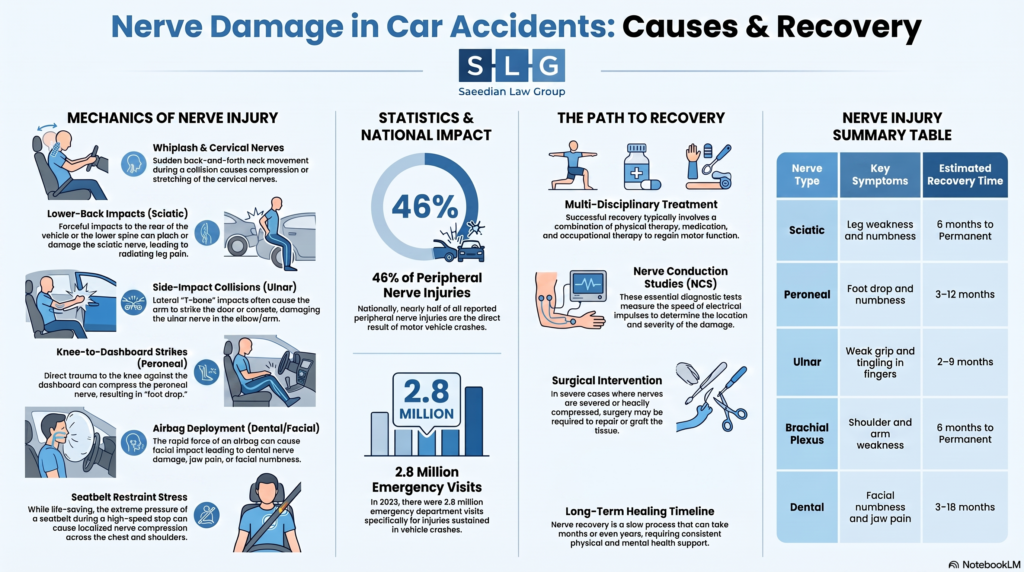
Several crash mechanics produce nerve injuries in California car accidents. Whiplash can stretch the cervical nerve roots, producing radiating pain into the shoulders and arms. Lower-back impacts often trigger herniated discs that compress the sciatic nerve in the lumbar spine. Sciatic nerve damage produces severe pain, weakness, and tingling running from the lower back into the foot.
Side-impact crashes commonly bruise the ulnar nerve at the elbow against the door or armrest. Ulnar nerve injuries affect grip strength and fine motor skills in the ring and little fingers. Knee strikes against the dashboard can crush the peroneal nerve at the side of the knee. Peroneal nerve damage causes foot drop and walking instability during recovery.
Another frequent cause is airbag deployment, which may produce dental nerve damage when facial impact concentrates on the jaw and teeth. A pinched nerve from a seatbelt injury can also produce ongoing pain that mimics severe injuries elsewhere. Identifying the specific nerve involved early helps direct the right medical treatment and supports the claim.
Long-term Effects and Rehabilitation
Recovery from nerve damage takes time, and outcomes vary by nerve type and injury severity. According to the NCBI StatPearls peripheral nerve injury review, motor vehicle crashes cause roughly 46 percent of peripheral nerve injuries nationally. That heavy concentration explains why nerve damage shows up so often in personal injury cases. Treatment typically includes physical therapy, medication, nerve conduction studies, occupational therapy, and sometimes surgery.
Physical therapy rebuilds strength and helps the brain remap signals around damaged nerves over months. Patients with severe nerve damage may need ongoing medical care for years following the crash. Mental anguish and emotional distress often track alongside chronic pain in long-term recovery. The CDC reports more than 2.8 million emergency department visits for motor vehicle crash injuries in 2023 alone.
A share of those visits lead to nerve damage diagnoses confirmed weeks later by specialists. Rehabilitation also includes occupational therapy focused on relearning fine motor skills lost after severe nerve damage. Mood support and counseling help patients cope with chronic pain that does not fully resolve.
The table below summarizes common nerve injuries seen after California car crashes. Recovery ranges are illustrative only, and individual results vary based on diagnosis, treatment response, and overall health.
| Nerve Injury Type | Typical Symptoms | Typical Recovery Range |
| Sciatic nerve damage | Radiating pain, leg weakness, numbness | 6 months to permanent |
| Peroneal nerve damage | Foot drop, lower-leg numbness | 3 to 12 months, sometimes permanent |
| Ulnar nerve injuries | Tingling in ring and little fingers, weak grip | 2 to 9 months |
| Brachial plexus injury | Shoulder and arm weakness, severe pain | 6 months to permanent |
| Dental nerve damage | Facial numbness, jaw pain, taste changes | 3 to 18 months, sometimes permanent |
| Pinched nerve (cervical) | Neck pain, radiating pain, tingling | Weeks to several months |
What Should You Do if You Suffered Nerve Damage in a Car Accident?

Get medical care immediately, document every symptom, and follow the entire treatment plan your providers recommend. Save bills, imaging reports, and a daily journal describing how the injury affects work and family life. Avoid early settlement offers from insurance companies, because those numbers rarely account for future medical needs. Speak with an experienced personal injury attorney before signing anything that resolves your claim. Saeedian Law Group is ready to review your case and explain your compensation options at no cost.
Our personal injury team at Saeedian Law Group has guided California crash victims through complex nerve damage claims. We document injuries thoroughly, push back on lowball offers, and pursue every available category of compensation. Call today for a free, no-obligation consultation, and let us evaluate your nerve damage car accident claim.
Frequently Asked Questions
Below are answers to common questions about nerve damage settlements.
What Is the Process of Filing a Claim for Nerve Damage?
Filing a personal injury claim begins with prompt medical treatment and accurate medical records. Report the crash to law enforcement and your insurer within their stated deadlines. Gather photos, witness contacts, and the police report from the scene. Then consult an experienced personal injury attorney before giving any recorded statement to an adjuster.
Your attorney sends a demand package once you reach maximum medical improvement or have clear future medical projections. California’s two-year statute of limitations under CCP 335.1 puts a hard deadline on the personal injury lawsuit. Missing that window usually bars the claim entirely, no matter how strong the underlying facts.
Can Nerve Damage Lead to Permanent Disability?
Yes, permanent nerve damage can produce permanent disability in some cases. Severe nerve damage involving complete nerve transection rarely returns to full baseline function. Complex regional pain syndrome, sometimes triggered by nerve injuries, often becomes chronic and disabling. A permanent disability finding by a treating physician adds significant weight to settlement value. Vocational experts can also document how the impairment affects future earning capacity for the claim.
What Types of Compensation Can Be Included in a Settlement?
A nerve damage settlement typically covers economic damages and non-economic damages. Economic damages include medical bills, future medical costs, lost wages, and lost earning capacity. Non-economic damages cover pain and suffering, emotional distress, mental anguish, and the impact on quality of life. Some serious injury claims also include compensation for loss of consortium and household services. Punitive damages remain rare and require proof of malice, oppression, or fraud under California law.
Is There a Standard Amount of Compensation for Nerve Damage Cases?
No standard amount applies to nerve damage settlement cases. Payout for nerve damage depends on injury severity, age, occupation, treatment, and applicable state law. Two claims with identical injuries can resolve at very different settlement values based on documentation and venue. Anyone promising a guaranteed maximum compensation figure should be questioned, because results vary by case. Honest counsel discusses likely ranges only after reviewing your records, your facts, and the policy limits at issue.
How Can a Lawyer Help You Obtain a Fair Payout?
A qualified personal injury attorney builds the medical, vocational, and damages evidence the insurer requires. That includes ordering nerve conduction testing, securing treating-physician narratives, and calculating future medical expenses with credible experts. An attorney also handles the insurance companies, deadlines, and lien negotiations that overwhelm most injured people.
Fair compensation and a fair settlement usually require sustained pressure backed by genuine trial readiness. Counsel also identifies every available coverage layer, including underinsured motorist and umbrella policies tied to the at-fault driver. A prepared file gives the claim real weight in mediation, arbitration, or trial, depending on how things develop. Documented refusal to accept inadequate offers signals that the claim has real trial value behind it.
Proper Disclaimer: The content above is provided for general informational purposes only and does not constitute legal advice. Past results do not guarantee or predict future outcomes. Any settlement ranges, multipliers, or calculator-style figures discussed are illustrative estimates only and not predictions for any specific case.
Reading this content does not create an attorney-client relationship with Saeedian Law Group. Saeedian Law Group attorneys are licensed to practice in California and are not certified as specialists by the California Board of Legal Specialization. Every personal injury case turns on its own specific facts and the application of state law. For advice on your particular situation, consult with a licensed California personal injury attorney.

Michael Saeedian founded Saeedian Law Group in 2009 with the goal of providing injured individuals and their loved ones with caring, personalized, and attentive legal representation.