

A back or neck injury after a car accident can change how you sleep, sit, work, and live, and the worry about what your case is worth often shows up before the pain fully settles. Most people in your position are trying to figure out whether the insurance company’s first offer is fair, whether they need a lawyer, and how to plan around medical bills that keep arriving.
The honest answer is that settlement values vary widely, often from a few thousand dollars to several million, depending on facts that may not be obvious at first. Car accident victims with a neck or back injury deserve straight answers about how those numbers are built and where the insurance company is most likely to push back.
At Saeedian Law Group, we focus on serious back and neck injury cases caused by car accidents, and we have seen firsthand how documentation, timing, and skilled negotiation affect settlement values. Our team works directly with treating physicians, accident reconstructionists, and life-care planners to build claims that reflect the full scope of medical, financial, and personal loss while standing up against insurance companies’ usual defenses. If you have been hurt and want a straight read on your options, contact us today for a free consultation.
This article explores the different factors impacting settlement amounts, the step-by-step process for filing a claim, and the different insurance policies that apply.
Factors Affecting Settlement Amounts for Back and Neck Injuries
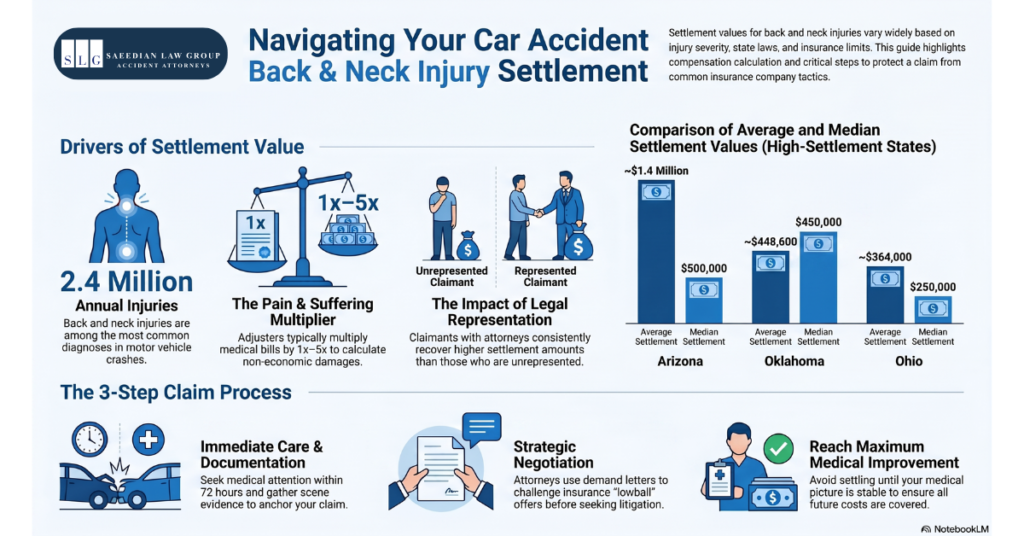
A car accident settlement for a back or neck injury is not pulled from a chart. It is built from a small number of factors that an experienced personal injury attorney weighs together, and the same factors apply across nearly all car accident cases. Understanding each one helps you see where your own claim is strong and where the insurance adjuster is likely to push back.
Severity of Injury
The single biggest driver is how serious the injury actually is. A soft tissue neck strain that resolves in a few weeks has a different outcome from a herniated disc that needs surgery, and both look very different from spinal cord injuries that cause permanent disability. Back injuries are particularly common in rear-end and side-impact collisions. According to the National Highway Traffic Safety Administration, more than 2.4 million people were injured in motor vehicle crashes in 2023, and back and neck injuries are among the most common diagnoses. The more severe injuries usually involve nerve damage, surgical intervention, or lasting limits on movement, and those facts pull settlement values up significantly.
Medical Expenses
Past and future medical expenses anchor most personal injury claim calculations. Past bills cover emergency room treatment, imaging, physical therapy, injections, surgery, and follow-up care. Future medical expenses cover ongoing physical therapy, anticipated injections, possible revision surgery, and pain management. Unpaid medical bills and balances held by providers also figure into the demand. The more extensive medical treatment a claim involves, the higher the floor of the settlement, because the bills are concrete numbers that an insurance company has a hard time disputing.
Loss of Income
Lost wages cover income missed while you recovered. Lost earning capacity addresses the long-term picture when the injury limits the work you can do going forward. A construction worker with a cervical neck sprain that resolves in a month loses a different amount than a roofer with a herniated disc that ends the ability to climb. We calculate lost wages from pay stubs and tax returns, and lost earning capacity often requires a vocational expert who looks at age, education, and work history.
Pain and Suffering
Pain and suffering damages compensate for the human side of the injury. This includes severe pain, shooting pain that radiates into an arm or leg, sleep loss, the inability to enjoy hobbies, and the strain a long recovery places on family. Insurance adjusters usually start with a multiplier of one to two times the medical bills for soft tissue injuries, and three to five for more severe injuries with surgery or permanent residuals. Strong documentation, including a personal pain journal and treating physician notes, can make all the difference in moving that multiplier up.
Legal Representation
Having a skilled attorney involved usually increases settlement value. Insurance companies have decades of internal data showing that represented claimants recover higher injury settlement amounts, even after attorneys’ fees. A car accident lawyer who knows how to value the claim, present the medical records, and credibly threaten a personal injury lawsuit creates the leverage that produces fair compensation. An unrepresented injured person often accepts the first offer and gives up real value.
Average Settlement Amounts by State for Back and Neck Injuries

Settlement values for back and neck injuries vary widely from one state to the next, even when the injuries are nearly identical, because state laws, jury pools, and insurance markets differ. The most important state-level factors are the comparative negligence rule, the presence or absence of damage caps, and whether the state runs a no-fault auto insurance system.
In a pure comparative negligence state like California, an injured person can recover even if partially at fault, with the recovery reduced by their share of fault. In a modified comparative negligence state like Texas or Florida, fault above a threshold (51% in Texas, more than 50% in Florida) bars recovery entirely. No-fault states such as New York and Michigan limit access to general damages unless the injury meets a serious-injury threshold.
High Settlement States
Several states tend to see higher settlement values for back and neck injuries. According to published research, Arizona was placed near the top, with an average settlement of about $1.4 million and a median of $500,000. Oklahoma also showed an average of about $448,600 with a median near $450,000. Ohio averaged around $364,000 with a median of $250,000, and Kentucky averaged about $365,733 with a median of $125,000. California and New York also tend to produce higher payouts because of their cost of living, jury pools, and the strength of damages law in pure comparative negligence systems.
Low Settlement States
States with statutory damage caps or strict no-fault rules tend to produce lower settlements. Some states cap non-economic damages in medical liability or auto cases, which can compress what is available for pain and suffering even when the injury is significant. No-fault states limit lawsuits unless the injury crosses a threshold for permanent or significant impairment, which means routine soft tissue claims often settle within first-party benefits rather than producing a meaningful third-party settlement. The takeaway is that location matters, and a fair settlement in one state can be very different from a fair settlement in another with the same facts.
Real-World Settlement Examples
The four scenarios below show how the dollars come together. They reflect documented patterns and reported case data rather than specific Saeedian clients.
A whiplash injury case is reflected in Victoria Starnes v. Kent Winship, a Missouri rear-end collision settled for $155,000 in March 2026 in Jackson County. The plaintiff was struck so hard her vehicle was pushed into the car ahead, and she suffered neck pain. She also experienced head, back, and spine pain, along with reported confusion at the scene. Medical treatment included emergency department CT imaging of the head, cervical spine, chest, and abdomen, followed by a course of chiropractic care, with the treating provider eventually releasing her at maximum medical improvement with a guarded prognosis.
Past medical bills totaled $102,536.91 before write-offs of about $53,452.12. Lost wages were not itemized in the public summary. Pain and suffering considerations included persistent symptoms after MMI. The settlement value reflected a clear liability picture and well-documented conservative treatment; values like this typically rise with consistent care and fall when records show gaps. Reported by Missouri Lawyers Media.
A herniated disc case is reflected in a confidential South Carolina $4.25 million settlement reached in November 2025 following an October 2022 rear-end collision with a national retailer’s delivery truck. The 29-year-old plaintiff suffered multiple disc injuries, cervical and lumbar radiculopathy, lumbar facet joint injuries, and persistent headaches. Medical treatment included years of physical therapy, multiple injections, radiofrequency ablations, and three spine surgeries. Past medical bills reached $350,802, and future medical costs were projected at $465,906. Lost wages were not itemized in the public summary.
Pain and suffering considerations included chronic pain and loss of functional ability over what would have been a long working life. Value increased because of the documented surgical necessity, well-projected future medical needs, and strong liability against a commercial defendant; the defendant’s initial offer had sat at $75,000 for nearly three years before climbing to $4.25 million shortly before trial. Reported by South Carolina Lawyers Weekly.
A soft tissue neck injury case is reflected in Mickel v. Royal Fam Trucking, a South Carolina jury verdict in which the plaintiff was struck when a dump truck with defective brakes ran a red light. After three months of continued pain that did not resolve with conservative care, the plaintiff obtained a neurosurgical evaluation and underwent radiofrequency ablation. Medical expenses and lost wages were not detailed in the public summary.
Pain and suffering considerations centered on persistent pain that required interventional treatment. The jury returned a $500,000 compensatory verdict plus a $1.5 million punitive verdict against the trucking company, for a $2 million total. Value increased substantially because liability was clear, the brake defect was documented, and the conduct supported punitive damages, which are rarely available in routine soft tissue claims. Reported by South Carolina Lawyers Weekly.
A severe spinal cord injury case is reflected in Shannon Shaw v. Amazon.com Inc., filed in Dorchester County Common Pleas in South Carolina as Case No. 2021-CP-18-02173. The plaintiff was struck by an Amazon delivery van driven by an associate whom internal data showed had more than 90 distracted-driving events in five months of employment. Medical treatment included care for traumatic brain injury, a massive rotator cuff tear, multiple lumbar transverse process fractures and annular bulges, and a cervical disc protrusion treated with cervical fusion surgery and the implantation of two permanent spinal cord stimulators.
Medical expenses and lost wages were not itemized in the public summary, but the economic damage award reflects extensive past and future medical needs. Pain and suffering considerations included permanent disability and lifelong reliance on spinal cord stimulators. The jury returned a $44.63 million total verdict, broken down as $11.11 million in economic damages, $3.3 million in non-economic damages, and $30.225 million in punitive damages distributed across Amazon and the delivery defendants. Value climbed dramatically because of catastrophic permanent injuries combined with documented corporate-conduct evidence supporting punitive damages. Reported by South Carolina Lawyers Weekly.
Process for Filing a Neck and Back Injury Claim

After an accident, the next steps you take can go a long way in determining the outcome of your case. Building a strong claim is a process, and each step protects either the evidence or the value of the case. Below is a step-by-step process on how to file a neck and back injury claim.
Step 1: Seek Immediate Medical Attention
Get medical care the same day, even if your pain seems minor. Many back and neck injuries do not produce symptoms immediately, and discomfort may not appear until 24 to 72 hours after the collision. Prompt medical evaluation also creates documentation that can support your injury claim.
Step 2: Call 911
Report the accident to law enforcement and request emergency assistance if anyone is injured. A police report can provide important details about the crash and may include statements from drivers and witnesses that become valuable evidence later.
Step 3: Gather Evidence
Take photographs of the vehicles, the accident scene, road conditions, traffic signs, and any visible injuries. If possible, collect witness contact information and preserve any other evidence that may help establish what happened.
Step 4: Notify Your Insurance Company
Inform your insurance company about the accident as soon as possible. Provide accurate facts about the crash, but avoid giving a recorded statement to the other driver’s insurance company before understanding your legal rights.
Step 5: Save Every Medical Record, Bill, and Receipt
Keep all medical records, treatment notes, prescription receipts, repair estimates, and other accident-related expenses organized in one place. These documents can help demonstrate the extent of your injuries and financial losses.
Step 6: Speak With an Experienced Attorney
Before signing any settlement agreement or accepting an offer from an insurance adjuster, consider speaking with an experienced personal injury attorney. Legal guidance can help you understand the value of your claim and avoid accepting less compensation than you may be entitled to receive.
Step 7: Negotiation Process
Once treatment is well underway and the injury picture is clearer, your attorney sends a demand letter that lays out liability, medical records, medical bills, lost wages, and a calculation of pain and suffering. The insurance company responds with a number, and settlement negotiations follow. Most personal injury cases settle in this phase. A skilled attorney pushes back on lowball offers using the records, witness statements, and credible willingness to file suit.
Step 8: Litigation
When negotiations stall, filing a personal injury lawsuit moves the case into formal discovery, depositions, and trial preparation. Litigation can add a year or more to the timeline and increase costs, but it also creates leverage. Many cases settle in mediation after key depositions are taken. The decision to litigate is strategic and depends on the offer, the evidence, the venue, and the client’s goals.
Understanding Insurance Policies and Their Influence

Insurance policies and the insurance company on the other side shape settlement outcomes as much as the medical facts. The relevant policies typically include the at-fault driver’s bodily injury liability coverage, the injured person’s underinsured or uninsured motorist coverage, personal injury protection or MedPay benefits where applicable, and health insurance that covers treatment with potential subrogation later. Policy limits often define what is realistically available. A serious injury with a low-limit policy may force a turn to underinsured motorist coverage, and that is one of the most overlooked sources of recovery in serious cases.
Insurance adjusters are trained to minimize payouts. Common insurance company tactics include requesting a recorded statement to catch inconsistencies, pointing to any gap in medical treatment, arguing that pre-existing conditions caused the symptoms, hiring private investigators to conduct surveillance, and making fast lowball offers before the full extent of the injury is known. An experienced personal injury lawyer prepares for each tactic and protects the car accident claim.
Common Settlement Mistakes
A few avoidable mistakes consistently reduce settlements. Accepting the first offer before reaching maximum medical improvement leaves money on the table. Posting on social media during a claim hands the defense unhelpful evidence. Missing the statute of limitations, which is typically two to three years from the date of the crash but varies by state, can end an otherwise strong claim entirely. Treating inconsistently or skipping appointments creates exactly the gap the insurance adjuster is looking for. None of these are technical errors; they are mostly avoidable with steady guidance.
Conclusion
Average settlements for car accident back and neck injuries cover a wide range, with soft tissue claims often resolving in the low five figures and herniated disc or spinal cord injury cases reaching into the hundreds of thousands or millions. The number that fits your case depends on injury severity, total medical expenses and future medical expenses, lost wages and lost earning capacity, pain and suffering, clear liability, your state’s rules, and the available insurance coverage.
Strong documentation and experienced legal representation consistently move settlement values upward, which is why injury victims who hire counsel typically see higher recoveries. Avoid the common mistakes that quietly reduce claims, and do not accept the insurance company’s first offer without an honest second look. Take the steps now that protect your evidence, your treatment, and your final car accident injury settlement.
At Saeedian Law Group, we have over 16 years of experience handling back and neck injury claims caused by car accidents, including herniated discs, surgical cases, and serious injuries with permanent disability. Our team is committed to giving injured clients straight answers, careful preparation, and the steady representation that settlement negotiations require. Contact us today to get started on your claim.
Frequently Asked Questions (FAQ)
This section provides answers to common questions about car accident neck and back injury settlement.
What Factors Determine the Average Settlement for a Car Accident Back and Neck Injury?
The main drivers are the severity of the injury, the total medical expenses (past and future), lost income and lost earning capacity, the strength of pain and suffering documentation, the clarity of liability, the state’s legal rules on comparative negligence and damage caps, and the available insurance coverage. The interplay between these factors decides whether a case settles toward the low end, middle, or high end of the typical range.
How Is the Average Settlement Amount Calculated for a Car Accident Back and Neck Injury?
Most calculations start with all economic damages: past medical bills, projected future medical expenses, lost wages, and lost earning capacity. To that, attorneys add pain and suffering damages, typically using a multiplier from one to five depending on severity, or a per diem calculation for ongoing impact. The total is adjusted for comparative negligence in states that apply it, capped by available insurance policy limits, and tested against jury verdicts in the venue where the case would be filed.
Can I Estimate the Average Settlement Amount for My Car Accident Back and Neck Injury?
You can estimate a range using your medical bills, expected future treatment, lost wages, and a reasonable multiplier, but the estimate is only as good as the inputs. The average car accident settlement for a back or neck injury depends heavily on those inputs. A whiplash claim with $7,500 in bills might fall in the $12,000 to $25,000 range, while a herniated disc with surgery and $85,000 in bills could land between $185,000 and $400,000. A free consultation with a personal injury attorney gives you a more accurate range built on the venue, the medical records, and the insurance involved.
What Is the Average Timeline for Receiving a Settlement for a Car Accident Back and Neck Injury?
Many soft tissue cases settle within three to nine months after treatment ends. Cases involving herniated discs or surgery generally take six to eighteen months because the medical picture has to stabilize first. Severe injury cases that go through litigation can take 18 months to three years. The strongest move is usually to wait until maximum medical improvement, because settling earlier can leave unpaid medical bills and future care uncovered.
What Should I Do If I Am Offered a Settlement for My Car Accident Back and Neck Injury?
Do not sign or cash the check until an experienced personal injury attorney has reviewed it. Early offers are often well below the value of the claim, especially when future medical expenses or lost earning capacity have not been calculated. A free consultation can confirm whether the number is fair or whether negotiation can move it. Once you sign a release, the claim is over, so the time to evaluate the offer is before you accept it.
This article is for general informational purposes only and does not constitute legal advice. Settlement ranges are illustrative and based on reported case data, not a guarantee for any particular case. Personal injury laws, including the statute of limitations and comparative negligence rules, vary by state. Reading this article does not create an attorney-client relationship. If you have suffered a back or neck injury in a car accident, consult a licensed personal injury attorney about your specific situation.

Michael Saeedian founded Saeedian Law Group in 2009 with the goal of providing injured individuals and their loved ones with caring, personalized, and attentive legal representation.