

A quick check from the insurance company often arrives within days of a crash, and that first settlement offer can feel like relief when medical bills are piling up. Accepting too fast is the single most common reason injured drivers walk away with less money than their case is actually worth. Your car accident settlement depends on evidence, medical documentation, negotiation skill, and timing far more than on the basic facts of the wreck itself. What follows is a practical playbook for pushing a low offer toward fair compensation.
At Saeedian Law Group, we represent injured drivers, passengers, and pedestrians across California. Our team has handled car accident claims ranging from minor rear-end impacts to severe injuries from high-speed collisions. Contact us for a free consultation, and we will give you our honest assessment before you respond to any settlement offer.
This article focuses on car accident settlements, including how they are calculated and the key factors that affect payout amounts
Understanding the Basics of Car Accident Settlements
A car accident settlement is a written agreement between you and the at-fault driver’s insurance company that closes the claim in exchange for a one-time payment. Once you sign the release, the case is closed for good in nearly every situation. Courts rarely set a signed release aside, even if new injuries surface or treatment runs longer than expected. That permanence is why an experienced attorney treats the first settlement offer as an opening number, not a final figure.
Most car accident claims resolve through private negotiation rather than at trial. The insurance adjuster has a target range pulled from claims-evaluation software, prior payouts on similar injuries, and the strength of the evidence in your file. The settlement amount you ultimately collect comes down to how well your file answers those internal models.
Factors Affecting Settlement Amount
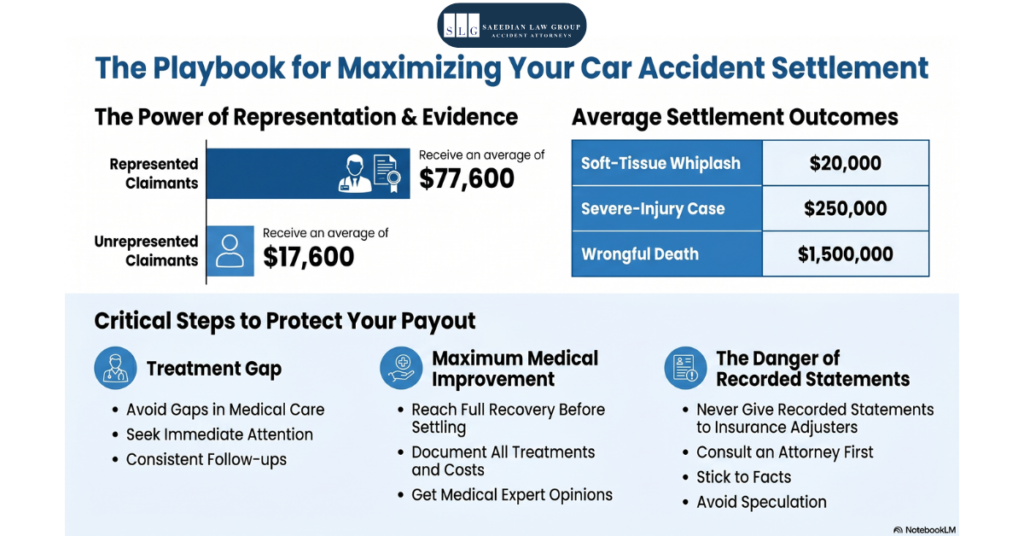
Six things drive the value of a car accident claim: severity of injuries, the clarity of fault, the quality of medical records, lost income, property damage, and the policy limits available. According to ConsumerShield’s June 2026 settlement data, the average car accident injury settlement runs around $28,750, with reported examples such as a soft-tissue whiplash case at $20,000, a severe-injury case at $250,000, and a wrongful death case at $1.5 million. Results vary by case. Pre-existing conditions, gaps in medical treatment, and any contributory fault assigned to you can pull the number down. A qualified personal injury attorney knows which factors carry weight with each insurance company and which are noise.
Gathering Strong Evidence
Evidence is the spine of any injury claim. Adjusters do not pay on stories; they pay on proof, and the stronger your file, the less room the insurance company has to argue your injuries were minor, pre-existing, or unrelated to the crash.
Start at the accident scene when it is safe to do so. Photograph vehicle damage, skid marks, traffic controls, and any visible injuries. Get contact details from the other driver and any witnesses, and write down the basic facts of the accident while they are fresh. The police report, photos from the accident scene, dashcam or surveillance footage, repair estimates for car repairs, and medical records all belong in the file.
Car accident victims who keep detailed records of prescriptions, co-pays, miles driven to medical visits, and missed shifts give their attorney the raw material to push for maximum compensation. Lost wages have to be proven with pay stubs and an employer letter, not estimated from memory.
Seek Medical Attention Immediately

Seek medical attention the same day as the crash, even if you feel fine. Adrenaline masks soft-tissue injuries, concussions, and internal trauma for hours and sometimes days. Any gap between the accident and your first medical visit gives the insurance adjuster a free argument that your injuries came from something else. The longer the injured person waits, the smaller the settlement tends to be.
Medical records are the bridge between the car wreck and the dollar figure on a settlement check. Insurers tie compensation to documented diagnoses, imaging, and the cost of medical care. A clean record that ties the injuries directly to the collision, supported by a treating physician’s narrative, significantly increases what the insurer will pay.
A Martindale-Nolo survey, summarized by FairSettlement.org, reported that claimants with attorney representation received an average of $77,600 compared to $17,600 for unrepresented claimants. Strong documentation does not, by itself, explain that gap, but it tends to track with represented files. The records do not just prove the injury. They drive the math.
Complete All Follow-Up Care
Finish what your medical team prescribed. If the doctor orders eight weeks of physical therapy sessions, attend all eight. If imaging is scheduled, get it. Missed appointments and early discharge signal to an adjuster that the injured person has recovered, regardless of what actually happened. Gaps in ongoing treatment can shave thousands off a settlement amount, and in severe injury cases they can shave six figures.
Adhering to care also builds the documentation needed to prove future damages. Future medical expenses, surgeries that have not yet happened, and long-term physical therapy all have to be supported by a treating physician’s written opinion. Keep a running log of pain levels, sleep quality, and activities you cannot perform. That log feeds the non-economic damages portion of your claim, which often equals or exceeds the economic side. Settling before reaching maximum medical improvement is one of the fastest ways to end up with less money than your injuries actually cost you.
Effective Communication with Insurance Companies
The insurance company representing the at-fault party is not on your side. Their adjuster’s job is to close your file for the smallest defensible figure. Effective negotiation starts with a written demand letter that lays out liability, lists every category of damages, and attaches the supporting records.
Damages include medical bills, lost income, future medical expenses, property damage, transportation costs, and non-economic damages for pain and suffering. Ask for more than you expect, push back with documentation, and avoid the urge to settle just to make the calls stop. A 2025 industry analysis reported by Digital Journal estimated that 68% of California accident victims accept the first settlement offer without legal consultation, and those initial offers averaged just 23% of the victim’s documented expenses.
Common Mistakes to Avoid
Six mistakes recur in undervalued car accident cases. Accepting the first settlement offer is the biggest. Giving a recorded statement to the other party’s insurance without an attorney present is close behind, because adjusters use those calls to lock in language that limits your personal injury claim.
Signing a broad medical authorization lets the insurance company comb through years of unrelated history. Posting on social media hands the defense free evidence. Skipping follow-up care, talking to the at-fault driver’s adjuster about fault, and waiting too long all hurt the financial recovery you can expect.
Consulting with a Legal Expert

An experienced car accident attorney changes the math on a car accident claim. Insurance Research Council data shows represented claimants recover three to three and a half times more on average than unrepresented ones, with the advantage widest in serious-injury cases. An experienced car accident lawyer handles the recorded statements, builds the demand package, applies the right multiplier to non-economic damages, and forces the insurance adjuster to value the claim against a credible threat of litigation rather than a hopeful injured person on the phone.
They also make sure important evidence is not lost or ignored. This includes police reports, medical records, witness statements, photos of the crash scene, and expert opinions when needed. Small details that most people overlook can make a big difference in the final payout.
A lawyer also protects you from saying things that can reduce your claim. Insurance companies often ask questions in a way that gets people to admit partial fault or downplay their injuries. A legal expert steps in to handle all communication so your words are not used against you.
Speak with an Experienced Lawyer today
Getting fair compensation after a car accident is rarely about luck. It is about evidence, medical documentation, patience, and refusing to accept less money than your injury claim is worth. The injured party who treats every step, from the accident scene through ongoing treatment, as part of building the personal injury case walks away with the most money. The one who cashes the first check rarely does.
Saeedian Law Group has built our practice on the negotiation strategies California personal injury settlements respond to, and our team has handled car accident claims involving everything from soft-tissue injuries to multi-vehicle severe-injury cases. We work to understand how each major insurance company values claims and to push them toward a fair settlement instead of a lowball offer. Call us today for a free case review and let an experienced car accident lawyer fight for the financial recovery your case may support.
Frequently Asked Questions
Below are answers to common questions about how to get more money from a car accident settlement.
How Can I Maximize My Car Accident Settlement?
To get the most money from a car accident claim, act like the case might go to trial from day one. Seek medical attention immediately, complete every prescribed course of medical treatment, keep detailed records of medical costs and lost wages, avoid recorded statements with the other driver’s insurer, and bring in a qualified personal injury attorney before responding to any settlement offer. Wait until your doctor signs off on maximum medical improvement before agreeing to settle.
What Factors Affect the Amount of a Car Accident Settlement?
Many factors influence the final accident settlement: severity of injuries, clarity of fault, quality of medical documentation, lost income, property damage, available policy limits, and your state’s comparative-fault rules. Pre-existing conditions, treatment gaps, and social-media missteps can pull the number down. California follows a pure comparative-fault rule, so even partial fault on your side reduces but does not eliminate recovery. How well the file is built matters as much as the basic facts of what happened.
Is It Possible to Negotiate a Higher Settlement?
Yes, and most car accident claims settle higher than the initial offer when the file is built correctly. A written demand letter, treating-physician opinions on future medical expenses, documented lost wages, and a willingness to file suit all push the insurer’s number up. An experienced car accident lawyer is the most reliable tool for turning a lowball first offer into a fair settlement and securing additional compensation.
Should I Accept the First Settlement Offer from the Insurance Company?
Almost never. The first settlement offer is the insurance company’s opening number, not its final one, and early offers arrive before you have reached maximum medical improvement and before future medical expenses are documented. Accepting a quick check closes the personal injury claim, so any new injuries or ongoing treatment becomes your problem. Counter with a documented demand and consult an experienced car accident lawyer before signing anything.
How Long Does a Car Accident Settlement Take in California?
Most California car accident cases settle within six to eighteen months from the date of the crash, though severe injuries or disputed-liability claims can take longer. A simple property-damage-only matter can close in weeks. A claim that requires you to reach maximum medical improvement and exchange a demand and counter-demand typically takes several months. If the insurance company refuses a fair settlement and your attorney files suit, expect at least another twelve to twenty-four months.
What Does the Contingency Fee Cover, and Can I Keep My Own Doctor?
A standard contingency fee in California personal injury cases runs around one-third of the recovery, sometimes higher if a lawsuit is filed. The fee comes out of the settlement, so you pay nothing up front and owe nothing if there is no recovery. You can keep seeing your own treating doctor in most cases.
Legal Disclaimer: The content above is provided for general informational purposes only and does not constitute legal advice. Past results do not predict or guarantee future outcomes, and every car accident case turns on its own specific facts. Saeedian Law Group is licensed to practice in California, and reading this content does not create an attorney-client relationship. For advice on your particular situation, consult with a licensed personal injury attorney.

Michael Saeedian founded Saeedian Law Group in 2009 with the goal of providing injured individuals and their loved ones with caring, personalized, and attentive legal representation.