
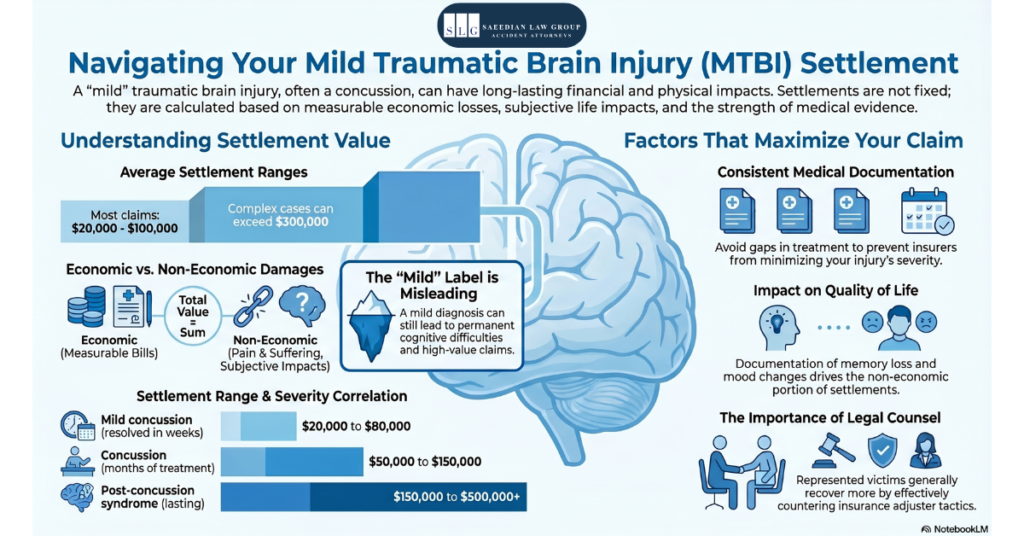
If you are researching mild traumatic brain injury settlements, you are most likely trying to answer one question: What is my claim worth? Most mild TBI and concussion cases settle somewhere between roughly $20,000 and $100,000, while claims involving post-concussion syndrome, lasting cognitive difficulties, or significant lost income can climb well past $300,000. The figure turns on how well your injury is documented, how long your symptoms last, and how clearly someone else’s negligence caused the crash.
Saeedian Law Group has over 16 years of experience in helping injured victims pursue the compensation they deserve after serious accidents and injuries. We understand the physical, emotional, and financial challenges that often follow a traumatic injury, and we are committed to providing skilled legal representation every step of the way. If you have been seriously injured in an accident, reach out to us today to pursue fair compensation.
This guide explains how these settlements are calculated, what strengthens a claim, and how an experienced personal injury attorney builds settlement value.
What Constitutes a Mild Traumatic Brain Injury?
A mild traumatic brain injury is the most common form of brain injury, yet it is also the one insurance companies fight hardest to minimize. Understanding what the injury is and how it differs from a severe traumatic brain injury is the starting point for any claim.
A mild traumatic brain injury, often called a concussion, is a traumatically induced disturbance of brain function caused by a blow to the head or a sudden jolt that shakes the brain inside the skull. According to the National Institute of Neurological Disorders and Stroke, a concussion is a type of mild TBI that can take minutes to several months to heal. Common symptoms of a mild traumatic brain injury include:
- Headaches and dizziness
- Confusion and difficulty concentrating
- Memory loss and slowed thinking
- Sensitivity to light or noise
- Mood swings, irritability, and changes in behavior
- Sleep disturbances and fatigue
Many people walk away from a car crash believing they are fine, only to notice cognitive difficulties and emotional changes days later. That delay is normal, and it is one reason immediate medical care matters so much to both recovery and any later claim.
Mild vs. Severe Traumatic Brain Injuries
The word mild describes the initial injury, not the long-term impact. A mild brain injury involves brief or no loss of consciousness and a normal or near-normal initial scan, while a severe traumatic brain injury involves extended unconsciousness, clear damage on imaging, and a high risk of permanent injury.
The label matters for diagnosis, but it can be misleading in a settlement. A so-called mild TBI that develops into post-concussion syndrome can affect daily life for years, and its settlement value can exceed that of injuries that sound worse on paper. A closed head injury, where the skull is not penetrated, is the typical mechanism in both mild and severe cases.
The Legal Process for MTBI Settlements

Following an MTBI, there are several important steps to take that can help protect both your health and any potential injury claim. First, get immediate medical care, even if symptoms seem minor, as a documented diagnosis at or near the time of the crash is the backbone of the claim. After receiving an initial evaluation, follow through on all recommended medical treatment, including any referral to a neurologist or specialist, to ensure your condition is properly monitored and treated.
In addition, report the accident and obtain the accident report, as this can serve as valuable evidence later on. As you move through the recovery process, keep every record, including medical bills, pay stubs for lost income, and a simple journal of your symptoms, since these documents can help demonstrate the impact of the injury. Finally, speak with a personal injury attorney before giving a recorded statement to any insurance adjuster so you can better understand your rights and avoid unintentionally harming your claim.
Every state sets a deadline, called the statute of limitations, for filing a personal injury lawsuit. Waiting too long can end a valid claim before it starts. Early legal action also protects evidence while it is fresh, including witness statements, accident reports, and surveillance footage that can disappear within weeks. Acting promptly does not mean rushing to settle. It means preserving your options while your attorney builds the case.
The Role of Personal Injury Attorneys
Brain injury victims who hire a lawyer generally recover more than those who handle claims alone, because a personal injury lawyer understands how TBI settlement values are determined and how to counter insurer tactics. This is true for TBI victims across the full range of head injuries, from a single concussion to severe injuries with lasting deficits.
An experienced personal injury attorney investigates how the crash happened and gathers and organizes your medical records. They also work with medical and vocational experts, calculate the full value of your damages, and negotiate with insurance companies on your behalf. If the insurer refuses a fair settlement, your attorney can file a brain injury lawsuit and take the case to trial. Most personal injury claims still settle before trial, but the willingness to litigate is often what moves an insurer to a fair number.
When choosing an attorney, look for a law firm with specific experience in brain injury cases, a record of handling traumatic brain injury cases through trial when needed, access to medical and economic experts, and clear communication about your options. A free consultation lets you judge whether the attorney understands the medical and legal sides of mild traumatic brain injury claims before you commit.
How Mild TBI Settlements Are Calculated
A settlement is not a single number pulled from a chart. It is the sum of your losses, divided into two categories that attorneys and insurers both recognize.
Economic Damages
Economic damages are the measurable financial losses you can prove with bills, receipts, and pay records. In a mild TBI claim, they typically include:
- Medical expenses for emergency treatment, imaging, and follow-up care
- Ongoing medical treatment, such as physical therapy and occupational therapy
- Future medical expenses and future medical bills for care you will still need after the settlement
- Lost wages for time missed during recovery
- Lost earning capacity when the injury limits the work you can do going forward
Future losses are where mild TBI cases are won or lost. A vocational expert and an economist can project the cost of ongoing medical treatment and reduced earning capacity over a lifetime, and that projection often dwarfs the bills you have already paid.
Non-Economic Damages
Non-economic damages compensate for losses that have no monetary value. These cover physical pain, emotional distress, loss of enjoyment of life, and the strain a brain injury places on relationships and daily life. Because these losses are subjective, strong documentation and credible testimony are what give them weight. The table below shows how the two categories compare.
| Damage Type | What It Covers | How It Is Proven |
| Economic damages | Medical expenses, future medical bills, lost wages, lost earning capacity | Bills, pay stubs, expert cost projections |
| Non-economic damages | Physical pain, emotional distress, loss of enjoyment of life | Medical records, symptom journals, witness statements, expert testimony |
Key Factors Influencing Mild Traumatic Brain Injury Settlements
Three factors do the heaviest lifting in nearly every mild traumatic brain injury settlement: the strength of your medical documentation, the proven impact on your quality of life, and the clarity of the other party’s liability.
1. Medical Documentation
Comprehensive medical records are the single most important asset in a brain injury claim. They establish that the injury exists, that it was caused by the accident, and that it has required real treatment. The following evidence consistently increases the credibility and value of a mild TBI claim:
- Medical records that document the diagnosis, treatment, and your reported symptoms over time.
- Diagnostic testing, such as CT or MRI imaging, even when results are normal, is common with mild TBI.
- Neuropsychological evaluations that measure memory, attention, and processing speed are often the only objective proof of a mild brain injury.
- Medical record linking, meaning records that tie your symptoms directly to the accident rather than to an unrelated cause.
- Witness statements describing how you looked and acted right after the crash.
- Accident reports that document the mechanism and force of the collision.
- Expert testimony from treating physicians and specialists who can explain your prognosis.
Gaps in treatment are the most common weakness insurers exploit. Consistent medical treatment, with no long unexplained breaks, tells a far more convincing story than scattered visits.
2. Impact on Quality of Life
A mild traumatic brain injury can change how a person works, sleeps, and relates to family. Documenting that change is essential because it drives the non-economic portion of the settlement. Insurers often treat a concussion as fully healed within two weeks. The CDC, clinical research, and the Brain Injury Association of America recognize that some patients develop lasting symptoms, and these effects are frequently underestimated in early settlement offers:
- Memory loss and difficulty retaining new information
- Mood swings, anxiety, and depression
- Cognitive difficulties with focus, planning, and multitasking
- Post-concussion syndrome, diagnosed when symptoms persist beyond three months
- Post-traumatic stress disorder following a frightening car crash
- Emotional distress that affects work and relationships
- Permanent injury risks in a minority of cases
While roughly 90 percent of concussion symptoms resolve within ten to fourteen days, the patients whose symptoms persist are exactly the ones whose claims are undervalued when these long-term effects are not documented.
3. Liability and Negligence
A settlement also depends on proving that someone else’s negligence caused your injury. In a car accident, that means showing the other driver breached a duty of care, such as running a red light or driving distracted, and that the breach caused the crash and your brain injury.
Many states apply comparative negligence, which reduces your recovery by your share of fault. If you are found 20 percent at fault, your settlement is reduced by 20 percent. Clear liability supports full value, while disputed liability gives insurers room to argue for less.
Average Settlement Range for Mild Traumatic Brain Injuries

There is no guaranteed average, because every injury and every life it disrupts is different. The ranges below reflect commonly reported outcomes for mild TBI claims and should be read as general guidance, not a prediction for your case.
The severity and prognosis of the injury sit at the center of value. A mild concussion that resolves in a few weeks settles toward the lower end, while a lasting injury with cognitive difficulties or post-concussion syndrome moves higher. Impact on earning capacity and lifestyle is the other major lever.
A younger worker whose injury limits a long career, or anyone whose lost income and reduced earning capacity are well documented, will see a higher figure than a claim with brief symptoms and no work disruption.
The table below gives a realistic picture of how mild TBI settlement values tend to fall by scenario. These figures describe observed ranges in reported personal injury cases, not amounts any firm can promise.
| Scenario | Typical Settlement Range |
| Mild concussion, symptoms resolve in weeks | $20,000 to $80,000 |
| Concussion with several months of treatment | $50,000 to $150,000 |
| Post-concussion syndrome with lasting cognitive difficulties | $150,000 to $500,000 |
| Mild TBI with significant lost earning capacity or permanent injury | $300,000 and above |
Settlement Challenges
Even a strong claim runs into resistance. Knowing the common obstacles helps you and your attorney plan around them. Insurance companies are businesses, and their goal is to pay as little as possible. Insurance adjuster tactics include requesting a recorded statement to catch inconsistencies, arguing that a normal CT scan means there is no real injury, pointing to any gap in medical treatment, and making a fast, low offer before the full extent of the injury is known.
Insurance coverage disputes and insurance policy limits also shape what is realistically available, since a settlement can be capped by the at-fault driver’s policy. When policy limits are too low, your attorney may look to underinsured motorist coverage. Liability disputes, where the other side denies fault or raises comparative negligence, are the final hurdle, and they are answered with the accident reports, witness statements, and expert testimony gathered early.
Factors That Increase Settlement Value
You have more influence over your settlement than most people realize. The steps below consistently strengthen mild traumatic brain injury claims.
Step 1: Immediate medical care that creates a clear record connecting the crash to the injury.
Step 2: Consistent medical treatment with no unexplained gaps.
Step 3: Physical therapy and occupational therapy that document functional limits and the effort to recover.
Step 4: Reaching maximum medical improvement before settling, so the full cost of the injury is known.
Step 5: Strong documentation, including medical records, bills, and a symptom journal.
Step 6: Experienced attorney representation that values the claim correctly and negotiates based on evidence.
Settling before reaching maximum medical improvement is the most common and costly mistake. Once you accept a settlement, you cannot return for more if symptoms worsen.
Steps to Maximize Your Settlement

Building value is a process that runs from the day of the injury through the final negotiation. Below are the necessary steps to maximize your TBI settlement.
Gathering Necessary Evidence
Strong claims are built on organized proof. Collect and preserve relevant evidence. This includes eyewitness accounts and witness statements, the accident report, all medical records and bills, proof of lost income, and any photographs of the scene and vehicles. Expert testimony from treating physicians, neuropsychologists, and economists turns raw records into a clear story about your injury and its cost. The earlier this evidence is gathered, the harder it is for an insurer to dispute.
Negotiation Strategies
Effective negotiation starts from a fully documented demand, not a guess. Your attorney presents the medical evidence, the damages calculation, and the liability proof, then counters the insurer’s low offers with specifics. Patience is a strategy in itself, because a willingness to wait and to file suit if needed signals that you will not accept an unfair settlement. When direct talks stall, mediation and arbitration offer a structured way to reach a fair settlement without a full trial. A neutral mediator can often bridge a gap that direct negotiation cannot.
Schedule Your Consultation With Saeedian
A mild traumatic brain injury is rarely as minor as the name suggests, and the settlement you reach can shape your recovery and your financial security for years. Value comes down to a few things you can influence: prompt and consistent medical care, complete documentation, and clear proof that someone else’s negligence caused the injury.
Insurance companies are prepared to minimize these claims, so understanding how settlements are calculated puts you on equal footing. If you or a loved one is dealing with a mild TBI, seeking professional legal guidance early is the most reliable way to protect your claim.
If you are facing the cost and uncertainty of a mild traumatic brain injury, you do not have to value or negotiate your claim alone. The personal injury team at Saeedian Law Group can assist you in filing a claim, gathering necessary evidence, and negotiating with insurance companies on your behalf. Contact us today to schedule your consultation and take the first step toward the fair settlement you deserve.
Frequently Asked Questions
This section provides answers to common questions about mild traumatic brain injury.
How Much Is the Average Settlement for a Mild Traumatic Brain Injury?
Most mild traumatic brain injury settlements fall between $20,000 and $100,000, though cases with lasting symptoms can reach $300,000 or more. The wide range exists because the average is driven by symptom duration, total medical expenses, lost income, and the strength of the evidence. A concussion that heals in weeks settles low, while post-concussion syndrome with documented cognitive difficulties and lost earning capacity settles far higher.
What Factors Are Considered in Determining a Settlement for Mild Traumatic Brain Injury?
The main factors are the severity and duration of the injury, the strength of your medical documentation, the impact on your daily life and earning capacity, and the clarity of the other party’s liability. Each factor matters because settlements are built from proven losses, not assumptions. For example, a claim with consistent medical treatment and a neuropsychological evaluation will outperform an identical injury with thin records.
What Is a Mild Traumatic Brain Injury?
A mild traumatic brain injury, also known as a concussion, is a brain injury caused by a blow to the head or a sudden jolt to the body. It is the most common type of TBI and often occurs in car accidents, falls, and sports. Despite the word mild, the effects can last months and sometimes longer.
How Are Settlements for Mild Traumatic Brain Injuries Determined?
Settlements are determined by adding economic damages, such as medical expenses and lost wages, to non-economic damages for physical pain and emotional distress, then adjusting for liability. The stronger the proof of injury and fault, the higher the figure. A documented injury caused by clear negligence supports full value, while disputed fault or weak records pull the number down.
What Are Common Symptoms of a Mild Traumatic Brain Injury?
Common symptoms include headaches, dizziness, confusion, memory loss, sensitivity to light or noise, and mood swings. Some people also experience sleep problems, fatigue, and trouble concentrating. Symptoms can appear right away or surface days after the initial injury, which is why prompt medical care is important.
How Long Does It Take to Settle a Mild Traumatic Brain Injury Case?
Most cases take several months to over a year, depending on the medical timeline and the insurer’s willingness to negotiate. A key reason for the wait is that settling before you reach maximum medical improvement can leave future medical bills uncovered. A straightforward claim with full recovery may resolve quickly, while a disputed claim with lasting symptoms takes longer.
Should I Hire a Lawyer for My Mild Traumatic Brain Injury Settlement?
Yes, hiring an experienced personal injury attorney is strongly recommended for any brain injury claim. A lawyer protects your rights, counters insurance adjuster tactics, and values the claim using medical and economic evidence you may not be able to assemble alone. Brain injury victims with legal representation generally recover more than those who negotiate on their own.
Disclaimer: This article is for general informational purposes only and does not constitute legal or medical advice. Settlement ranges are illustrative and based on reported case data, not a guarantee of any outcome. Personal injury laws, including the statute of limitations and comparative negligence rules, vary by state. Reading this article does not create an attorney-client relationship. If you have suffered a traumatic brain injury, consult a licensed attorney and a qualified medical provider about your specific situation.

Michael Saeedian founded Saeedian Law Group in 2009 with the goal of providing injured individuals and their loved ones with caring, personalized, and attentive legal representation.