

A cervical spine injury can change everything about how you work, sleep, drive, and care for your family. Settlement amounts for these injuries span a wide range, from a few thousand dollars for mild soft tissue injuries to several million dollars for catastrophic spinal cord damage.
The number that ends up in your case file depends on injury severity, the medical care you need, the income you’ve lost, and how aggressively the insurance company is willing to negotiate.
At Saeedian Law Group, our personal injury attorneys have represented California car accident victims with neck and back injuries since 2009. We’ve handled cases from minor whiplash through cervical fusion surgery to severe spinal cord damage. Contact us for a free case evaluation.
This article explores cervical spine injury settlement amounts, factors influencing the amount, and how these amounts are determined.
Average Cervical Spine Injury Settlement Amounts by State
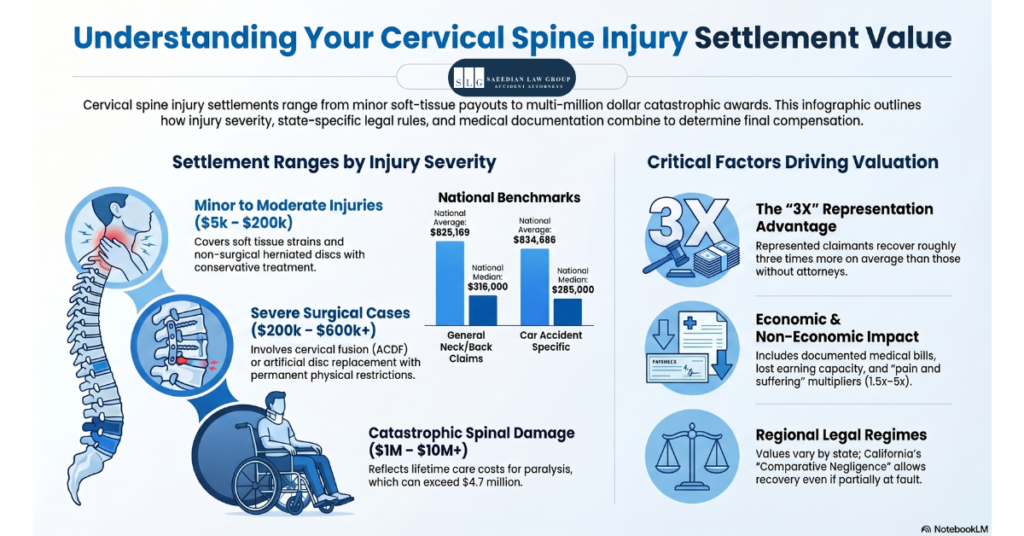
Settlement amounts for cervical spine injury cases differ from state to state because each state writes its own rules for negligence, evidence, insurance minimums, and damages caps. A herniated disc case worth $150,000 in California might recover less in a state with strict contributory negligence rules, and more in a state with broader pain and suffering allowances.
According to Forbes Advisor, the median settlement for neck and back injury claims in the United States is often estimated between $100,000 and $500,000, though severe spinal injury cases may result in substantially higher compensation. Car accident cases averaged $834,686, with a median of $285,000.
Alabama to California: Regional Variations
States in the Southeast and West Coast handle these cases under sharply different legal regimes. Alabama follows pure contributory negligence, which means a plaintiff found even one percent at fault recovers nothing. That single rule pushes Alabama settlement amounts below the national median in close-liability cases.
California, by contrast, applies pure comparative negligence under Li v. Yellow Cab Co., 13 Cal. 3d 804 (1975), so an injured rider or driver can recover even if they share most of the blame. The recovery is just reduced by their fault percentage. California’s mandatory minimum auto insurance limits increased on January 1, 2025, under Senate Bill 1107, raising bodily injury coverage minimums from $15,000/$30,000 to $30,000/$60,000, along with a $15,000 property damage minimum.
That low floor caps recovery in any case where the at-fault driver carries only the state minimum. States with higher minimums (Alaska, Maine) tend to produce higher settlement floors. States with lower minimums and contributory rules (Alabama, Virginia) compress the range.
New York to Texas: High vs. Low Settlement States
New York consistently ranks among the highest settlement states for cervical spine injuries. Jury pools in Manhattan, Brooklyn, and the Bronx have historically returned generous awards, and New York’s no-fault structure works alongside third-party liability claims for serious injury cases. Reported settlements for surgical cervical cases out of New York County frequently land in the $500,000 to $2 million range.
Texas runs lower on average. Modified comparative negligence with a 51 percent bar means a plaintiff more than half at fault recovers nothing, and Texas juries in rural counties trend conservative on pain and suffering. Florida sits between the two, with modified comparative fault and a tort reform statute capping non-economic damages for some injury categories. The takeaway is straightforward. The same physical injury can carry a very different settlement value depending on where the accident occurred and where the case is filed.
Legal data sets show that surgical neck cases settle significantly higher than non-surgical ones, urban venues outperform rural ones, and cases with documented permanent impairment recover roughly three to five times more than soft-tissue-only claims. Outliers above $5 million tend to involve commercial defendants with deep policy limits or catastrophic spinal cord injuries with full paralysis.
Factors Influencing Cervical Spine Injury Settlements

Several key factors push a cervical spine injury settlement amount up or down. Some are clinical, some are financial, and some come down to how well the case is presented to the insurance adjuster.
Severity of Injury
The medical evaluation is the foundation. An emergency room visit followed by six weeks of physical therapy reads very differently from a positive MRI showing a herniated disc at C5-C6 with nerve root compression. The more documented and objective the injury, the harder it is for the insurance company to dispute. Severity also tracks long-term prognosis. A patient cleared back to full work in three months supports a different valuation than one with chronic pain, restricted range of motion, and a recommendation for future cervical fusion surgery.
As an illustration, a soft-tissue strain that resolves with conservative care often settles in the $10,000 to $50,000 range, while a herniated disc requiring epidural injections and partial work restrictions tends to land between $50,000 and $200,000. A surgical cervical fusion with permanent impairment can exceed $500,000.
Medical Expenses
Past medical bills are the easiest numbers to defend, because they’re documented in invoices and explanations of benefits. Insurance companies generally cover those costs without much argument when liability is clear. The harder conversation is future medical expenses or future health costs. A cervical spine injury can require years of physical therapy, pain management, repeat imaging, and sometimes additional surgery.
A life care planner or treating physician can produce a written projection of future medical costs, and that projection becomes a major lever in settlement negotiations. Common medical expenses included in a cervical spine settlement include emergency care, diagnostic imaging like MRI and CT scans, orthopedic and neurology specialist visits. Others include physical therapy, pain management injections (epidural steroid injections, facet blocks), prescription medications, surgical fees, hospital stays, and ongoing rehabilitation.
When the case involves a spinal cord injury, the cost projections climb sharply. The National Spinal Cord Injury Statistical Center estimated in its 2025 Facts and Figures publication that lifetime medical costs for high tetraplegia (C1-C4 injury) reach approximately $4.7 million for a 25-year-old patient, with first-year costs above $1 million and annual costs after the first year above $184,000.
Loss of Income and Earning Capacity
Lost wages from the date of the accident through the date of settlement are calculated from W-2s, pay stubs, or business records. The more contested figure is the loss of future earning capacity. A construction worker with a cervical fusion that limits overhead lifting may never return to the same trade. A surgeon with restricted neck rotation may face the same problem.
Vocational experts produce written reports that quantify the gap between what the injured person would have earned and what they can now realistically earn, projected over their working life. Long-term earning capacity claims often add six or seven figures to a serious cervical spine case.
For example, a 35-year-old earning $80,000 a year who can no longer perform their job faces roughly $2.4 million in lost income over a 30-year working life before any adjustments for inflation, promotions, or fringe benefits.
Non-Economic Damages
Pain and suffering damages compensate for the human cost of the injury. There’s no invoice for chronic pain, sleep disruption, the inability to pick up a child, or the depression that often follows a long recovery. Insurance companies and lawyers commonly use a multiplier method to estimate non-economic damages, multiplying the documented medical bills by a factor of 1.5 to 5, depending on injury severity, permanence, and impact on daily life.
A more severe and permanent injury pushes the multiplier higher. Emotional distress can be a separate line item, especially when the accident was traumatic (a high-speed collision, a rollover, a serious motorcycle crash) and the injured person developed documented PTSD or anxiety. Treatment records from a licensed mental health provider strengthen this part of the claim.
Legal Representation
The most often-overlooked factor is the lawyer’s involvement. The Insurance Research Council has reported, in research that has been widely cited in the industry, that injured claimants represented by attorneys recover roughly three times more on average than unrepresented claimants, even after attorney fees. Negotiation strategy matters.
An experienced personal injury attorney knows what comparable cases have settled for, where insurance companies will push back, and when to file suit to break a stalled negotiation. This is a major reason settlement values vary even between similar injuries. A claimant who accepts an early offer often leaves significant money on the table.
Cervical spine injury settlement amounts by severity
Settlement amounts in cervical spine injury cases vary widely based on the seriousness of the injury, the type of medical treatment required, and the long-term impact on the victim’s daily life and ability to work. Cases involving more severe damage, such as herniated discs, spinal fusion surgery, or permanent nerve impairment, generally result in higher compensation.
Minor Injuries
Minor cervical spine injuries usually involve mild soft tissue damage. Whiplash, cervical strain, and minor sprain are the most common diagnoses in this category. Symptoms typically resolve within six to twelve weeks with conservative care: rest, over-the-counter anti-inflammatories, physical therapy, and sometimes chiropractic treatment. There’s usually no objective imaging finding beyond muscle inflammation.
Typical settlement ranges for minor cervical injuries run from $5,000 to $50,000. The lower end applies when treatment is brief, time missed from work is minimal, and the injured person makes a complete recovery. The higher end applies when symptoms persist for several months or when the case involves a clear liability picture and good documentation.
Moderate Injuries
Moderate cervical spine injuries often involve a herniated disc, bulging disc, or facet joint injury without surgical intervention. The injured person usually has positive MRI findings, undergoes a longer course of physical therapy (three to nine months), and may receive epidural steroid injections for pain management. There’s often some persistent neck pain, occasional radiating symptoms into the arm, and a partial work restriction.
Average settlement amounts in this tier generally fall between $50,000 and $200,000. Factors that push the number higher within this range include documented nerve root compression on imaging, failed conservative treatment, a recommendation for future surgery, and significant time off work.
Severe Injuries
Severe cervical spine injuries involve surgical intervention, typically a cervical fusion (anterior cervical discectomy and fusion, known as ACDF) or artificial disc replacement. The injured person faces a recovery that runs six to twelve months, permanent restrictions on lifting and range of motion, and often ongoing pain management. There may be hardware in the neck that produces lifelong monitoring needs.
Settlement amounts for severe cervical injuries commonly run from $200,000 to $600,000 in straightforward liability cases, and higher when the injured person can no longer perform their pre-injury job. Surgical cases in venues with generous jury history, particularly large urban counties in California, New York, and Illinois, have settled well into seven figures.
Catastrophic Injuries
Catastrophic cervical spine injuries involve spinal cord damage. Depending on the level (C1-C4 high tetraplegia, C5-C8 low tetraplegia), the injured person may face permanent paralysis affecting the arms, legs, breathing, and bladder and bowel function. The medical cost is staggering, and the human cost is more so. The National Spinal Cord Injury Statistical Center estimated the lifetime costs of approximately $4.7 million for high tetraplegia in a 25-year-old patient. Indirect costs from lost productivity averaged $95,309 annually in 2024 dollars.
Settlement amounts for catastrophic cervical injuries reflect that lifetime cost picture. Reported settlements in this category commonly range from $1 million to $10 million, and verdicts in liability-clear cases with high-value defendants (commercial trucks, corporate premises) have exceeded $20 million. The case value tracks the medical cost projection, the lost earning capacity, the pain and suffering, and the available insurance and asset coverage of the at-fault party.
How Settlement Amounts Are Determined for Cervical Spine Injuries

The process moves through three stages, and the case can settle at any one of them. Understanding what happens at each stage helps an injured person make better decisions about when to accept an offer and when to push back.
Step 1: Insurance company evaluation
The first formal evaluation comes from the at-fault driver’s insurance company. After the claim is opened, the adjuster collects the police report, the medical records, the bills, and a demand letter from the claimant or their attorney. The adjuster runs the case through a claims valuation software (Colossus is the most well-known) that assigns numeric values to each diagnosis, treatment, and impairment code. The software output gives the adjuster a target settlement range.
Policy limits set the ceiling. If the at-fault driver carries California’s minimum $15,000 per person bodily injury policy and the medical bills alone are $40,000, the insurance company will tender the policy limit early, and the claimant will need to look at their own uninsured or underinsured motorist coverage to recover the rest. When the policy limits are higher (a commercial trucking policy can run $1 million or more), the negotiation has more room, and the evaluation process takes longer.
Step 2: Legal process and negotiation
Most cervical spine injury cases settle without going to trial. The negotiation runs through demand letters, counter-offers, and often a formal mediation with a neutral mediator. Evidence drives the conversation. The strongest demand packages include the MRI and CT imaging, the treating physician’s narrative report, an itemized medical bills summary, lost wage documentation, a vocational or life care planner report for serious cases, and personal statements describing the day-to-day impact.
When the case is filed as a lawsuit, the discovery process opens up depositions, written interrogatories, and expert witness reports. Defense attorneys often hire their own medical examiners to challenge the severity of the injury. The plaintiff’s case strengthens when independent medical opinions back up the treating physician’s findings. Cases that survive defense scrutiny in discovery typically settle in the months before trial, often through a court-ordered mediation.
Step 3: Judicial intervention
When negotiation fails, the case goes to trial, and a judge or jury decides the verdict. Trial outcomes can swing in either direction. A jury that finds the plaintiff credible and the injury well-documented can award a verdict far above the highest pretrial offer. A jury that finds otherwise can award nothing.
The threat of trial is itself a negotiation tool. An insurance company that knows the plaintiff’s attorney has the resources and willingness to try the case will usually offer more in mediation than one negotiating with an attorney whose practice is settlement-only. This is part of why working with an experienced personal injury lawyer matters in serious cervical spine injury cases.
Need a Personal Injury Lawyer?

A cervical spine injury settlement amount is shaped by injury severity, medical costs, lost earnings, non-economic damages, the venue where the case is litigated, and the quality of legal representation. Realistic numbers range from a few thousand dollars for minor soft tissue injuries to several million for catastrophic spinal cord damage.
The single biggest mistake injured people make is accepting an early offer before the full medical picture is documented, because future medical costs and earning capacity losses often dwarf the immediate bills. If you or a loved one has suffered a cervical spine injury in a car accident or other incident in California, talk to a personal injury attorney before signing anything. A free consultation costs you nothing and protects your right to fair compensation.
Saeedian Law Group offers free, no-obligation case evaluations for cervical spine injury and other personal injury cases in California. Our team handles cases in Beverly Hills, Los Angeles, San Diego, and across Southern California on a contingency basis, which means no fees unless we recover maximum compensation for you. Reach our office by phone at 310.288.3000, visit our Beverly Hills personal injury page for more on how we handle these cases.
Frequently Asked Questions
Below are answers to common questions about cervical spine injury settlement amounts.
What Factors Determine the Settlement Amount for a Cervical Spine Injury?
The settlement amount is driven primarily by injury severity, documented past and future medical expenses, lost wages and earning capacity, pain and suffering, the available insurance policy limits of the at-fault party, and the comparative fault rules of the state where the case is filed. Legal representation also affects the outcome, since represented claimants historically recover more than unrepresented ones.
How Can I Estimate the Settlement Amount for a Cervical Spine Injury?
A reliable estimate requires reviewing the full medical record, the wage and earnings impact, and comparable verdicts and settlements in the venue. A personal injury attorney with experience in cervical spine cases can provide a defensible range after evaluating these factors. Online settlement calculators give rough benchmarks, but they cannot account for venue, insurance coverage, or the strength of the liability evidence.
What Is the Average Settlement Amount for a Cervical Spine Injury?
National data published in 2025, based on 702 publicly reported neck and back injury settlements, showed an overall average of $925,169 and a median of $316,000. The median is the more useful number for a typical case, because the average is pulled upward by a few large catastrophic-injury settlements. Most non-surgical cervical spine cases settle below the median; most surgical cases settle near or above it.
Can I Negotiate the Settlement Amount for a Cervical Spine Injury?
Yes. Insurance companies almost always open with an offer below what the case is worth, and negotiation is expected. The strongest negotiating position comes from full medical documentation, a clear demand letter, and a credible willingness to file suit if negotiations stall. An experienced attorney typically handles the negotiation on the claimant’s behalf.
Are There Any Limitations on the Amount I Can Receive for a Cervical Spine Injury Settlement?
Yes. The most common limit is the at-fault party’s insurance policy. If the at-fault driver carries only state-minimum coverage and has no personal assets, the recovery is capped at the policy limits unless the injured person has their own underinsured motorist coverage. Some states also cap non-economic damages in certain case types, though California does not cap pain and suffering damages in standard personal injury cases. Statutes of limitations also matter. In California, the deadline to file a personal injury lawsuit is generally two years from the date of the accident under Code of Civil Procedure §335.1.
Disclaimer: This article is for general information and does not constitute legal advice. Past results do not guarantee future outcomes. Every cervical spine injury case turns on its own facts, applicable state law, and the available evidence. For advice on your specific situation, contact a licensed California personal injury attorney.

Michael Saeedian founded Saeedian Law Group in 2009 with the goal of providing injured individuals and their loved ones with caring, personalized, and attentive legal representation.