

The California medical lien statute of limitations for contractual provider liens is 4 years for written agreements and 2 years for verbal The California medical lien statute of limitations for contractual provider liens is 4 years for written agreements and 2 years for verbal agreements. Government or statutory liens like Medi-Cal or Medicare follow different timelines, but must also be enforced before settlement funds are disbursed. Ultimately, the statute of limitations varies based on the type of lien and how it was created.
At Saeedian Law Group, we’ve helped personal injury victims in California recover over $12 million in compensation. With 16+ years of experience, our team of expert personal injury lawyers can help you review medical lien agreements, understand deadlines, negotiate reductions, and protect your settlement. Book a free consultation with us today – let’s help you get the full compensation you deserve without unexpected lien issues.
In this blog, we’ll explain the different types of medical liens in California, how the statute of limitations applies to each, what happens if a lien expires, and the exceptions that might extend the deadline.
What Is a Medical Lien in California?

In California, a medical lien is a legal claim that a healthcare provider places on a personal injury lawsuit or settlement to ensure they get paid for medical services rendered. It is commonly used in personal injury cases, such as car accidents, slip and falls, or other negligence claims.
When a person gets injured and does not have the money to settle medical bills upfront, a doctor or hospital may agree to treat them on a lien basis. So, instead of asking for payment upfront, the healthcare provider typically agrees to defer payment until the case is resolved.
The injured party then signs a lien agreement to pay the provider from the compensation they’ll eventually receive. The lien is usually formalized with a written agreement and sometimes recorded with the county.
Once a settlement is reached, the lien gives the medical provider the right to collect payment directly from the settlement before the patient gets their share. If the injured person refuses to pay, the provider may take legal action to enforce the lien or file a claim against the settlement funds.
People typically use medical liens when they don’t have insurance or don’t have money to pay for care immediately. But while liens help people get needed treatment, they can also reduce how much money the injured person receives at the end. This is because medical providers might charge more than typical insurance rates, and lien payments can take a big portion of the personal injury settlement.
Types of Medical Liens

In California, various types of medical liens may apply, depending on who covered the treatment and how. Understanding the types of liens can help injured individuals and their attorneys protect their settlement and manage the amount ultimately paid out.
Contractual Provider Liens
These are private agreements between the patient and a medical provider, like a doctor, clinic, or hospital. The provider agrees to treat the patient without upfront payment, in exchange for being paid later from the personal injury settlement. The patient typically signs a lien agreement allowing the provider to collect directly from the settlement funds.
Hospital Liens Under the Hospital Lien Act
California gives licensed hospitals a lien that does not depend on you signing anything. Under Civil Code sections 3045.1 through 3045.6, a hospital that provides emergency and ongoing care to an accident victim holds a lien on the damages that victim recovers, up to the reasonable and necessary value of its services.
Two limits make this lien very different from a contract lien. First, the hospital has to give written notice to the party alleged to be liable and to that party’s known insurer before any settlement money is paid. And a lien that is never perfected that way generally cannot be enforced against the payer.
Second, the hospital cannot take everything. Its claim reaches only so much as can be satisfied out of 50% of the money due under the judgment or settlement after any prior liens are paid. If a defense insurer pays the injured person after receiving proper notice and ignores the lien, that insurer becomes liable to the hospital for the lien amount.
Statutory Liens
Statutory liens are automatically granted by law when government programs pay for injury-related treatment. For example, if Medi-Cal pays for medical care related to the injury, it has a legal right to be reimbursed from any settlement. The same applies to Medicare and the Department of Veterans Affairs. These agencies usually send formal notices to the injured person or their attorney about the lien. In addition, they expect repayment before the injured person receives their share of the settlement.
Government liens come with their own arithmetic, and it works in the injured person’s favor more often than people assume. Medi-Cal’s recovery is reduced by 25% for attorney’s fees under Welfare and Institutions Code section 14124.72, and section 14124.78 caps what the Department of Health Care Services can take at 50% of what the beneficiary actually recovers after fees and litigation costs come out. Whichever calculation produces the smaller number is the one that applies. On the federal side, Medicare makes conditional payments and then recovers them from the settlement, and its recovery is reduced to reflect the procurement costs you paid to obtain that settlement.
One development is worth knowing about because it widened these liens. In Gallardo v. Marstiller (2022) 596 U.S. 420, the U.S. Supreme Court held that a state Medicaid agency may recover from the portion of a settlement allocated to future medical care, not only the portion covering past medical bills. That decision expanded what Medi-Cal can reach and makes how a settlement is allocated far more consequential than it used to be.
Health Insurance Liens
Some private health insurance plans include a subrogation clause. Subrogation allows the insurance company to recover what it paid if the injured person later gets a settlement. These liens often involve negotiation between the health insurer and the injured party’s attorney to determine repayment.
These liens depend on the terms of the insurance policy and the type of plan. Some employer-based ERISA plans may be more aggressive in seeking full repayment. Meanwhile, attorneys often negotiate these liens to reduce the repayment amount, especially if the settlement is limited or doesn’t cover all damages.
Comparing the Four Lien Types
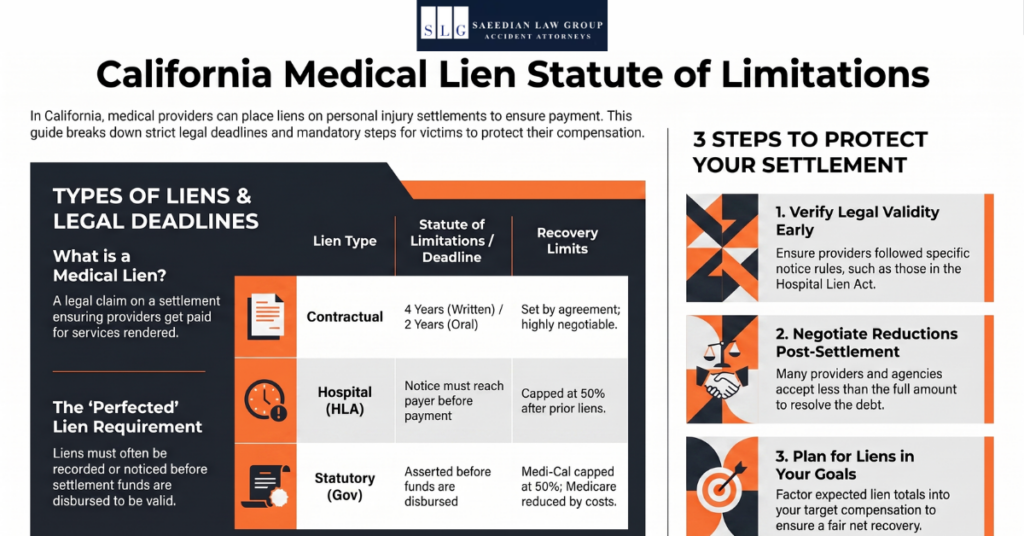
The differences between these liens matter most when several of them land on the same settlement, because they do not share a single deadline or a single ceiling. The table below sets them side by side.
| Lien type | Where the right comes from | Deadline to enforce | Limit on what it can take |
| Contractual provider lien | A signed or oral agreement between you and the provider | 4 years written, 2 years oral, from when payment was due | Whatever the agreement says, subject to negotiation |
| Hospital lien | Civil Code sections 3045.1 to 3045.6, no signature needed | Written notice must reach the payer before settlement is paid | 50% of the settlement after prior liens |
| Medi-Cal or Medicare lien | State and federal statute, arising automatically | Must be asserted before funds are disbursed, and Medicare has 3 years from notice to sue | Medi-Cal capped at 50% after fees and costs, Medicare reduced for procurement costs |
| Health plan or ERISA lien | The terms of your insurance policy | Governed by the plan document and the contract clock | Set by the plan language, often negotiable |
What Is the Statute of Limitations for Medical Liens in California?
Statute of limitations simply means the legal deadline for filing a lawsuit or enforcing a legal right. In the context of medical liens in California, it refers to how long a medical provider, insurance company, or government agency has to legally pursue repayment after treatment has been provided or a settlement is reached.
Under California law, the statute of limitations for medical liens depends on the type of lien and how it was created. Generally, providers and agencies must act before the settlement funds are distributed. If they wait too long, they risk losing their right to recover payment. To protect all parties, attorneys usually verify, negotiate, and resolve liens during or immediately after the injury claim is settled.
For contractual medical liens, the statute of limitations is generally 4 years from the date payment is due, according to the California Code of Civil Procedure 337. If the agreement was verbal, the statute of limitations is 2 years, as specified in the Code of Civil Procedure 339. These California medical lien deadlines start when the provider should have been paid, typically when the personal injury case is resolved.
For statutory liens, such as those involving Medi-Cal, Medicare, or Veteran Affairs, enforcement is governed by state or federal law. Government programs generally assert their lien rights during the claim process and must act before funds are disbursed to the injured person. For example, under the Hospital Lien Act in the California Civil Code, a hospital must record the lien before the settlement is paid out.
Medicare works differently again. It is not bound by a contract clock at all, and the federal government may bring an action to recover a conditional payment within three years of the date it receives notice that a primary payer was responsible.
“People fixate on the deadline, and the deadline is almost never what decides these cases,” says Michael Saeedian, Founding Attorney at Saeedian Law Group. “What decides them is whether the lien was perfected correctly and what the statutory cap allows. A hospital that never served its notice, or an agency asking for more than the law lets it keep, is a number you can move before your client ever sees a disbursement sheet.”
Are There Exceptions to the Statute of Limitations for Medical Liens?
Yes, there are some exceptions to the statute of limitations for medical liens in California, depending on the type of lien and the surrounding circumstances. Although time limits generally apply, there are certain situations where these time limits can be extended or paused. These exceptions help make sure that lienholders aren’t unfairly prevented from recovering payment due to delays beyond their control.
If the injured person or their attorney acknowledges the debt in writing or makes a partial payment toward the lien, this can restart the statute of limitations. This rule applies to contractual liens and gives the provider more time to enforce the agreement, starting from the date of the new acknowledgment or payment.
If a patient or attorney intentionally hides the settlement or fails to notify the lienholder, courts may allow extra time to file a claim. Such fraud or concealment can toll (pause) the statute of limitations until the provider discovers the wrongdoing. This protects providers of health care services from losing their right to collect simply because they were misled.
If the lienholder isn’t properly notified or if the settlement is delayed for a long time, they may still have a valid claim. For statutory liens, especially those involving Medi-Cal, Medicare, or hospital liens, the lienholder must be notified before the settlement is paid out. Courts generally expect lienholders to act promptly, but a delay that wasn’t their fault may justify an exception.
If the injured party is legally incapacitated, such as due to a coma, mental illness, or being a minor, or if they file for bankruptcy, the statute of limitations may be paused. These situations can extend the time a lienholder has to pursue repayment. That’s because the law recognizes that the person may not be in a position to resolve the debt immediately.
What Happens if the Statute of Limitations Expires for a Medical Lien?

If the statute of limitations expires for a medical lien in California, the lienholder may lose the legal right to enforce the lien or recover payment through court action. This means the provider, health insurance company, or government agency can no longer sue or collect the debt by legal force. Essentially, the lien becomes legally unenforceable, although the debt may still appear in billing records or credit reports as medical debt.
For statutory liens, failing to record the lien before settlement or not giving proper notice can result in the lien being invalid. And if the lien is not properly asserted before the settlement funds are distributed, the lienholder generally has no further claim on the settlement. This is why attorneys often work to verify and resolve all liens before finalizing a personal injury case.
Sometimes, while not a legal remedy in court, a provider might continue to report the unpaid amount to credit agencies or send bills to the patient. If the statute has expired, the patient has the right to dispute this, especially if the debt is past the 7-year reporting limit under the Fair Credit Reporting Act (FCRA).
Be careful with what you may have read about medical debt disappearing from credit reports. The Consumer Financial Protection Bureau finalized a rule in January 2025 that would have stripped medical bills out of credit reporting entirely, and the Bureau estimated it would clear roughly $49 billion in medical debt from the files of about 15 million Americans. A federal court vacated that rule in July 2025, so it never took effect. What remains are the voluntary steps the three national credit bureaus took in 2023, which removed paid medical collections and unpaid medical collections under $500. An unpaid medical lien balance above that threshold can still show up on your report even when nobody can sue you for it.
However, even after expiration, a lienholder and patient or their attorney may agree to a voluntary repayment. In certain cases, this happens if the lienholder negotiates a reduced amount. In some other cases, the injured party may prefer to settle the matter to avoid credit damage, future billing, or disputes. Note that this is optional, as the patient cannot be forced to pay once the lien is unenforceable.
Should You Hire a Doctor on a Lien Basis in California?
Hiring a doctor on a lien basis in California can be a helpful solution if you need immediate medical treatment but cannot afford to pay out of pocket. However, it’s a decision that comes with both advantages and potential disadvantages. Whether it’s the right choice depends on the nature of your personal injury case, the strength of your claim, and your access to other medical or insurance options.
The main benefit of hiring a doctor on a lien basis is access to immediate medical attention without upfront payment. Apart from that, it can also strengthen your personal injury claim, since documented treatment shows the seriousness of your injuries and creates a clear medical record.
However, the biggest risk is cost. Doctors who work on a lien basis often charge higher rates because they’re taking on financial risk and waiting months or years to get paid. Once your case settles, those charges come directly out of your share, potentially leaving you with less than expected. That’s why it’s important to work with an attorney who has experience handling lien-based treatment and who can negotiate down the lien amounts after your case resolves.
Additionally, some insurance adjusters and defense attorneys may question the credibility of treatment provided on a lien, especially if they suspect overbilling or bias. In such cases, it could impact the value of your claim.
When It Makes Sense
In summary, a lien arrangement is worth considering when you have no health insurance or cannot cover medical expenses yourself, and when your personal injury case is strong with clear liability. It works best when you are already working with a skilled personal injury attorney who can manage the liens and negotiate reductions at the end, and when the provider has genuine experience with personal injury cases and understands how the lien process runs. If any one of those four is missing, the arrangement tends to cost you more of your settlement than it needs to.
How to Handle Medical Liens and Protect Your Interests in CA
If you don’t manage medical liens properly, they can eat deep into your compensation. But with the right steps, you can minimize what you owe and keep more of your settlement. Here are practical tips to help you handle medical liens effectively:
Step 1: Hire a Personal Injury Attorney Early
An experienced personal injury attorney can guide you through the lien process from the start. They can review lien agreements before you sign, make sure that providers follow legal procedures, and even negotiate lien reductions when your case settles.
Step 2: Review all Lien Agreements Before Signing
Don’t sign any lien agreement without reading it carefully. Make sure it clearly states the provider’s rights, the repayment terms, and any limits on the amount they can collect. If the language is overly aggressive, ask your attorney to negotiate fairer terms or look for another provider.
Step 3: Keep Detailed Records of All Medical Treatment
This includes all medical bills, appointment summaries, lien agreements, and communications with providers. These records help your attorney confirm that charges are related to your injury and are reasonable.
Step 4: Confirm that All Liens Are Legally Valid
For a lien to be enforceable, it must follow specific rules under the California medical lien laws. For example, hospitals must provide notice of the lien before settlement is paid out. An invalid or improperly filed lien may not have to be honored, so your attorney should verify the legitimacy of each claim.
Step 5: Negotiate Reductions After Settlement
Many providers are willing to accept less, especially if your settlement is limited or if there’s a risk they might receive nothing. Moreover, government agencies like Medi-Cal or Medicare also have procedures for negotiating fair settlement reductions based on hardship or proportionality.
Step 6: Plan for Liens When Calculating Your Settlement Goals
Understand that liens will come out of your final settlement, so factor them in when negotiating the total compensation. Your attorney can help estimate how much you’re likely to owe so you have a realistic picture of your net recovery.
Need Help From an Experienced Personal Injury Attorney?
Whether you’re a patient or a medical provider, understanding the statute of limitations for medical liens can protect your rights and your settlement. To avoid costly mistakes, it’s best to work with a personal injury attorney who understands how medical liens work in your jurisdiction.
If you’re dealing with medical liens in a California personal injury case, Saeedian Law Group can help. We’ll handle the legal details and fight for the best outcome on your behalf. Contact us today for a free consultation and let our experienced team help you get the most out of your case.
FAQ
With over 16 years of experience, we understand that handling medical liens can prompt a lot of questions, especially during a stressful personal injury case. Thankfully, our expert personal injury lawyers at Saeedian Law Group have compiled some quick answers to common questions you may have about how medical liens work and how to protect yourself.
How Can I Find a Doctor Who Will Accept a Medical Lien in California?
Many personal injury attorneys have a network of doctors who are willing to treat patients on a lien basis. You can also search online for lien-based medical care in California or ask your attorney for referrals.
Do Personal Injury Attorneys Work With Lien Doctors?
Yes, most personal injury attorneys regularly work with doctors who accept liens. They often coordinate care and help ensure the provider agrees to wait for payment until the case settles.
What Happens if I Have a Medical Lien but Lose My Case?
If you lose your case, you may still be personally responsible for the medical bills. Some providers may be willing to negotiate or reduce the amount, but the lien itself doesn’t disappear just because the case was unsuccessful.
How to Get a Medical Lien Removed
To remove a medical lien, you or your attorney can try negotiating with the provider to waive or reduce it, especially if there was no settlement. In some cases, you can challenge the lien if it wasn’t properly filed or doesn’t meet legal requirements.
Do California Health Care Providers Generally Accept Medical Liens?
Not all providers do, but many who focus on personal injury treatment will. These include chiropractors, orthopedic specialists, and physical therapy clinics familiar with lien-based billing.
Are There Specific Requirements for Medical Liens to Be Valid in California?
Yes, especially for hospital liens under the Hospital Lien Act. The provider must give proper notice before settlement funds are distributed, and the lien must relate to medical costs for treatment of the injury involved in the case.
Attorney Advertising: This page constitutes legal advertising under the California Rules of Professional Conduct. The discussion above sets out general principles of California and federal lien law and is not legal advice about your own case. Viewing this page or writing to our office through it does not create an attorney-client relationship, which arises only when you and we sign a written retainer. Lien deadlines, statutory caps, and credit reporting rules are amended from time to time, and the outcome in any matter depends on the specific agreements, notices, and program rules that apply to it. Talk to a licensed California attorney before you sign a lien agreement, agree to a repayment figure, or authorize disbursement of settlement funds.

Michael Saeedian founded Saeedian Law Group in 2009 with the goal of providing injured individuals and their loved ones with caring, personalized, and attentive legal representation.